
As India accelerates into an AI-led decade, datacenters are rapidly becoming the invisible backbone of the nation’s digital economy. These facilities involve high density construction, energy intensive systems, and thousands of workers operating in mission critical environments. In such settings, the role of Environment, Health and Safety teams is expanding beyond compliance into foresight, prevention, and technology-led risk management.
With India’s datacenter capacity projected to double by fiscal 2025, the urgency to modernize safety practices is more pressing than ever. New age technologies such as artificial intelligence, virtual reality, drones, IoT sensors, and digital EHS platforms are reshaping what safety excellence looks like in this sector.
AI Is Transforming Construction Safety from Detection to Prediction
Traditional safety processes rely on periodic manual inspections. While still valuable, they cannot match the pace or complexity of large datacenter environments. Artificial intelligence provides continuous, real-time monitoring that helps identify hazards before they escalate.
AI powered vision systems can observe work zones, recognize unsafe behavior, track fatigue indicators, and alert supervisors instantly. Safety teams also benefit from unified dashboards that consolidate incidents, near misses, and audit findings to support quicker and more informed decisions. Our organizations are further using AI to convert site images and engineering content into standardized digital training modules, accelerating knowledge transfer.
Virtual Reality Makes Safety Training Immersive and Behavior Changing
One of the biggest challenges in safety is helping workers understand the full consequence of a hazard. VR training bridges this gap by allowing workers to step into simulated environments where risks are made visible and tangible. Simulations for height work, crane operations, floor opening hazards, vehicle movement, and emergency response help workers build instinctive safety responses before entering a live site.
VR based training has been shown to improve hazard recognition, reduce anxiety for first time tasks, and strengthen overall safety behavior.
How VR Strengthens Safety Culture in Datacenters
VR enhances workforce preparedness in several powerful ways:
- Helps workers internalize high risk scenarios without physical exposure
- Builds confidence for first time or complex activities
- Improves response time in real life situations
- Enhances retention of safety procedures and protocols
- Supports multilingual workforces through visual, intuitive learning
These benefits make VR one of the most effective tools for transforming safety culture across large and diverse project teams.
AI Enabled Health Screening Protects Workforce Well Being
Long working hours, heat exposure, heavy physical effort, and confined spaces make daily health monitoring essential in datacenter projects. Technology-enabled occupational health systems allow rapid screening of vital parameters including blood pressure, pulse rate, oxygen saturation, ECG patterns, and metabolic data. Results are uploaded instantly into digital dashboards, helping EHS teams identify fatigue trends, catch anomalies early, and ensure workers are ready for high risk tasks.
This proactive approach strengthens both safety outcomes and workforce morale, while eliminating delays associated with manual medical checks.
BIM and AI Predict Risks Before Construction Begins
Building Information Modelling integrated with artificial intelligence has become indispensable for planning safe construction. Detailed 3D and 4D models help visualize temporary works, scaffolding, equipment movement, lift shafts, and floor openings well before physical execution. Field BIM tools allow site engineers to compare current conditions with model intent, highlight discrepancies, and document hazards in real time.
These predictive capabilities help prevent incidents caused by unclear communication, rushed planning, or design ambiguity.
Drones Expand the Reach of Onsite Safety Monitoring
Drone surveillance improves speed, accuracy, and frequency of safety inspections. Drones capture high resolution imagery of excavation sites, rooftops, vertical structures, and remote zones that are difficult or unsafe to access manually. When paired with AI analytics, drone data reveals patterns and anomalies that help detect unsafe conditions early. For large greenfield campuses, drones reduce monitoring time and strengthen emergency preparedness.
Digital EHS Tools Are Reshaping Safety Governance
Next generation digital tools are bringing unprecedented agility, accuracy, and transparency to datacenter safety. What once required paper trails, manual tracking, and time consuming approvals can now be completed in real time through integrated platforms. These technologies ensure that risks are identified early, actions are recorded instantly, and safety leaders have complete visibility across the site.
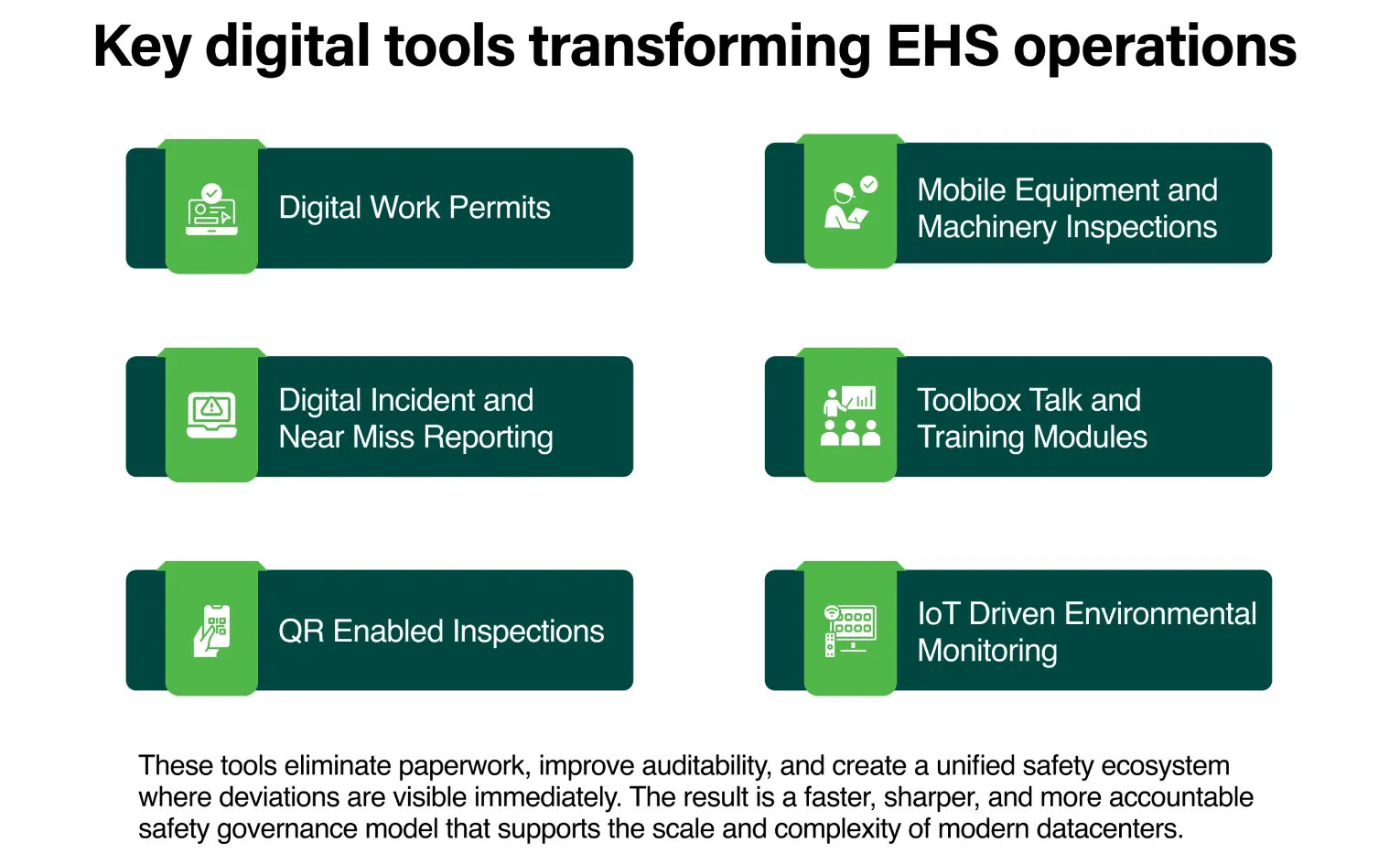
Key digital tools transforming EHS operations include:
- Digital Work Permits
Enable controlled work starts, ensure approvals are completed, and prevent unauthorized activities at site. - Mobile Equipment and Machinery Inspections
Streamline daily checks, flag noncompliance instantly, and support preventive maintenance practices. - Digital Incident and Near Miss Reporting
Allow immediate capture of events with photos, location tagging, and automated escalation for faster closure. - Toolbox Talk and Training Modules
Deliver consistent safety messaging to every crew and maintain digital proof of participation. - QR Enabled Inspections
Provide quick, traceable verification of equipment, barricades, and confined space readiness. - IoT Driven Environmental Monitoring
Track temperature, humidity, vibration, air quality, and gas concentration in real time to prevent unsafe conditions from escalating.
Overcoming Barriers to Build a Predictive Safety Culture
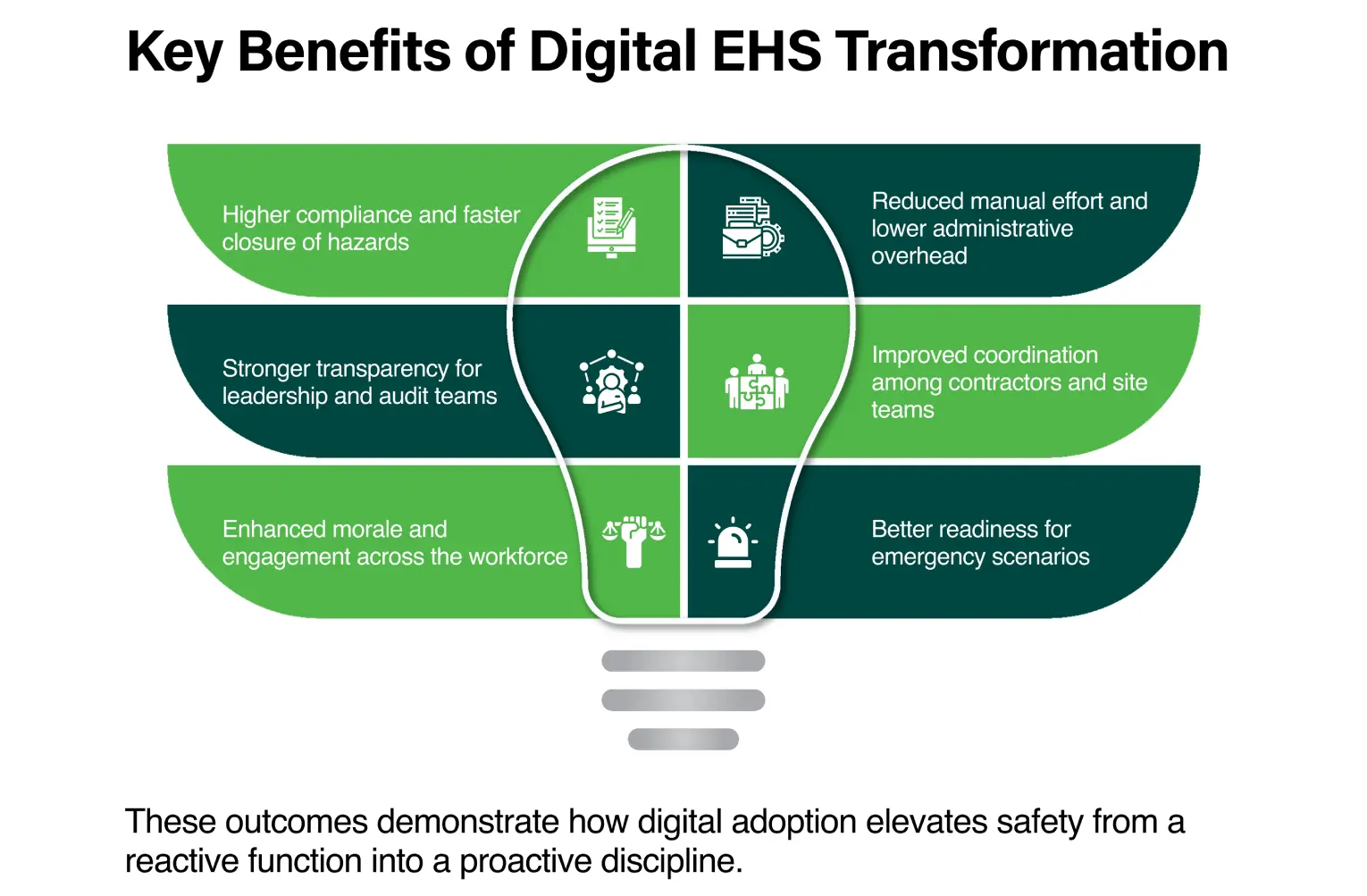
Introducing digital safety tools often requires overcoming challenges such as skill gaps, budget constraints, or concerns around data security. However, the return on this investment is significant. Technology enhances the judgment of safety professionals rather than replacing it. It also helps organizations move from incident driven responses to predictive risk management, which is essential for the scale and speed of modern datacenter projects.
CtrlS’ Commitment: Safety First, Always
At CtrlS, Environment, Health & Safety is embedded into the way we design, build, and operate our datacenters. With 50+ million safe man-hours delivered across campuses, a consistent record of zero major incidents, and global recognitions including multiple RoSPA Gold Awards and British Safety Council’s International Safety Awards (Distinction) & BSC’s Sword of Honors, safety is not just a priority – it is a discipline we practice every day.
Our EHS programs combine rigorous on-ground governance with sustainability-led engineering. At our campuses, dust- and noise-suppression systems, smart barricading, heat-stress management protocols, and 24/7 environmental monitoring ensure that both people and ecosystems are protected. Every worker undergoes structured training, competency evaluation, and periodic refresher drills, supported by digital tools that standardize procedures and eliminate oversight gaps.
Beyond compliance, our teams proactively drive safety innovation – introducing AI-enabled initiatives across project sites. This approach has enabled us to build some of India’s largest and most complex datacenter campuses while maintaining a culture where safety, responsibility, and well-being stand at the heart of every decision.
Conclusion: The Future of Datacenter EHS Is Intelligent, Immersive, and Predictive
India’s datacenter ecosystem is entering a transformative era. To support the country’s digital ambitions, safety excellence must evolve from conventional compliance to anticipatory, insight driven, and technology enabled practices. AI powered monitoring, immersive training, drone intelligence, BIM based risk prediction, and smart health screening will form the foundation of safer datacenters in the coming decade.
Organizations that embrace these innovations will set new benchmarks for resilience, worker well-being, and operational continuity.

Divakar Ganesan, VP & Head - EHS, CtrlS Datacenters
A dynamic EHS professional with over 21 years of experience, Divakar brings deep expertise in strategic planning, execution, monitoring, and leading EHS operations. With a proven track record of implementing industry-leading safety practices, he consistently drives EHS excellence through strong stakeholder engagement and a holistic approach to creating safe, sustainable work environments.

 marketing@ctrls.in