
When we think about national infrastructure, we naturally imagine highways, airports, power grids, and railways. But there is another category of critical infrastructure, rarely seen, rarely discussed, yet essential for India’s economic growth and global competitiveness.
These are submarine fiber optic cables – the thin strands of glass lying thousands of meters beneath the ocean, carrying more than 97% of the world’s internet and data traffic.
Every UPI transaction, video call, WhatsApp message, cloud workload, Netflix stream, or corporate VPN connection you initiate relies on these underwater cables.
In many ways, submarine cables are the digital arteries of the modern economy, and their importance to India’s future cannot be overstated.
India’s Digital Engine Runs on Subsea Connectivity
Over the last decade, India has undergone a massive digital transformation:
- UPI handles billions of transactions monthly and is now a global benchmark for digital payments.
- 5G networks are enabling a new era of real-time services.
- AI, Cloud, IoT, and high-performance computing are becoming enterprise priorities.
- Digital governance, from Aadhaar to DigiLocker, has created a data-driven public ecosystem.
- OTT, online gaming, and content delivery have exploded.
- India has become a global hub for GCCs (Global Capability Centers) and digital services exports.
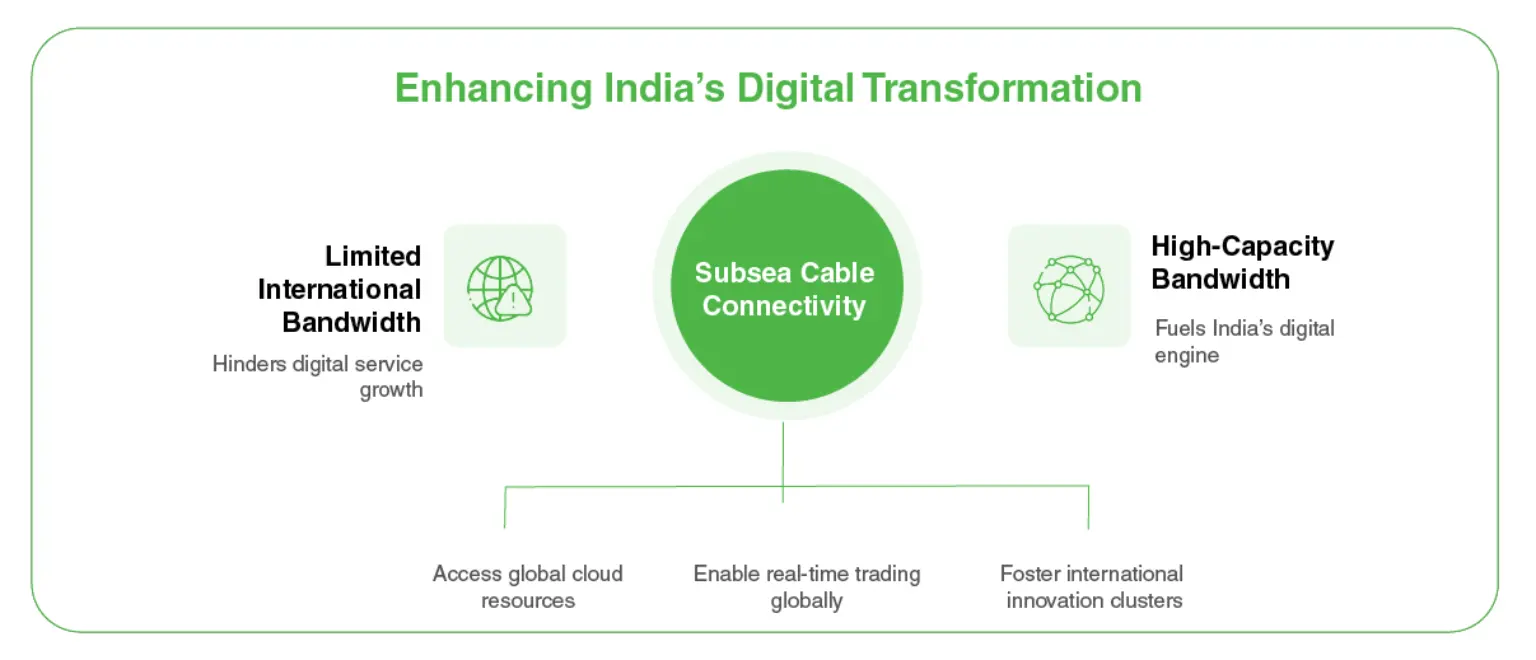
None of this would be possible without high-capacity, low-latency international bandwidth supported by subsea cables. They connect India to global data centers, cloud regions, financial trading hubs, R&D ecosystems, and innovation clusters across continents.
India on the Subsea Map
India today is firmly visible on the global submarine cable map.
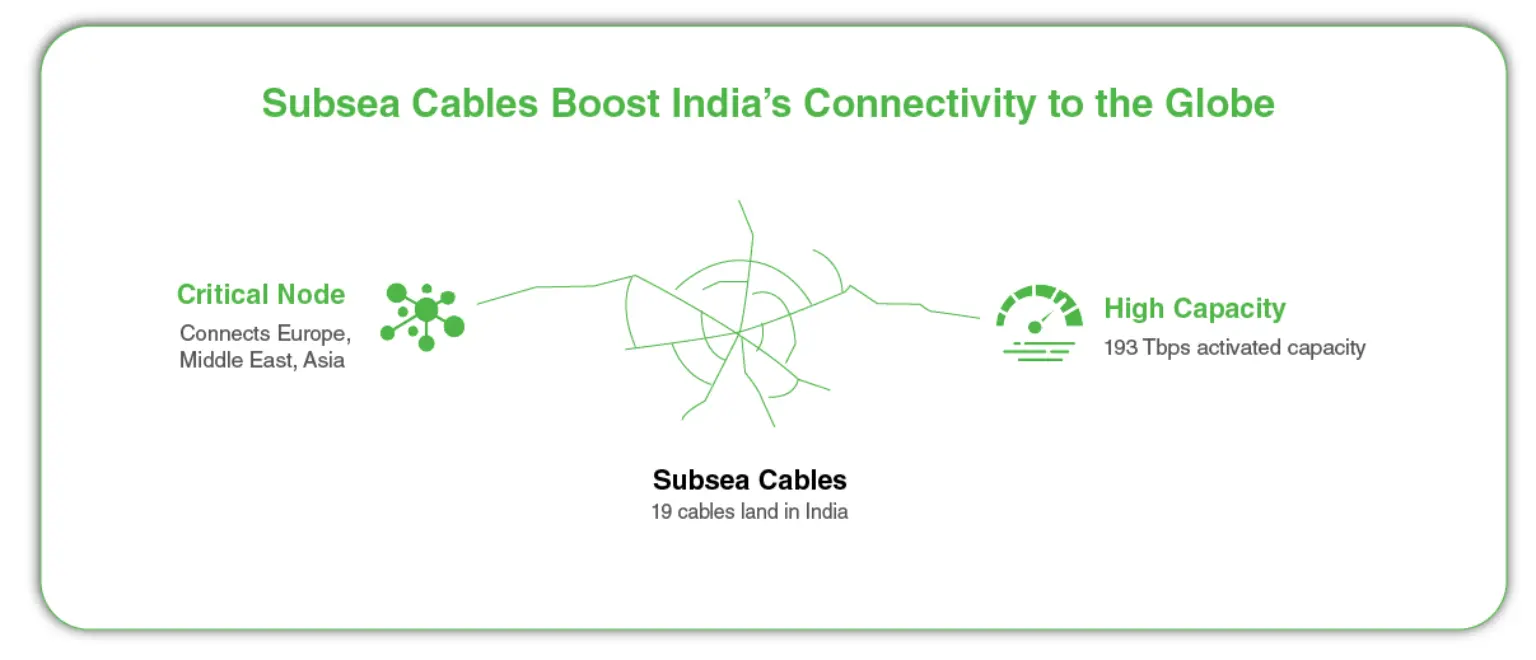
- The country hosts around 19 international subsea cables with landing stations, concentrated in Mumbai, Chennai, Kochi, Tuticorin and Thiruvananthapuram
- These landings are operated by a mix of players including Tata Communications, Bharti Airtel, Reliance Jio, BSNL and others, making India a critical node between Europe, the Middle East and Asia-Pacific.
- The overall activated and Lit capacities across these cables stands around 193 Tbps.
Why Submarine Cables Matter More Now Than Ever
India’s digital economy is projected to surpass USD 1 trillion within the next few years, heavily fuelled by cloud adoption, AI compute needs, and global data exchange. With AI models now requiring massive bandwidth, high-performance connectivity and hyperscale data movement, submarine cable ecosystems are the new foundation for national growth.
The demand for global capacity is growing exponentially due to:
- AI training & inference workloads across cloud platforms
- Edge data centers enabling latency-critical applications.
- Explosive growth in digital consumption
- Enterprise transformation and hybrid cloud
- 5G and future 6G mobility ecosystems
If we do not expand and diversify our subsea cable network, we will eventually run into a wall, and it could slow down the digital growth we are all counting on.
Strategic and Geopolitical Importance
Undersea fiber systems are also critical for national security and digital sovereignty. Submarine cable outages, whether accidental or due to geopolitical tensions can disrupt financial markets, cloud access, and business continuity.
Globally, countries like France, Singapore and the UAE transformed themselves into digital gateways by aggressively enabling private cable landings and building supporting interconnect and data center ecosystems. Today, they attract hyperscalers, tech investors, and high-value digital industries.
India has the same opportunity an even larger one due to its:
- Strategic geography between Europe, the Middle East and APAC
- Growing domestic digital economy
- Hyperscale cloud expansion
- AI and semiconductor ambitions
- Startup and innovation leadership
For India to become a global technology and data hub, we must accelerate investment in new submarine cable systems, additional landing points, and carrier-neutral infrastructure at the shores and at the edge.
The Need for Cable Diversity & New Landing Points
Today, a majority of India’s subsea capacity lands in Mumbai and Chennai. While these remain critical gateways, concentration creates risk, both operational and strategic.
Expanding to more landing points and coastal regions will:
- Enable natural route diversity around fault zones.
- Reduce dependency on a few chokepoints.
- Improve resilience and uptime.
- Reduce international latency for various parts of the country.
- Strengthen regional connectivity for Tier 2/3 metros.
This is where edge data centers, carrier-neutral colocation and integrated terrestrial fiber ecosystems play a key role. Subsea landing points by themselves are not enough, they must be supported by:
- Dense, low-latency terrestrial fiber networks
- Interconnect ecosystems and IXs.
- Distributed and metro edge data centers for caching and routing.
- Hyperscale cloud zones closer to consumption centers
Together, they form the digital superhighways that support future innovation and employment.
Policy Support: An Enabler for the Next Wave
The Telecom Regulatory Authority of India (TRAI) has already recognized submarine cables as vital digital communication infrastructure and has issued recommendations to modernize the licensing framework and regulatory mechanisms for cable landings.
These steps, including clarity on Cable Landing Station (CLS) models, support for new-generation systems, and incentives around repair and maintenance are crucial to:
- Reduce time-to-market for new cables.
- Improve the ease of doing business for subsea investments.
- Encourage more global consortia to choose India as a landing destination.
Policy, infrastructure, and private investment will need to move together for India to fully unlock its potential as a global subsea and data hub.
Economic Impact: A Growth Multiplier for India
Global experience shows that every dollar invested in digital connectivity can deliver a multi-fold return in GDP through innovation, inclusion, productivity, and competitiveness.
Submarine cable investments directly enable:
- Data center growth and job creation
- Digital services and software exports
- Financial services and trading efficiency
- Startups and digital entrepreneurship
- AI and cloud ecosystems
- Regional development beyond Tier 1 cities
In simple terms: subsea cables are the foundation on which India’s trillion-dollar digital ambition is built.
The Way Forward – From Cables to a Complete Digital Fabric
For India to solidify its leadership in the global digital economy, we must:
- Encourage open access, carrier-neutral landing infrastructure.
- Incentivize global investors and cable consortia to land more systems in India.
- Enable multiple, geographically diverse landing locations across both coasts and island territories.
- Strengthen terrestrial backhaul, metro fiber and intercity diversity.
- Build an integrated ecosystem of hyperscale, regional and edge data centers linked tightly with these landing hubs.
- Ensure security, resilience, and route diversity at a design level.
My Perspective: Why This Matters Now
From my vantage point in the edge and network infrastructure ecosystem, I see a clear pattern:
- Customers are asking for lower latency, more diverse routes, and predictable performance for mission-critical workloads.
- Hyperscalers, OTTs and digital-native enterprises are looking beyond one or two traditional gateways; they want distributed, resilient architectures across India.
- Edge data centers in emerging cities are becoming natural extensions of submarine landings, not just remote endpoints.
At CtrlS Datacenters, we see submarine cables, terrestrial fiber, hyperscale campuses and edge data centers as one integrated fabric, not separate industries. The more we can stitch these layers together in a neutral, open, and resilient way, the faster, we as a nation, can move up the value chain from being a large “consumer market” to becoming a global producer and exporter of digital services, AI and innovation.
Conclusion: Investing in the Invisible Backbone
The future global economy will be shaped by countries that can move data faster, safer, and more efficiently than others. Submarine cables are not just telecom infrastructure, they are the backbone of progress, competitiveness, national security, and digital transformation.
As India aspires to become a global AI and digital hub, submarine cables will play the same role that railways and highways once did for the physical economy.
They are the invisible arteries of our digital nation – and investing in them is, quite simply, investing in India’s future.

Vipul Kumar, Senior Vice President – Edge & Network Business, CtrlS Datacenters
Vipul is a seasoned telecom and datacenter leader with over two decades of rich experience spanning submarine cable systems, edge datacenters, and network infrastructure ecosystems. He is passionate about building sustainable, compliant, and scalable digital infrastructure that empowers regional enterprises, SMEs, and hyperscale players alike. As Senior Vice President – Edge & Network Business at CtrlS, he leads initiatives that bridge connectivity and compute — from fiber and network deployments to strategic partnerships and business development, building the network foundation and ecosystem partnerships that power CtrlS’s pan-India edge datacenter expansion.

 marketing@ctrls.in