
What is changing in data center strategy is not scale but constraint. AI adoption is accelerating faster than energy systems, regulatory frameworks, and physical infrastructure can adapt. This misalignment is now visible at the enterprise level. Infrastructure choices increasingly determine whether growth plans remain executable or become theoretical.
Data centers today operate inside overlapping systems of power availability, regulatory jurisdiction, silicon supply chains, and capital discipline. Decisions once optimized for efficiency are now evaluated for resilience, compliance readiness, and execution certainty. As AI moves from experimentation to core business function, infrastructure stops being an enabler and becomes a limiter when not designed deliberately. 2026 represents a tipping point where infrastructure choices become board-level decisions, not IT considerations.
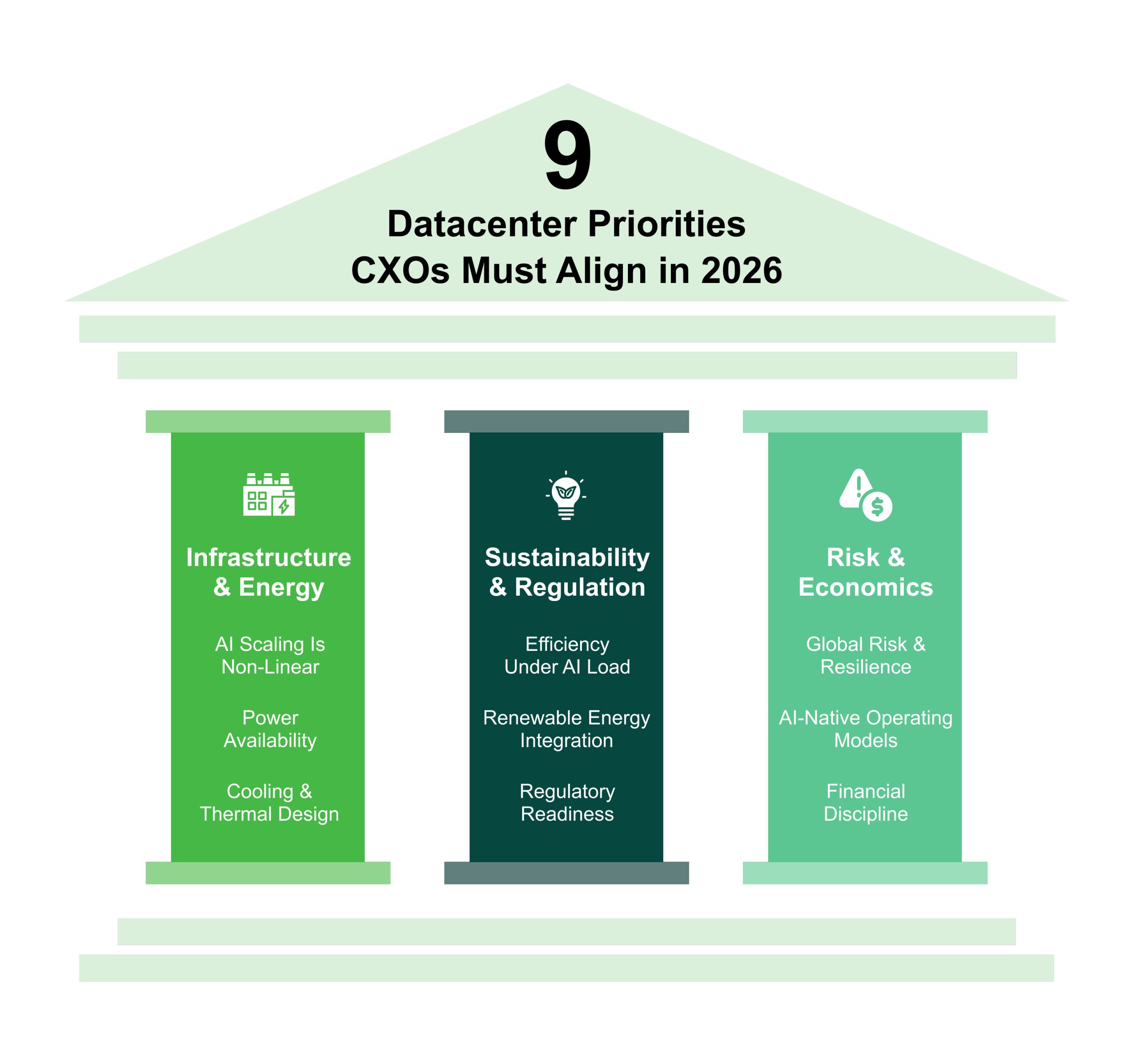
Following priorities outline where leadership attention must now be focused.
Priority 1: AI Driven Infrastructure Scaling Is No Longer Linear
AI workloads behave differently from enterprise compute. GPU clusters introduce uneven density, sudden demand spikes, and sustained high load that invalidate traditional planning assumptions.
Design models built around predictable utilization no longer hold. Scaling now requires flexibility in power, cooling, and physical layout, as well as the ability to expand in phases without disrupting live environments. Execution speed has also become strategic. Large campuses are now delivered on compressed timelines, and delays directly translate into lost opportunity.
Rigid infrastructure locks organizations into decisions that age quickly. While, adaptive infrastructure absorbs uncertainty.
Priority 2: Power Availability as a Strategic Constraint
Power has overtaken capital and land as the dominant constraint on data center expansion. Grid access, substation readiness, and approval timelines increasingly determine where growth is possible.
AI workloads drive power density beyond historical thresholds, forcing enterprises to think in megawatts rather than racks. As a result, power procurement, diversification, and long term availability planning now sit alongside investment strategy and market entry decisions.
The International Energy Agency (IEA) projects that global electricity consumption by data centers will more than double by 2030, largely driven by growth in AI and related workloads, rising to around 945 TWh per year.
Electricity is no longer a facilities problem. It is an enterprise growth problem.
Priority 3: Energy Efficiency Under AI Load
Efficiency under AI load cannot be assessed through legacy facility metrics alone. PUE provides limited insight into how AI workloads actually consume energy.
What matters now is workload aware efficiency. Understanding how specific models draw power, generate heat, and stress infrastructure over time is essential to unlocking additional capacity without new builds. Continuous and granular monitoring is becoming foundational.
Priority 4: Cooling and Thermal Design Will Decide AI Viability
Rising rack densities are pushing air cooling toward its practical limits. Liquid cooling, hybrid approaches, and direct to chip solutions have become increasingly necessary.
Thermal design now directly affects uptime, energy efficiency, and regulatory exposure. In parallel, water availability and usage restrictions are shaping cooling strategies, particularly in regions facing environmental stress.
Cooling systems are cited as a significant factor in data center outage risk. In a related report, 14% of serious data center outages were linked to cooling failures, indicating cooling is a frontline infrastructure issue as density.
This further confirms that thermal planning has become a gating decision rather than an optimization exercise.
Priority 5: Renewable Energy and Clean Power Integration
Clean energy is no longer peripheral to data center strategy. It has become central to long term scalability.
Regulators, customers, and investors are applying sustained pressure, but the operational driver is more direct. Renewable power access increasingly determines whether AI capacity can expand within regulatory and grid constraints. Power purchase agreements, captive generation, and hybrid energy models are converging as organizations seek both reliability and sustainability.
The challenge lies in integrating clean energy without compromising uptime, particularly in environments exposed to intermittency and grid volatility.
Priority 6: Regulatory and Policy Readiness
Regulatory complexity is rising across data sovereignty, AI governance, and energy reporting. These requirements do not evolve uniformly across geographies, creating operational friction for multi region operators.
Retrofitting infrastructure to meet compliance mandates increases cost and risk. Auditability, traceability, and reporting capability must now be embedded into design decisions from the outset.
Infrastructure that performs but cannot demonstrate compliance will increasingly become unusable.
Priority 7: Risk and Resilience Are Now Globally Coupled
Higher density increases the blast radius of failure. Power dependency amplifies downtime impact. AI workloads raise tolerance thresholds for disruption.
At the same time, infrastructure risk is no longer local. It is shaped by global silicon supply chains, export controls, and geopolitical concentration of advanced manufacturing.
Resilience planning must therefore extend beyond redundancy and into supply chain and geopolitical exposure.
Priority 8: Operating Models Must Evolve for AI Native Demand
AI infrastructure demands skills across energy management, compliance, thermal engineering, and automation. These capabilities remain scarce.
Traditional IT operating models were not built for extreme density, rapid deployment, or continuous regulatory oversight. Automation is increasingly required to manage complexity at speed, reduce human error, and maintain consistency across environments.
Organizations that fail to evolve operating models will struggle to operate what they build.
Priority 9: Financial Planning and Cost Discipline
AI infrastructure introduces sustained capital intensity. GPUs carry higher upfront costs, shorter refresh cycles, and faster obsolescence. Energy volatility complicates operating cost forecasts.
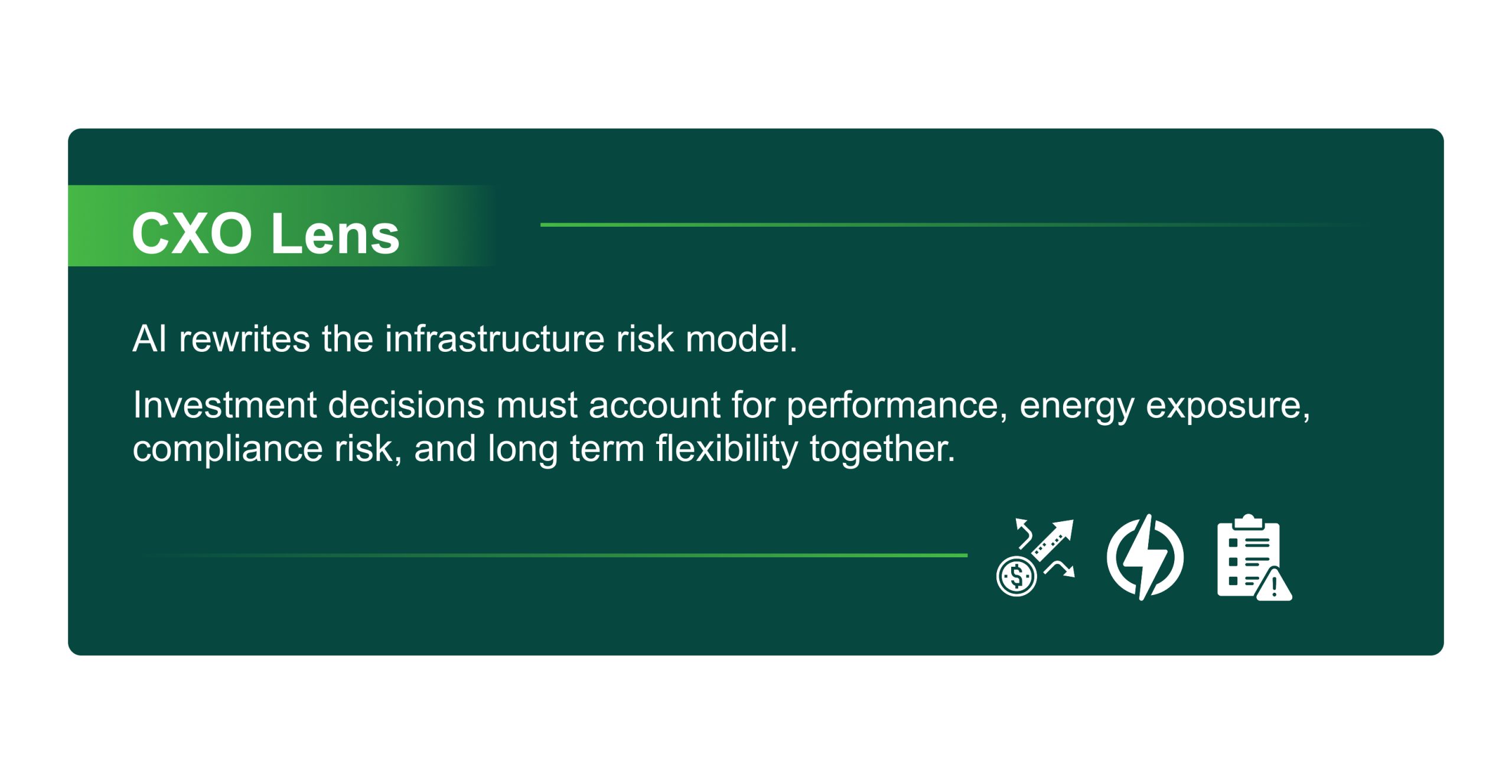
Return on investment must now be evaluated across multiple dimensions including AI performance, energy exposure, compliance risk, and long term flexibility. Decisions optimized for short term savings often create long term lock in.
So, financial discipline in 2026 requires evaluating risk alongside return.
Conclusion: Preparing for 2026
AI, energy, regulation, and silicon dependencies are now inseparable. Infrastructure decisions taken today will define what is possible tomorrow.
Future-ready data centers will be built deliberately. They will align technology, governance, sustainability, and execution speed from the outset rather than correcting course later.
In an environment defined by constraint, advantage will belong to organizations that plan for limits before those limits are imposed.
To learn more about how CtrlS is building future-ready data center infrastructure, visit:
https://www.ctrls.com

Manzar Saiyed, Vice President - Service Delivery, CtrlS Datacenters
With over 15 years of rich experience in project and program management, Manzar has been instrumental in planning and executing mid to large size complex initiatives across different technologies and geographies. At CtrlS, he is responsible for solutioning and bidding for large system integration projects across emerging markets.

 marketing@ctrls.in