
For years, enterprises optimized infrastructure around performance, cost, and scalability. Workloads were placed wherever efficiency was highest, often across globally distributed environments. That model assumed stability.
Today, that assumption is under pressure. Geopolitical disruption is no longer a rare event. It is an active and recurring risk. Enterprises are already experiencing the consequences through restricted access, regulatory shocks, and operational instability.
Infrastructure strategy is no longer just about performance. It is about ensuring continuity when external conditions change.
The Disruptions Are Already Reshaping Infrastructure Decisions
The global environment has introduced a new layer of risk into infrastructure planning.
The Russia-Ukraine conflict has shown that digital infrastructure is not insulated from geopolitical events. Enterprises have faced power instability, connectivity disruptions, and operational uncertainty.
At the same time, US-China decoupling has fragmented infrastructure strategies across Asia Pacific. Technology access and data movement are increasingly shaped by policy.
In the Middle East, instability has exposed the vulnerability of subsea cable systems, which carry over 95% of global internet traffic. Local disruptions can have global impact.
A new risk category is also emerging. Data centers are being viewed as strategic assets, increasing exposure to physical targeting in certain regions.
Regulation adds another layer. Data laws are now being used to control access, enforce localization, and restrict cross-border operations.
The cost of reacting to these shifts is significant:
- Emergency deployments increase cost and complexity
- Compliance frameworks must be rebuilt across jurisdictions
- Applications often require redesign to meet new constraints
- Operations are disrupted during transition
Enterprises that pre-position infrastructure in stable environments avoid these cascading risks. The advantage is structural, not incremental.
What Defines a True Digital Safe Harbor
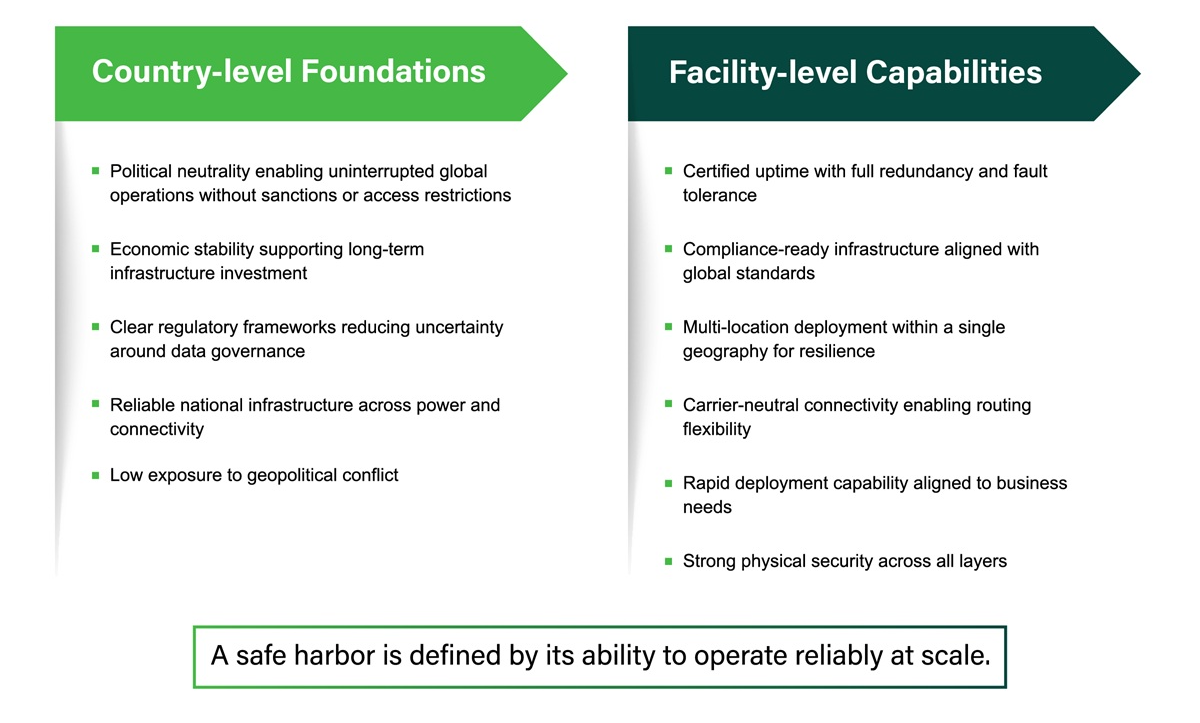
A digital safe harbor combines geopolitical stability with infrastructure readiness.
At the country level, it requires a predictable operating environment. At the facility level, it requires infrastructure designed for continuous, compliant, and scalable operations.
Why India is Emerging as a Strategic Safe Harbor
India’s positioning is driven by both geopolitical neutrality and economic momentum.
The country has maintained active relationships across major global blocs without exposure to sanctions or access restrictions. This ensures continuity of operations for enterprises.
This neutrality is not just diplomatic positioning. It is an operational advantage. It eliminates the risk of sudden access barriers and allows enterprises to operate across markets without restructuring infrastructure.
India’s economic growth further strengthens its relevance. As one of the fastest growing major economies, it offers sustained demand and long-term investment stability.
Regulatory progress is also shaping the landscape. The Digital Personal Data Protection framework is bringing greater clarity to data governance.
Market validation is visible. Hyperscalers are expanding, Global Capability Centers are scaling, and infrastructure investments are accelerating.
India is becoming a primary infrastructure destination.
The Technical Case: Infrastructure Stack Maturity
India’s strategic advantage is reinforced by rapid advancements in infrastructure capability.
Modern facilities are being built to Rated-4 standards, delivering high levels of resilience and uptime.
Key elements of this infrastructure stack include:
- Rated-4 architecture delivering 2N redundancy, concurrent maintainability, and fault tolerance with uptime approaching 99.9999%
- Power systems with multiple feeds, on-site generation, and UPS support for high-density AI workloads exceeding 40 to 100 kW per rack
- Advanced cooling systems including liquid cooling and direct-to-chip architectures
- Strong connectivity through subsea cable landings and domestic fiber networks
- Carrier-neutral ecosystems enabling BGP routing diversity and provider failover
- Physical security with layered access control and surveillance, stronger than conflict-exposed regions
- Compliance alignment with ISO 27001, SOC 2, PCI DSS, and HIPAA
- Disaster recovery through active-active and active-passive deployments across cities
- Direct cloud interconnects to AWS, Microsoft Azure, Google Cloud, and Oracle Cloud
These capabilities align with global demand trends. According to Goldman Sachs, data center power demand is expected to grow by up to 160% by 2030, driven largely by AI workloads.
Moving from Cost Optimization to Risk-Adjusted Strategy
Infrastructure decisions are shifting from cost optimization to risk-adjusted evaluation.
Enterprises are increasingly assessing:
- Geopolitical exposure of infrastructure location
- Regulatory predictability and compliance risk
- Cost of downtime and operational disruption
- Flexibility to scale or relocate workloads
- Value of resilience built into infrastructure
Distributed infrastructure is becoming the default. The key question is no longer cost. It is whether infrastructure strategy is defensible.
Deployment Strategy Will Determine Outcomes
India offers a strong foundation, but execution determines success.
Infrastructure maturity varies across regions. Power reliability, regulatory interpretation, and connectivity ecosystems differ by location.
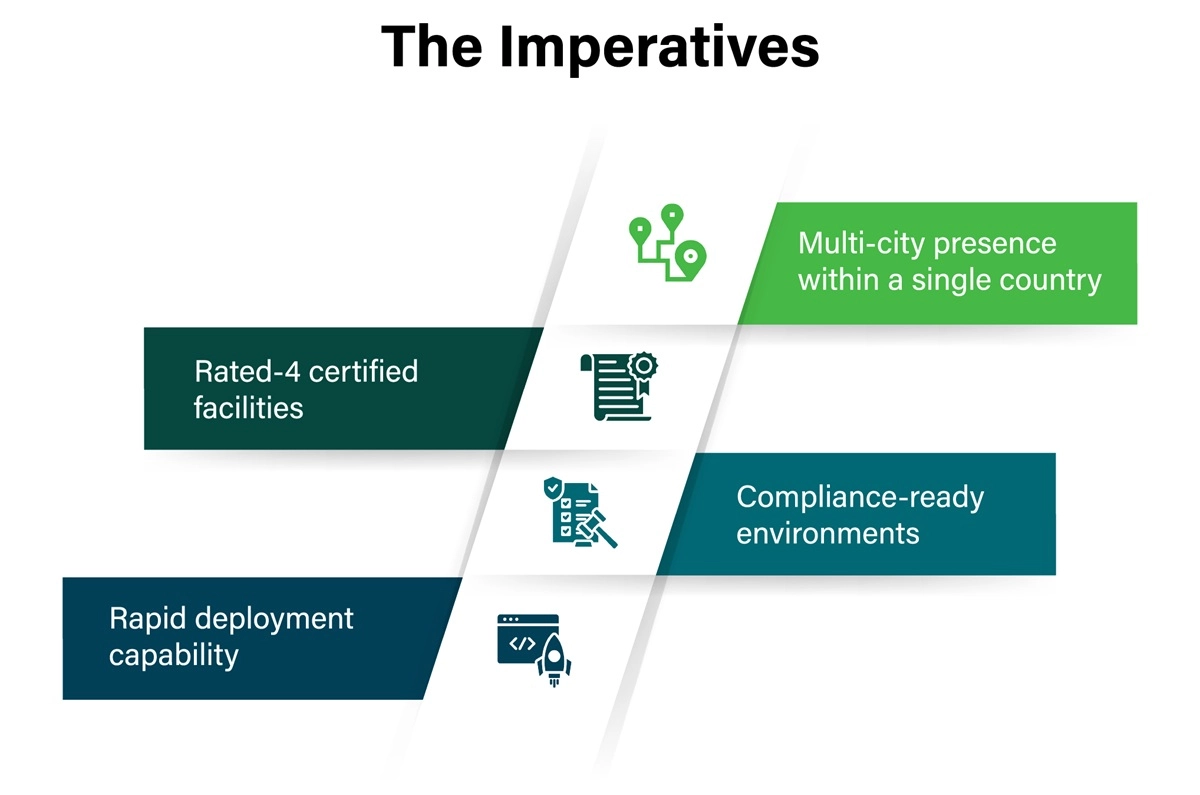
Providers such as CtrlS enable enterprises to operationalize resilient infrastructure strategies through nationwide Rated-4 facilities, carrier-neutral ecosystems, and infrastructure designed for high-density workloads.
Conclusion: The Decision Is About Timing
The era of location-agnostic infrastructure is over.
Enterprises are now making infrastructure decisions based on resilience, stability, and long-term continuity. India offers a combination of geopolitical neutrality, economic growth, regulatory clarity, and infrastructure maturity.
Enterprises building infrastructure in India today do so as a strategic choice. Those that wait may be forced to act under pressure, with higher cost and lower flexibility.
The safe harbor is available. The decision is whether to use it before the storm or during it.

Ranjit Metrani, President - Managed Services, CtrlS Datacenters
A business leader with over 30 years of experience, Ranjit has a proven track record of delivering high-scale growth in leading organizations in IT services, cloud, and datacenter industries. At CtrlS, Ranjit spearheads the Managed Services business, with a focus on enterprises' driving digital transformation. His rich expertise spans GTM strategy, infrastructure, software, sales, partner management, and driving customer growth through digital transformation.

 marketing@ctrls.in