
GPUs are increasingly taking the centerstage in datacenters. Every week, a new neocloud announces another cluster, with accelerated compute capacity making headlines. Businesses are rushing to get access, and a new class of infrastructure provider has emerged to meet that demand. According to Synergy Research Group, neocloud revenues exceeded $23 billion in 2025, a 200% year-over-year increase. Meanwhile, IDC puts full-year 2025 AI infrastructure spending at $318 billion, more than double the $153 billion recorded in 2024.
The numbers are huge, and they’re only leading in one direction.
But there’s something that’s becoming obvious to anyone building serious AI workloads. The GPU is just the beginning of it.
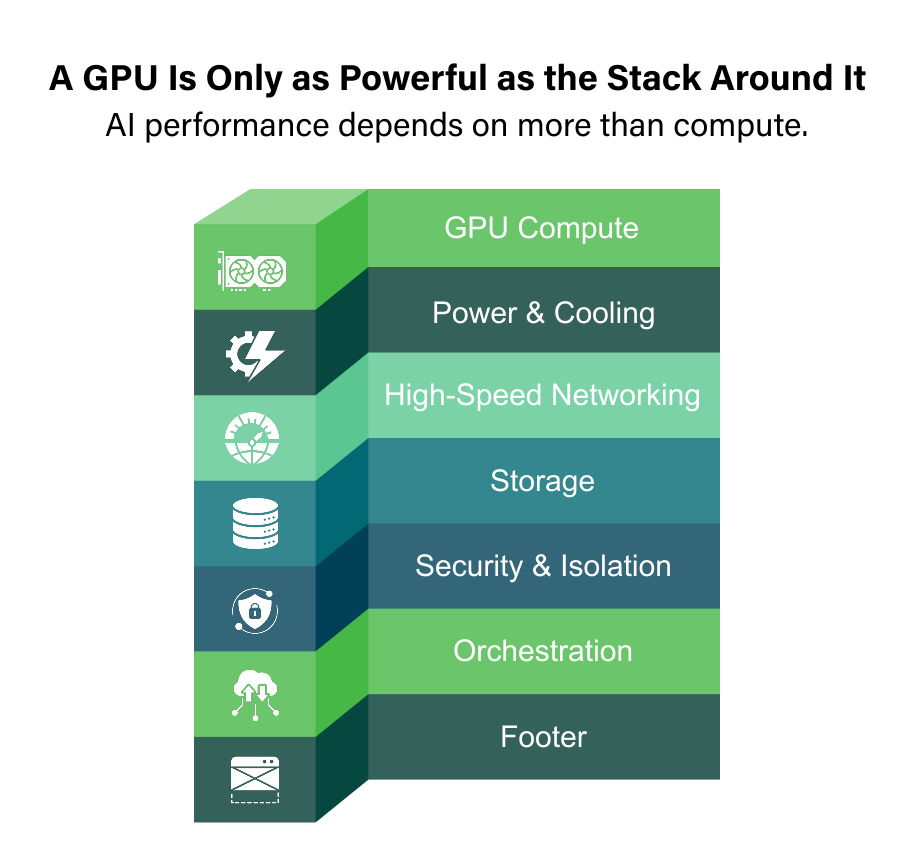
Businesses that are winning at AI infrastructure aren’t winning because they secured more GPUs. It’s because they got every other thing right. This includes network, power, cooling, storage and the management layer. All of this, combined as a stack, is what determines the success of a neocloud.
The GPU Obsession is Understandable, But Incomplete
When AI found its way into enterprise boardrooms, the conversation was focused on compute, and GPUs became the one critical element of AI readiness. It made sense for a while, but not anymore.
As per VentureBeat’s Q1 2026 AI Infrastructure & Compute Market Tracker, concerns around access to GPUs and their availability dropped from 20.8% to 15.4% in a single quarter. The market has pivoted, and the question is now about making GPUs perform as they should.
This is the reality today – GPU clusters don’t deliver full performance when they run on under-provisioned power, congested networking, and slow storage. Imagine buying a sports car only to drive it in a gridlock. The problem isn’t the chip; everything around it is.
When this happens, infrastructure gaps start showing up in real deployments, underperforming training runs, skyrocketing costs, and compliance failures; not to mention the growing frustration of AI/ML teams who had high expectations.
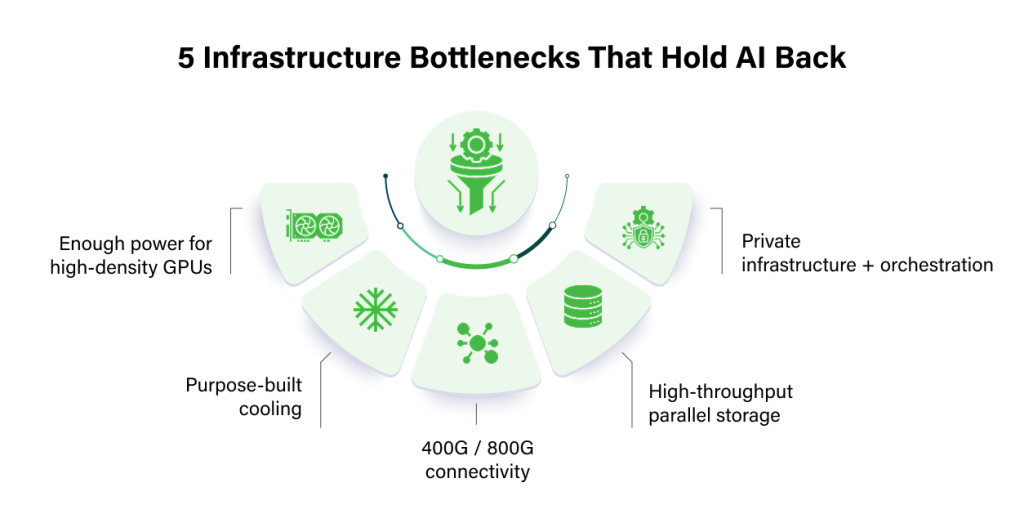
5 Things That Truly Determine AI Infrastructure Performance
Let’s break down and dive into what a neocloud actually needs to deliver on its promise.
Power and Cooling
AI clusters demand significantly more power than traditional datacenters can ever handle. According to Gartner, in 2026 alone, AI-optimised servers are projected to account for 31% of total datacenter power consumption. Use of AI-optimised servers witnessed an increase of 83 per cent in 2025, which is expected to further increase by 84 per cent in 2026, reaching 175 TWh globally. Without purpose-built power and advanced cooling infrastructure, businesses will face thermal throttling, degraded performance, and reduced hardware lifespan.
High-Speed Networking
Distributed AI training is highly dependent on GPUs connectivity. The shift to 400G and 800G networks has now become a basic need, because latency and bandwidth bottlenecks between GPUs would result in wasted compute cycles. It may sound small, but every millisecond of unnecessary latency in training compounds across thousands of iterations.
Storage and Data Pipeline
GPUs are extraordinarily fast, and your storage needs to keep up too. IDC’s own analysts have noted that AI storage infrastructure is being systematically undercounted in market forecasts, and they believe storage will be a significantly larger part of AI systems than current projections suggest. When storage can’t feed the GPUs with speed, the most expensive element of your stack sits idle.
Physical and Network Isolation
For regulated sectors, shared infrastructure isn’t an option when it comes to data sovereignty and compliance. The Flexential State of AI Infrastructure Report flagged that performance issues due to networking and datacenter scaling challenges; alongside AI’s unique data privacy and security challenges; are actively holding back revenue from AI initiatives. Purpose-built isolation is now a basic requirement.
Orchestration and Management
Managing utilisation across GPU clusters, preventing idle GPU sprawl, maintaining visibility, orchestrating workloads across a heterogeneous environment are operationally complex challenges without the right software layer. As VentureBeat’s tracker puts it, the luxury of underutilisation is now a liability.
If businesses get any of these wrong, their GPU investment underperforms; and if they get several wrong, they have built a very expensive bottleneck.
The High Cost of GPU Failure for Neoclouds
For neoclouds that operate with restricted budgets, the cost of a GPU failure poses an existential risk. The consequences of operational failure can extend to their very survival. Repair and replacement costs stack up fast, alongside SLA credits and penalties owed to customers, and lost billing revenue from GPUaaS downtime.
The stakes rise even higher when the deployment is done for training a large AI model. Customers may seek compensation because training stops until the failed GPU is replaced or the workload is recovered. Large distributed training jobs are especially sensitive here; a single failed GPU can halt thousands of GPUs across the cluster.
Why Enterprises Are Moving Toward Private Cloud for AI
Here’s something that’s easy to overlook in the GPU-first conversation. About 61% of enterprises now prefer private cloud for AI workloads. According to Gartner’s forecasts, worldwide sovereign cloud IaaS spending will reach $80 billion in 2026, a 35.6% increase from 2025, and this will be driven by enterprises seeking digital independence. Gartner also predicts that by 2030, over 75% of enterprises will have a digital sovereignty strategy, with many choosing to host environments that offer greater sovereignty even at the cost of some technical capabilities.
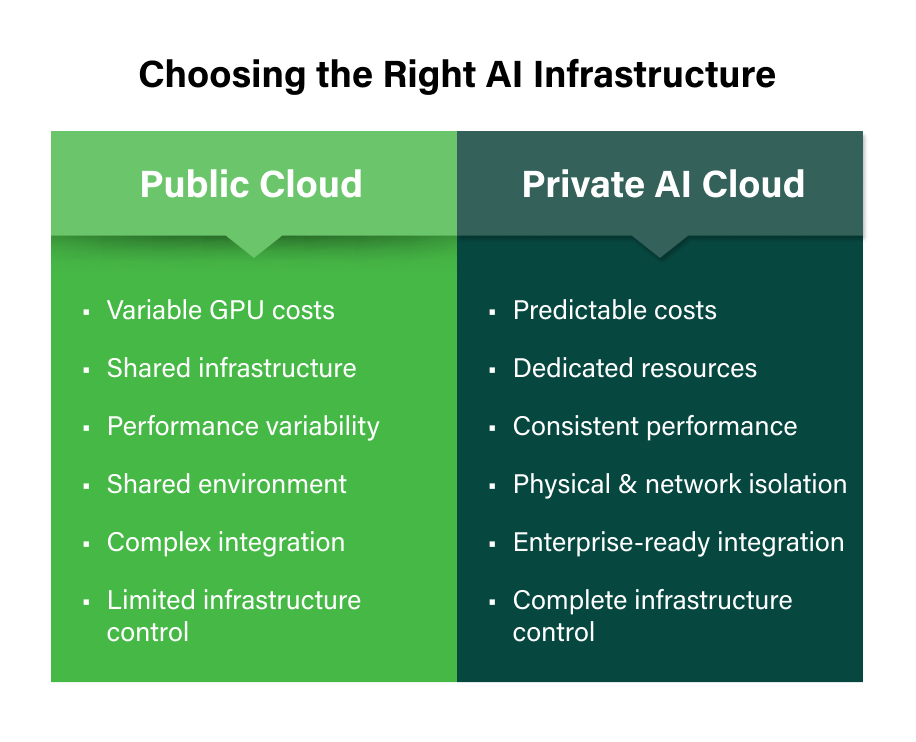
As AI workloads mature, the economics of public cloud start working against you:
- Unpredictable costs: Pricing of GPU instances on public cloud is volatile, and long training runs can generate billing surprises that make ROI calculations nearly impossible. More than 38% of organisations see uncertain ROI as a primary concern with public cloud AI. Gartner warns that by 2030, companies that fail to optimise their underlying AI compute environment will pay over 50% more.
- Data sovereignty gaps: Multi-tenant environments create serious exposure for regulated industries. Nearly 3 in 10 companies have experienced privacy breaches or security incidents on public cloud.
- Integration complexity: Integrating AI infrastructure with existing enterprise systems, data pipelines, and compliance frameworks is significantly harder when you can’t control the entire stack. Because of this, 39% of organisations cite integration difficulty as a key challenge.
Private cloud addresses these challenges by offering control, isolation, and predictability without sacrificing scalability.
Policy Tailwinds Backing India’s AI Infrastructure Buildout
The Government of India has announced a tax holiday for eligible foreign cloud providers until 2047 if they operate through India-based datacenters. This long-term framework provides investment certainty, and is set to accelerate neocloud footprints in India.
It is complemented by a broader effort to reduce supply chain dependency and build cost advantage. This is backed by two more initiatives. One, the India Semiconductor Mission, aimed at designing and manufacturing of semiconductor equipment in India. Two, the Electronics Components Manufacturing Scheme (ECMS), which encourages electronic component manufacturing. When combined, these initiatives are set to expand the scope for AI adoption in India.
What Purpose-Built AI Infrastructure Actually Looks Like
So, what does it look like when a provider gets it right? It starts with complete ownership of the full stack, including compute, network, platform, AI lifecycle tooling, and physical infrastructure.
CtrlS’s GPU Private Cloud is built to deliver exactly this. The Accelerated Cloud Platform (ACP) offers bare metal accelerators and cutting-edge infrastructure, backed by 400G/800G networks for higher throughput and lower latency. Physical and network isolation is built-in by design, making it a natural fit for regulated enterprises that need data localisation.
What makes it more useful for enterprises is the management layer with high-performance GPU/xPU clusters that are accessible from a single dashboard, and the flexibility to scale as workload requirements evolve. With this, ML teams focus on model development and business outcomes, instead of hardware management.
The stack extends beyond just infrastructure; from use case discovery through development, deployment, and monitoring; and into Neutrino, CtrlS’s agentic AI platform for enterprise operations.
Why Neoclouds Can Rely on CtrlS
As GPU hardware become more expensive, neoclouds need more than raw capacity; they need assurance, and CtrlS delivers that assurance through predictive infrastructure health monitoring, Rated-4 redundant power and cooling infrastructure, and a full-stack portfolio of managed services, including live migration and checkpoint/restart capabilities tailored to every application. All of it is backed by a highly stringent, preventive maintenance framework.
This operational excellence is what turns infrastructure reliability into a competitive advantage for neoclouds.
Compute is the Starting Line, Not the Finish
The neocloud era is here and real. As per Gartner’s forecasts, neoclouds will capture 20% of the $267 billion AI cloud market by 2030. Whereas, IDC projects AI infrastructure spending will reach $758 billion by 2029.
But GPUs are just the starting line.
The scale and success of your AI initiatives will be determined by what happens after you secure the compute.
According to Gartner, by 2029, 50% of all cloud compute resources will be dedicated to AI workloads. Businesses that will build the right infrastructure foundation today, will be ones to lead.
At this moment, the question worth asking is “do you have everything the GPUs need to do their job?”
That’s the infrastructure conversation the industry needs to be having.
Ready to see what a purpose-built AI infrastructure stack looks like? Explore CtrlS GPU Private Cloud.

Dharmendra Singh, VP - Hyperscale Business & Alliances, CtrlS Datacenters
Dharmendra is a seasoned expert in hyperscale and enterprise Datacenter Build-to-Suit (BTS) and hosting solutions. He leads initiatives that bridge collaborations with hyperscale service providers, large enterprises, government entities, and OEMs, driving innovative solutions that address the evolving IT infrastructure landscape. With a deep focus on customer engagement and architecture optimization, he ensures seamless transitions across on-premises, colocation, cloud, and hybrid environments. Committed to delivering customer success, he emphasizes network redundancies, cost-effective strategies, and operational efficiency, enabling organizations to realize their strategic objectives and maximize value from their IT investments.

 marketing@ctrls.in