
It’s no surprise how digital transformation has changed the rules of how enterprises operate. AI, cloud computing, digital services, real-time and always-on customer expectations have made digital infrastructure the backbone of the modern business. In this world and age, resilience has become a business imperative.
This shift is increasingly evident in Hyderabad, serving as South India’s emerging technology destination for global enterprises. Over the past decade, the city has grown into one of India’s leading technology and innovation hubs, home to Global Capability Centres, life sciences organisations, BFSI institutions, and one of the country’s largest cloud ecosystems.
According to a JLL report, Hyderabad now accounts for nearly 18% of India’s operational datacenter capacity. This a clear signal of how central the city has become to India’s digital economy.
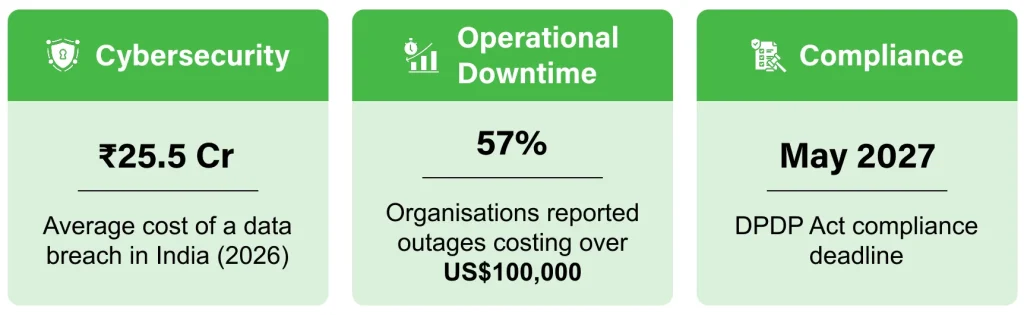
As enterprises go further digital and prepare for the AI future, the value of staying resilient is now more than ever before. According to studies, the average cost of a data breach in India reached an all-time high of Rs 25.5 crore this year, a significant increase of 15.9% from the previous year. What’s worth noticing is what separates the businesses that absorbed that cost well from those that couldn’t. Businesses that had invested extensively in AI-driven security and automation paid meaningfully less per breach and identified incidents faster than those without it. Preparedness, in other words, pays for itself.
The same pattern can be seen in outages. According to Uptime Institute’s 2026 Annual Outage Analysis, 57% of organisations reported their most recent major outage cost more than $100,000, and for the second year running, one in five put that figure above a whopping $1 million. The same report also noted that outage frequency has been declining for five straight years on a per-site basis. This is a proof that resilient design and operations genuinely move the needle.
Regulation is reinforcing this shift as well. With India’s Digital Personal Data Protection Act now in its implementation phase, and full compliance due by May 2027, EY’s research shows organisations are actively working through gap assessments, data mapping, and governance frameworks to achieve compliance. It’s a big lift, but it’s also an opportunity for organisations. Businesses that treat DPDP readiness as a chance to modernise their data governance now will be the ones operating with the most confidence later.
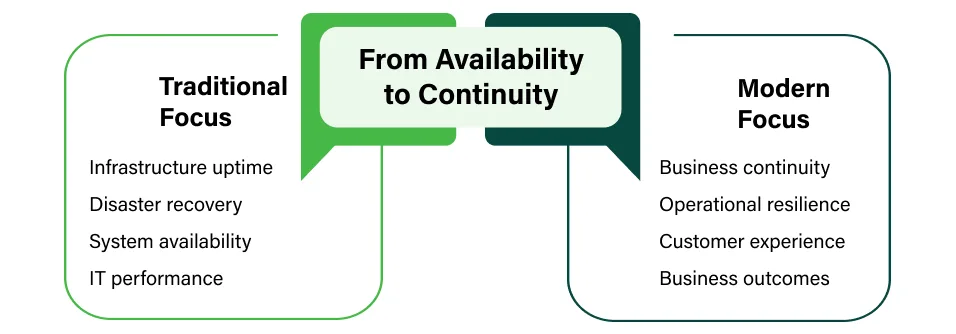
When put together, these signals point to one shift. The conversation has now moved from mere uptime to preparedness for disruption and resilient business operations.
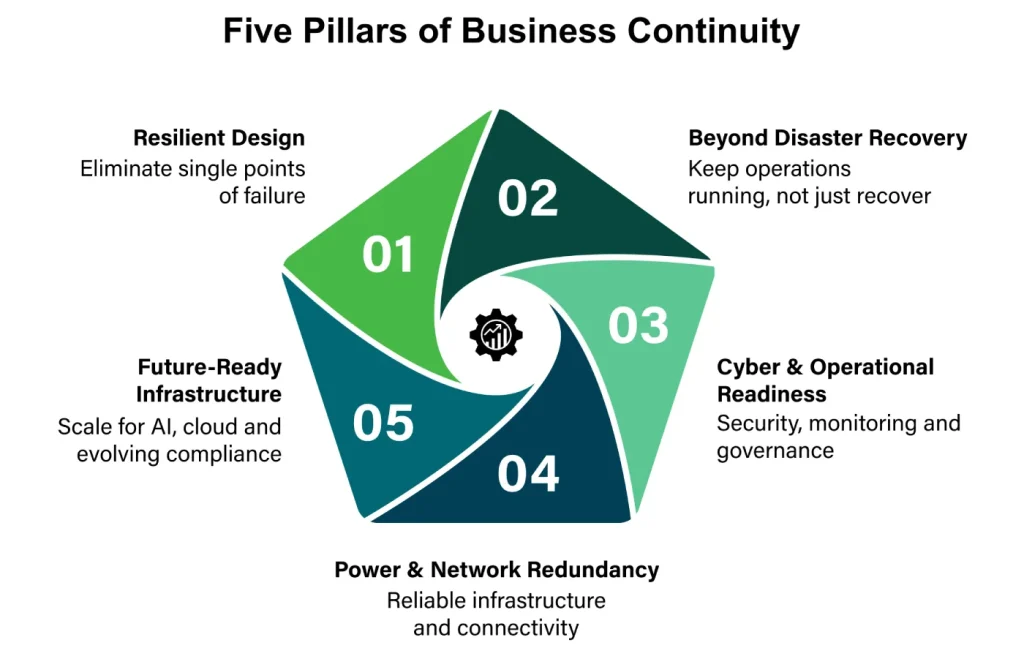
Five Priorities for Business Continuity
1. Design for Resilience from Day One: Business continuity starts with resilient underlying infrastructure. Enterprises should look for infrastructure built with redundant power, cooling, and network systems that remove single points of failure before they impact business operations.
2. Look Beyond Disaster Recovery: Disaster recovery restores systems after something goes wrong, but business continuity keeps critical operations running with minimal disruption in the first place. For true resiliency, modern infrastructure should be built to do both.
3. Strengthen Cyber and Operational Readiness: Resilience isn’t just about physical infrastructure. Secure facilities, continuous monitoring, disciplined operational processes, and strong governance frameworks, all work together to lower business risk and reinforce compliance, especially as AI reshapes both the opportunity and the threat landscape.
4. Prioritise Power and Network Redundancy: Both, reliable power and resilient connectivity are highly critical for uninterrupted business operations. Multiple carrier options, diverse network paths, and reliable power infrastructure help businesses keep services running without interruption.
5. Building for the Future: Technology, regulation, and business risks keep evolving. Your digital infrastructure should be ready to support AI adoption, hybrid cloud strategies, future expansion, and changing compliance requirements without having to redesign every time something changes.
Questions Every CIO Should Be Asking
Before choosing a digital infrastructure partner, it’s worth pausing and asking a few important questions that will determine business resiliency.
- Is resilience built into the infrastructure by design?
- Can our mission-critical business operations continue through disruption, not just recover from it?
- How quickly can our essential services actually come back online?
- Does our digital infrastructure strengthen our security and compliance posture?
- Will it support the business as technology and customer expectations continue to evolve?
Organisations that ask these questions early will be the ones building a real edge for their business.
Looking Ahead
As Hyderabad strengthens its place as one of India’s leading digital economies, resilient infrastructure is becoming a genuine competitive advantage.
The organisations that come out ahead in the years ahead won’t simply be the ones that invested in availability. They’ll be the ones that invested in infrastructure built for continuity, engineered to minimise operational risk, and designed to give leadership the confidence to keep innovating.
In today’s digital economy, resilience isn’t measured by uptime alone anymore. It’s measured by how confidently a business keeps operating when the unexpected happens.

Praneeth Busireddy, VP - Enterprise Colocation Sales, CtrlS Datacenters
Praneeth is a seasoned IT professional with over 20 years of industry experience. Currently, he leads Mid-Market business across India and manages colocation services for Telangana and Andhra Pradesh. With deep industry expertise, strong business acumen, and extensive experience in datacenter services, Praneeth brings valuable insights and leadership to every engagement.

 marketing@ctrls.in