
For years, enterprises chose colocation based on floor space, rack count and location. Those measures still matter, but they no longer tell the full story of whether a facility can support the next generation of computing.
AI is changing the infrastructure equation. Training large models, running inference at scale and supporting high-performance computing can create much higher power and cooling requirements than conventional enterprise workloads. The IEA estimates that a conventional datacenter may be around 10 to 25 MW, while hyperscale, AI-focused facilities can reach 100 MW or more. It also expects global datacenter electricity consumption to more than double from 2024 levels by 2030.
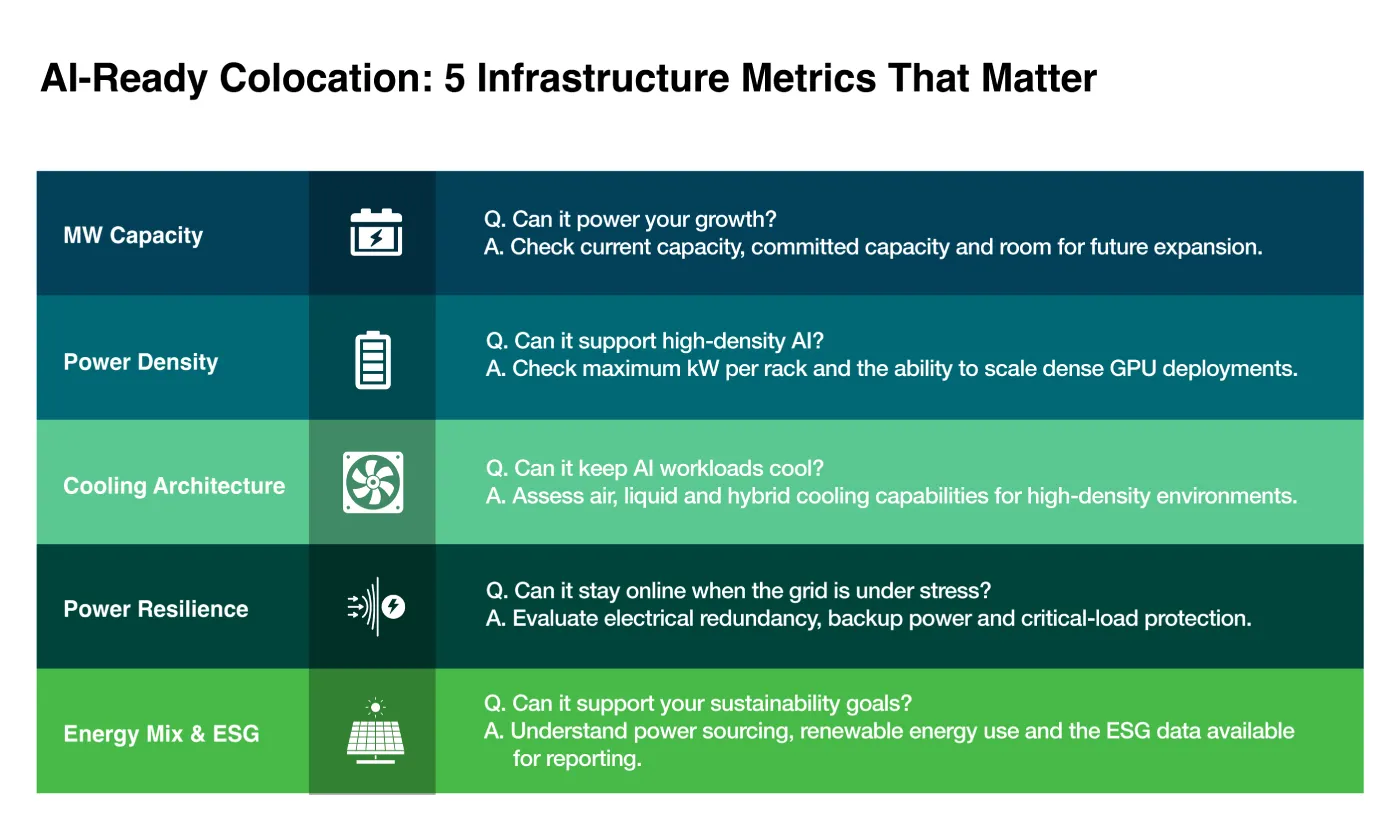
An enterprise evaluating an AI-ready datacenter now needs to understand how much power a facility can deliver, how much density it can support, how resilient that power supply is, and where that electricity comes from.
The choice of colocation partner can affect the speed of AI deployment, the ability to scale and the quality of sustainability reporting.
Megawatts, the Real Unit of Modern Compute and Square Footage Is No Longer the Right Measure
Colocation was built around physical space. Enterprises bought cabinets, cages and floor area. Rack counts gave infrastructure teams a practical way to estimate how much equipment a site could accommodate. The model worked when compute requirements were relatively predictable and rack power stayed within the capabilities of conventional air-cooled environments.
AI changes that equation. Modern GPU clusters can concentrate a large amount of compute into a small physical footprint. Vertiv, for example, now offers reference architectures for 100 kW racks, while its high-density infrastructure can support racks exceeding 100 kW.
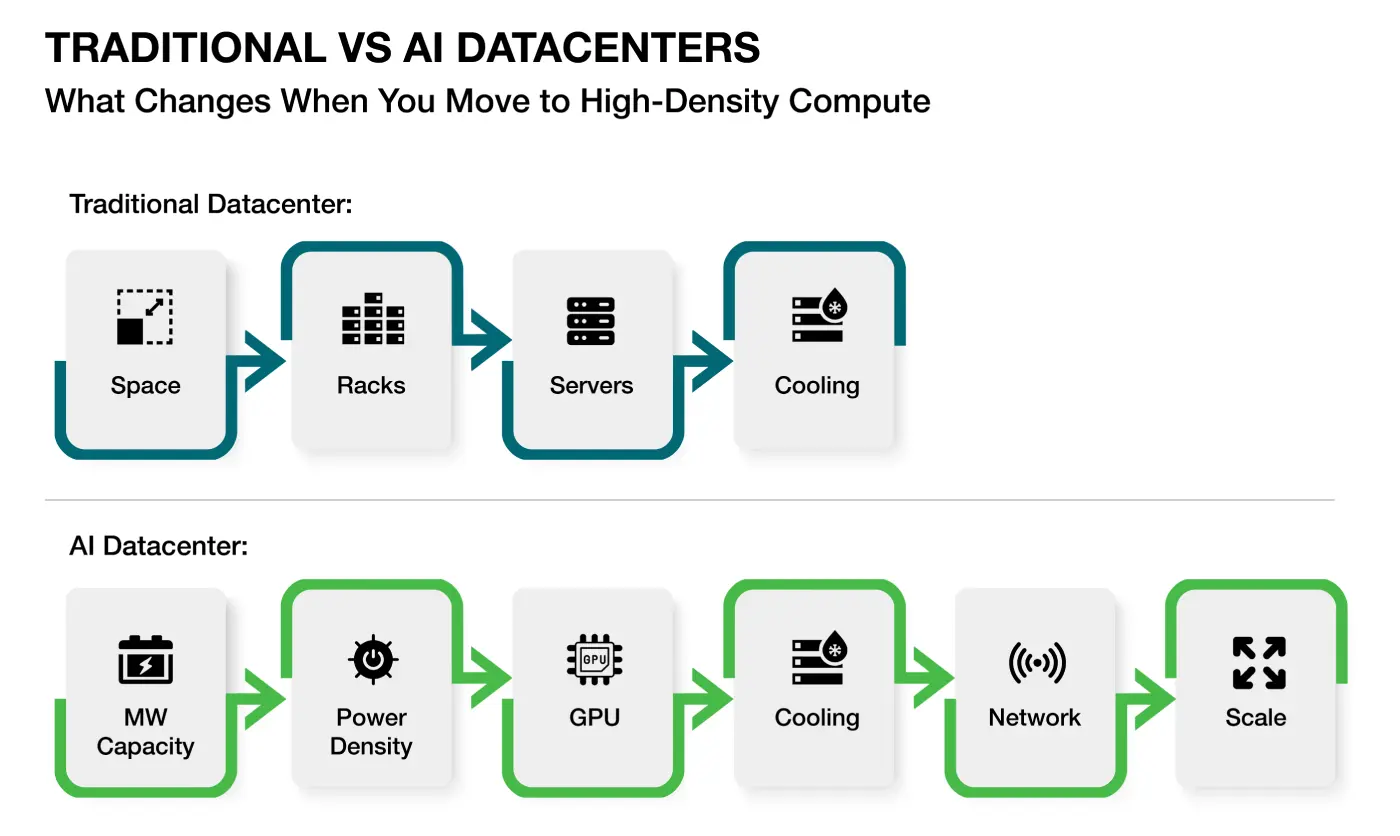
The result is a simple shift in how capacity should be discussed. A facility can have plenty of empty floor space and still lack the electrical and thermal capacity required for an AI deployment.
That is why datacenter power capacity, measured in megawatts, has become such an important part of the buying conversation. At rack level, datacenter power density, measured in kilowatts per rack, tells you how much compute can be supported in a given footprint. At facility level, MW capacity tells you whether the site has enough power available to support the overall IT load and future expansion.
Preparing the Business for Future AI Workloads
For a CIO or CTO, buying GPUs is usually a procurement exercise. Powering those GPUs is a facilities and infrastructure challenge. The hardware may arrive on schedule while deployment slips because the selected facility cannot support the required electrical load, distribution architecture or cooling system. The issue becomes more difficult as AI clusters scale and power density rises.
Cooling is a major part of the equation.
AI-ready datacenters are increasingly using technologies such as direct-to-chip liquid cooling and rear-door heat exchangers to manage high-density environments. These systems allow operators to remove heat closer to the source and support rack densities that are difficult to handle with conventional air cooling alone.
An AI-ready datacenter therefore needs coordinated design across power, cooling, electrical distribution, network architecture and physical space.
The facility should be designed around the workload profile rather than adapting an existing room after the GPUs arrive.
High-density systems placed in infrastructure designed for lower loads can create thermal constraints, power distribution limits and deployment delays. AI workloads are especially sensitive to these constraints because the infrastructure has to support large amounts of compute in a tightly integrated environment.
IEA estimates that around 20% of planned global datacenter capacity could face delays by 2030 because of grid connection constraints.
For enterprises, this changes the meaning of future capacity. A provider saying that land is available for expansion is very different from a provider having power capacity secured for that expansion.
Power Availability Is a Growth Constraint – Secured Capacity Matters More Than Theoretical Capacity
The next question is whether the advertised capacity can actually be delivered when the business needs it.
A colocation provider may have a large development pipeline, but that does not mean every megawatt is immediately available to customers. Grid connections, substations, transformers, permitting and generation capacity can all affect how quickly a datacenter can grow.
This makes power planning part of enterprise growth planning. A company preparing for AI workloads should examine the provider’s current power availability, committed future capacity and expansion path. From resilience standpoint, redundant feeds, backup generation, UPS systems and appropriate electrical architecture remain important because high-density compute has little tolerance for interruptions.
AI workloads can also have different operating patterns from conventional enterprise applications. Large GPU environments may create substantial and rapidly changing electrical demand. A facility needs to be engineered to handle this variable power profile reliably.
ESG and Clean Power, The Other Side of the MW Equation and Where the Power Comes From
Datacenters consume large amounts of electricity, which means the energy mix behind a facility can influence an enterprise’s environmental reporting and broader sustainability goals. The IEA estimates that renewables currently supply about 27% of electricity consumed by datacenters globally, with solar, wind and hydropower making up most of that share.
For enterprises with emissions targets, the conversation therefore needs to move beyond how many megawatts a facility provides. It should include how those megawatts are sourced.
A renewable energy datacenter may draw power from a grid that includes renewable generation, procure renewable electricity through contracts or use a combination of sources. The details matter because renewable energy claims depend on how electricity purchases and environmental attributes are accounted for.
The GHG (Green House Gas Protocol by World Resource Institute) defines Scope 2 emissions as indirect emissions from purchased or acquired electricity, steam, heating and cooling. Its guidance also addresses the use of contractual instruments such as renewable energy certificates and other energy contracts in Scope 2 accounting. This creates an important procurement consideration.
Enterprises should understand whether a colocation provider can provide credible information about its electricity sourcing, renewable energy procurement and the environmental attributes associated with that electricity.
The GHG Protocol is currently reviewing its Scope 2 guidance, including how electricity consumption and clean energy claims should be represented. One issue under review is the relationship between renewable energy procurement, location and the timing of actual electricity consumption.
For enterprises reporting emissions, that distinction can become important.
ESG Is Becoming an Infrastructure Data Question
Sustainability reporting is also becoming more structured.
For technology leaders, this means infrastructure decisions increasingly have a reporting dimension. The colocation provider becomes part of the data chain behind those disclosures.
Enterprises should be able to understand the energy profile of the facility, the renewable sources being used, the basis for renewable energy claims and the information available for emissions reporting. A sustainable datacenter therefore needs to be evaluated through operational performance and energy sourcing, with reporting quality considered alongside both.
The Next-Gen Colocation Decision
That is where CtrlS fits into the conversation.
For enterprises planning AI infrastructure, CtrlS brings together datacenter capacity, high-density deployment capabilities and a focus on renewable energy and sustainability. The goal is to give technology leaders an environment where compute can scale without treating power, cooling and environmental performance as separate decisions.
For enterprises looking at their next datacenter investment, CtrlS offers a platform built around that reality: capacity measured in megawatts, infrastructure designed for higher density and sustainability considerations built into the power equation. The future of colocation will be measured in more than square feet. It will be measured by the reliable, scalable and responsible power available behind every rack.

Nikhil Rijhwani, Vice President – Sales and City CEO, CtrlS Datacenters
with over 20 years of experience growing digital infrastructure businesses in India. He leads sales and cross-functional teams serving hyperscalers, neoclouds, enterprises and government institutions. His expertise spans datacenter economics, capacity monetization and strategic partnerships. Through business transformation, he helps build scalable infrastructure that supports India’s digital economy.

 marketing@ctrls.in