
India’s datacenter narrative has moved from a niche real estate conversation to one of the most important infrastructure investments. As cloud adoption grows along with AI workloads, the physical digital infrastructure capacity behind them has become a real marker of where India stands in the global digital economy.
According to Knight Frank’s Global Data Centre Atlas 2026, two Indian cities are making big strides. We’re talking about Mumbai and Hyderabad. One has already arrived, and the other is rapidly closing the gap. Together, both cities tell a story that’s not just about capacity, but also about where India is headed as a digital economy.
Mumbai – the city that got here first
Mumbai isn’t new to this game. As India’s financial capital and a coastal city, it sits on some of the country’s strongest fiber routes, and doubles as a landing point for a good share of the subsea cables connecting India to the rest of the world. That combination has made it a natural home for datacenters for many years.
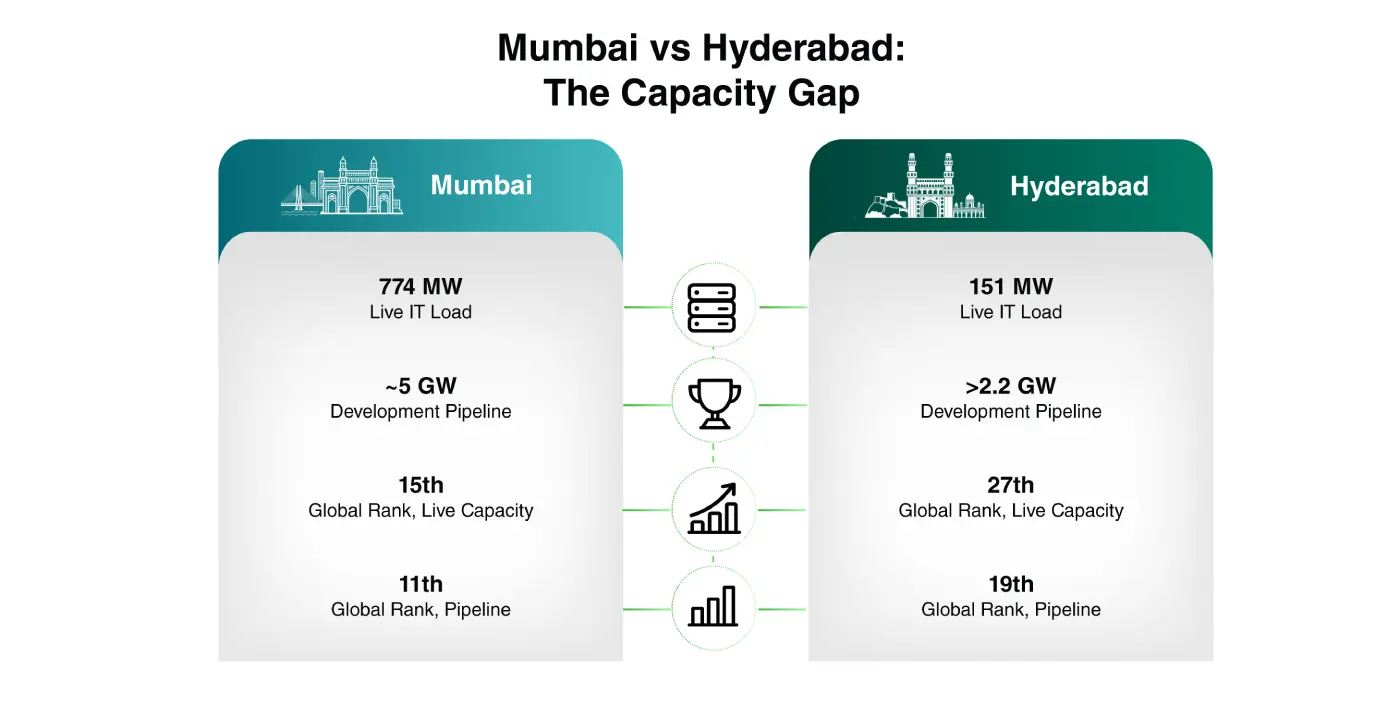
Mumbai now holds 774 MW of live IT load capacity, placing the city at 15th place among the 36 major datacenter market. But what’s more telling is the pipeline. With nearly 5 GW of additional capacity under development, Mumbai is placed 11th globally on that front. CBRE’s research backs this up from another angle. Mumbai alone accounts for over half of India’s entire operational datacenter inventory. Together with Chennai, Delhi-NCR and Bengaluru, the city makes up close to 90% of the country’s Tier-1 region datacenter capacity.
While it’s a major market already, Mumbai continues to add more capacity. CBRE puts India’s overall operational capacity at roughly 1,530 MW as of late 2025, with 260 MW added that year alone. The city that built India’s datacenter industry is still the one accelerating the country’s datacenter growth.
All in all, Mumbai isn’t just India’s biggest datacenter market. It’s also becoming one of APAC’s most important digital infrastructure hubs.
Hyderabad – the one to watch
While Mumbai is an established market, Hyderabad is the one everyone’s closely watching. Hyderabad’s current numbers may look modest when compared to Mumbai’s. The city ranks 27th globally with 151 MW of live capacity. But look at what’s coming; a development pipeline of more than 2.2 GW. That’s enough to put Hyderabad at 19th position globally.
Now let’s do the math on that. Hyderabad’s datacenter pipeline is over 14 times its current live capacity. That means the city is betting big on what’s ahead, with investors betting right alongside it.
But why Hyderabad, you may think.
It’s a metro where large land parcels are actually available. That’s a rare thing in India’s crowded metros. Additionally, operating costs remain competitive, there’s consistent state government support, and the city has a technology ecosystem that keeps getting bigger. Put those together and you get exactly the kind of environment hyperscale and AI-focus companies are looking for.
It’s a pattern showing up elsewhere too. As per Wood Mackenzie’s research, states like Andhra Pradesh, Telangana, Uttar Pradesh and Karnataka are next in line for major investments, even as Maharashtra and Tamil Nadu continue to hold the bulk of India’s installed IT load capacity today. Hyderabad, in other words, isn’t an outlier. It’s a preview of where the next wave of capacity is headed.
Here’s where it gets more interesting. Chennai is increasingly becoming a gateway to South East Asia, while Bengaluru continues to benefit from the sheer volume of Global Capability Centres and enterprise R&D centers. Pune and the NCR, too, are expanding steadily.
And then there’s the next wave, where cities like Visakhapatnam and Jamnagar are attracting serious interest for large greenfield projects. Planned subsea connectivity infrastructure and state-level incentives are working to their advantage. CBRE’s recent research points to the same trend, identifying Ahmedabad, Patna and Bhopal as Tier-2 markets that are gaining traction due to the demand for lower latency, 5G rollouts, and data localisation.
When we put these pieces together as one big picture, India’s datacenter map looks more like a network; one that’s built to support different kinds of demand, from enterprise colocation to hyperscale cloud and AI training clusters.
Why AI changes the game
None of this growth is happening in silos. AI is the big force driving it, and it’s changing what a datacenter even needs to be.
Gartner expects the total global datacenter systems spending to surpass $650 billion in 2026, with AI-optimised servers accounting for a major share. Global AI spending itself is projected to top $2 trillion this year, and India’s datacenter build-out is driven by the same growth. According to Wood Mackenzie, India’s AI-dedicated datacenter capacity will grow nearly 24-fold, from 275 MW today to over 6,500 MW by 2030.
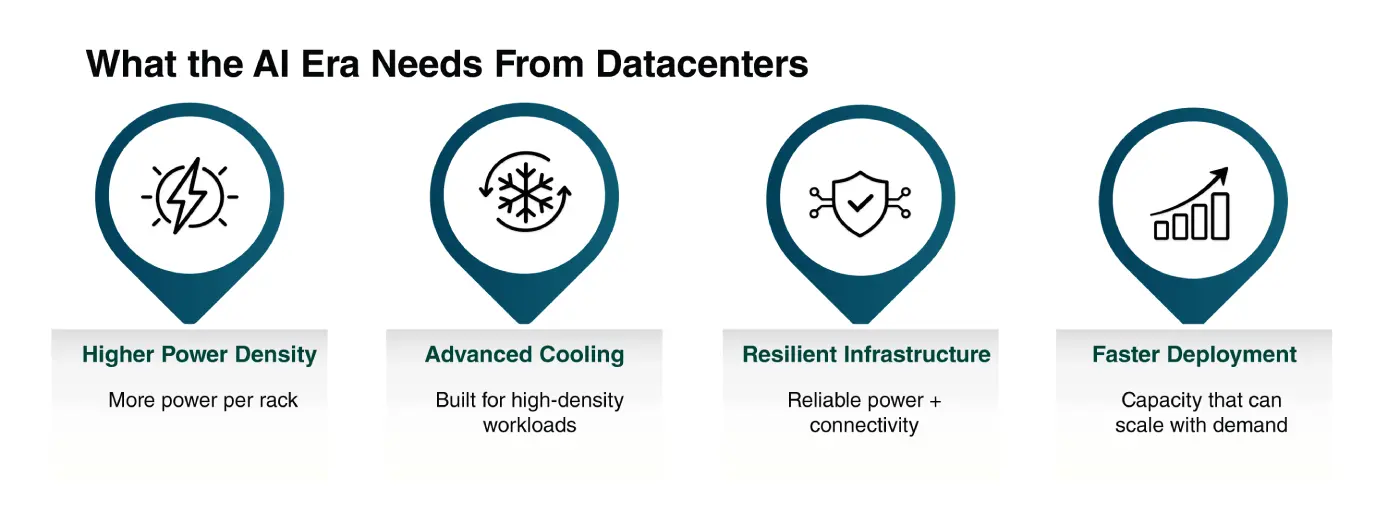
AI workloads draw far more power per rack, need denser cooling, and demand infrastructure that can scale quickly. This calls for the next generation of facilities to be designed differently from the ground up. Density, resilience, and speed of deployment make all the difference.
Here’s the part that matters most. Nobody’s asking anymore whether India will need more datacenters, because that question is settled. The conversation is about whether the infrastructure can keep pace with the demand. This also includes factors like power lines, transmission capacity and approvals.
India’s Power Ministry expects datacenter electricity demand to hit 26.3 GW by FY32. That’s nearly double the estimate from just months earlier. The encouraging part is that India added a record 44.5 GW of renewable capacity in 2025 alone, giving the grid the capacity to absorb this load sustainably. But faster power provisioning, stronger transmission, streamlined approvals, wider fiber coverage and development-ready land will all need to move at the same speed as the demand curve.
This is now the crux of India’s datacenter era. Earlier, having land or buildings used to be the competitive edge.Now, the edge belongs to those who can promise and deliver reliable power, strong connectivity and the ability to deploy capacity fast, without the usual delays that come with scaling physical infrastructure in India.
Where this leaves us
Mumbai has placed India on the global datacenter map, and now Hyderabad is showing how fast the next chapter can be written. Alongside, a growing list of cities is laying the groundwork for something more distributed, resilient, and better built for India’s AI needs.
The opportunity in India is enormous, but seizing that opportunity will take more than demand and capital. The cities and companies that win India’s next datacenter cycle will be the ones that bring power, connectivity, resilience and speed of deployment together, all at once.

Mayur Gautam, SVP - Colocation Sales, CtrlS Datacenters
Mayur is a seasoned leader with extensive experience in leadership, business development, and strategic sales within the IT services industry. During his tenure at CtrlS, he has held multiple leadership roles, driving business growth, building high-performing teams, and providing strategic and operational oversight across IT service management. His expertise spans new client acquisition, revenue growth, key account management, and long-term customer relationships. He has a strong track record of identifying new opportunities, negotiating and strengthening customer engagement to drive sustained business growth.

 marketing@ctrls.in