
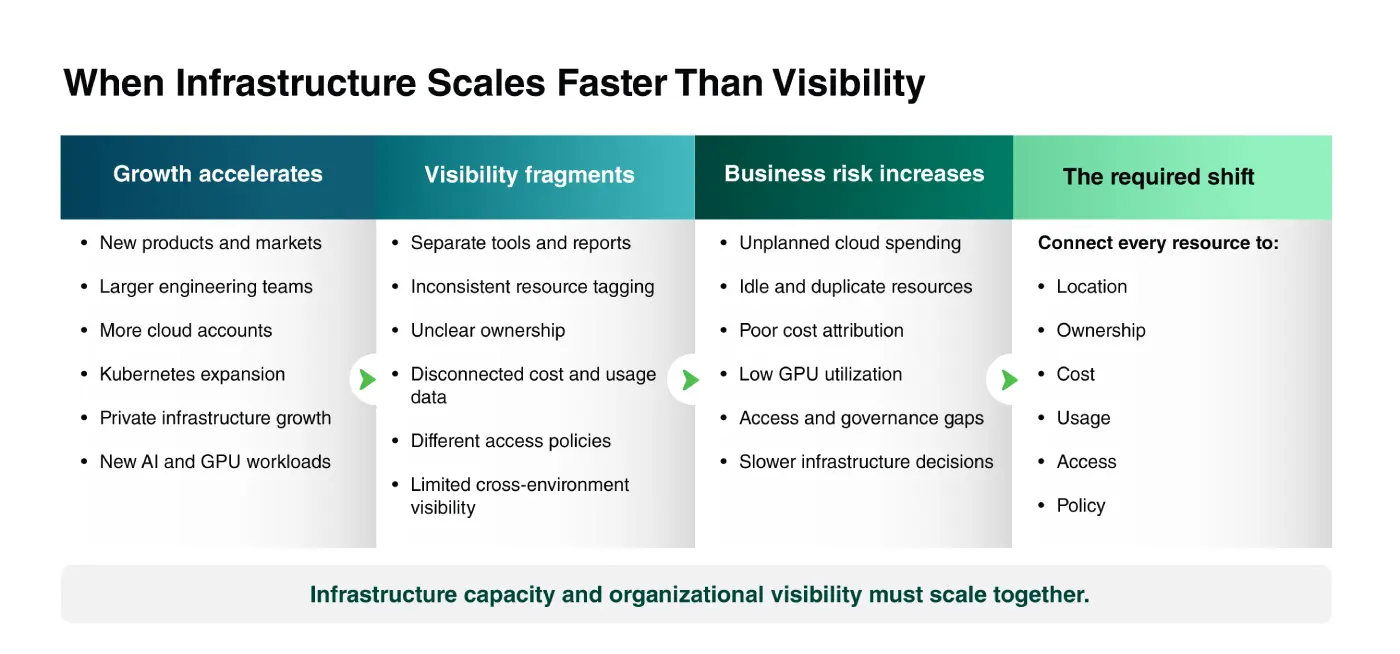
Soonicorns need infrastructure capacity to grow quickly. But speed should not weaken visibility, accountability or control. New products, larger engineering teams and AI initiatives can turn a relatively simple infrastructure estate into a fragmented one within months.
Growth should increase infrastructure capacity, not decrease the organization’s ability to understand, govern and optimize it.
Rapid Growth Creates Fragmentation Before Leaders Recognize the Risk
Funding-led expansion changes infrastructure faster than most operating models can adapt. Every new product, geography and engineering team can introduce additional cloud accounts, Kubernetes clusters, private infrastructure, software tools and access requirements. AI projects add GPU environments and a new set of infrastructure consumers.
Each environment may remain manageable in isolation. The problem appears when they expand together without a common operating view.
Cloud teams understand public-cloud consumption. Infrastructure teams monitor private capacity. Platform teams manage Kubernetes. AI teams track GPU workloads. No team necessarily sees the full picture.
This is becoming the normal operating context. Flexera’s State of the Cloud research reports that 73% of surveyed organizations operate hybrid cloud estates, combining public cloud with private or on-premise environments. Flexera findings reported by TechRadar
The implication is clear: infrastructure diversity is no longer exceptional, but the visibility required to govern it has not always kept pace.
Infrastructure fragmentation is not caused by growth. It is caused by allowing capacity and organizational visibility to scale at different speeds.
For a soonicorn, that gap can quickly become a business risk. Technology leaders lose decision speed, finance teams lose cost accountability, and founders may have less confidence in infrastructure economics.
What initially appears to be an operational inconvenience can eventually affect investment priorities, margins and the ability to scale predictably.
Unanswered Infrastructure Questions Signal That Visibility Is Falling Behind
Visibility problems rarely begin with a major control failure. They first appear as basic questions that require multiple teams, reports and spreadsheets to answer.
As products and teams multiply, the organization should be able to establish:
- Where is spending changing, and who owns it?
Leaders need to connect increases in cloud and infrastructure expenditure with specific products, projects, teams and business outcomes. - Which resources are productive, and which are underutilized or idle?
Provisioned capacity should be compared with actual usage across cloud instances, Kubernetes clusters, private infrastructure and GPU environments. - Who has access, and are policies being applied consistently?
Permissions, approval workflows and infrastructure policies should remain visible as employees, vendors and workload environments increase.
When answers depend on separate reports from cloud, platform, infrastructure and AI teams, leaders receive a delayed and often incomplete picture.
By the time inconsistent ownership or unexpected expenditure becomes visible, the organization may already have accumulated redundant resources, fragmented policies and manual processes.
The financial impact can be significant. According to Flexera’s State of the Cloud research, organizations estimate that approximately 29% of their IaaS and PaaS cloud spend is wasted.
Common causes can include unused instances, oversized resources, obsolete storage and capacity that is no longer aligned with workload requirements.
Incomplete visibility allows these costs to become embedded in the operating baseline instead of being identified and challenged.
Infrastructure Without Attribution Cannot Be Properly Controlled or Optimized
Cost data alone does not create accountability.
Infrastructure resources should be connected, wherever possible, to an owner, workload, project, application or business purpose.
Without that attribution, leaders cannot easily distinguish productive investment in growth from capacity that may be delivering limited value.
This distinction matters during rapid expansion.
An increase in infrastructure expenditure may support customer acquisition, product performance or entry into a new market. It may also result from duplicate resources, oversized configurations, idle development environments or decentralized purchasing.
Both may appear simply as increased infrastructure spending in a financial report, but they require very different leadership decisions.
AI infrastructure makes these existing gaps more expensive.
GPU capacity carries a high unit cost, while experimental workloads can have irregular demand and distributed ownership. CAST AI reported average GPU utilization of approximately 5% across the Kubernetes clusters included in its analysis before optimization. CAST AI findings reported by TechRadar
This does not mean every GPU environment should operate continuously at maximum utilization. AI workloads vary significantly by training, inference, development and experimentation patterns.
The finding does, however, demonstrate how easily expensive compute capacity can remain provisioned without delivering proportional value if utilization and ownership are not sufficiently visible.
Governance Is Easier to Embed During Growth Than to Retrofit Later
Governance introduced early can support speed because teams operate within clearer ownership, access and provisioning rules.
Governance introduced after fragmentation must first reconcile conflicting tools, definitions and working practices.
As separate teams develop their own processes, standardization becomes progressively harder.
Cost tags may differ between business units. Access reviews may follow different cadences. Cloud and private infrastructure may use unrelated approval models. GPU resources may be allocated without a consistent utilization, ownership or chargeback framework.
Soonicorns should therefore embed a number of fundamental controls while the infrastructure estate is still scaling:
- Consistent attribution:
Link resources to business units, projects, applications, environments and accountable owners. - Standard access governance:
Establish clearly defined roles, approval paths and review processes appropriate to each infrastructure environment. - Shared governance policies:
Define common principles for provisioning, utilization, cost thresholds and resource lifecycle management while allowing implementation to reflect the underlying technology. - Comparable cost and usage data:
Evaluate infrastructure expenditure alongside capacity and utilization rather than treating financial and operational measures separately. - Repeatable workflows:
Establish common processes for requesting, allocating, reviewing, scaling and retiring infrastructure capacity.
The right governance model does not constrain growth. It removes the uncertainty that makes growth harder to sustain.
A Common Operating View Allows Capacity and Control to Scale Together
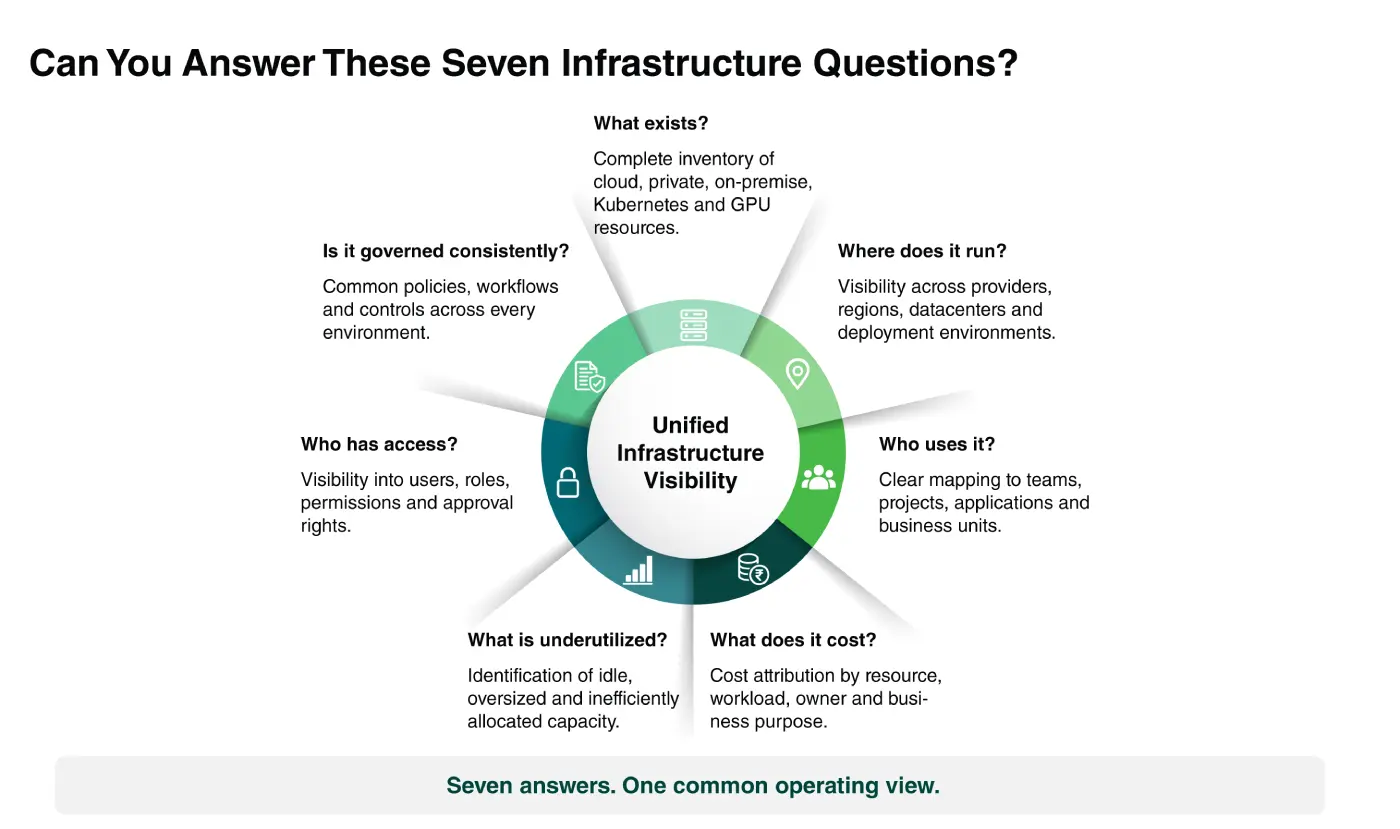
These questions are easier to answer when infrastructure information can be brought into a common operating view rather than being manually reconciled across separate teams and tools.
As organizations expand across private infrastructure, Kubernetes, GPU environments, on-premise systems and public cloud, a consistent operational layer can improve visibility into capacity, utilization, ownership and governance without requiring every workload to run on the same infrastructure.
This does not mean every environment has to be managed identically.
Public cloud, private infrastructure, bare metal, Kubernetes and GPU platforms have different operational characteristics. The objective is not to eliminate those differences, but to give infrastructure teams a more consistent way to understand and govern them.
Bringing Heterogeneous Infrastructure Into a Common Operational Layer
CtrlS Accelerated Cloud Platform is designed to provide a unified orchestration, visibility and governance layer across heterogeneous infrastructure environments.
ACP brings infrastructure operations, Kubernetes, bare-metal and GPU environments into a common platform while supporting integration with broader cloud and enterprise environments.
This gives technology teams a more consistent way to understand infrastructure consumption, utilization, ownership and operational status as their estates grow.
By reducing dependence on fragmented tools and manually consolidated reports, organizations can establish a stronger foundation for infrastructure governance while retaining the flexibility to run workloads across different environments.
The objective is not to force infrastructure standardization.
It is to make heterogeneous infrastructure easier to operate, understand and govern as the organization scales.
For a rapidly growing organization, that distinction becomes increasingly important.
Capacity can scale quickly.
Visibility, accountability and governance must scale with it.
Explore the CtrlS Accelerated Cloud Platform to understand how a common operational layer can help improve visibility, orchestration and governance as infrastructure complexity increases.

Chetan Sonar, SVP – GPU Cloud & AI Orchestration, CtrlS Global
With over 21 years of experience across datacenters, cloud, managed services and AI infrastructure, he brings together deep technology expertise with business and operational leadership.
His current focus includes AI datacenter strategy, GPU cloud architecture, high-density infrastructure, AI/HPC orchestration, multi-tenant GPU platforms, performance engineering, TCO and pricing models, and the evolution of datacenters into AI factories. He is particularly interested in where engineering decisions become business decisions, connecting architecture, performance, automation, economics and customer experience.

 marketing@ctrls.in