
At unicorn scale, the infrastructure challenge is often not only about adding capacity. It is also about maintaining a clear view of how that capacity is being consumed, utilised, accessed and governed.
Growth distributes infrastructure across teams, products, clouds, clusters and AI environments faster than operational models can sometimes adapt. Leadership may see individual platforms functioning effectively while finding it increasingly difficult to understand the complete infrastructure picture.
The priority, therefore, is not simply another monitoring layer. It is a common operating view that helps technology teams understand infrastructure consumption, utilisation, ownership, access and operational status across an increasingly diverse environment.
Growth Distributes Infrastructure Faster Than Accountability
Rapid expansion changes the infrastructure operating model.
New products create cloud accounts. Business units adopt different platforms. Engineering teams deploy Kubernetes clusters. AI teams add GPU capacity. Acquisitions and regional expansion can introduce private infrastructure, on-premise systems and new infrastructure owners.
Each environment may remain operationally manageable in isolation, yet maintaining an enterprise-wide view becomes progressively more difficult.
According to the CNCF 2025 Annual Cloud Native Survey, 82% of container users run Kubernetes in production. Distributed infrastructure has become mainstream, but operating models do not always evolve at the same speed.
As environments expand independently, organisations can find themselves relying on separate tools, processes and teams to understand different parts of the infrastructure estate.
Infrastructure can remain operationally healthy while becoming increasingly difficult to understand and govern as a whole.
Fragmented Visibility Becomes an Operational Accountability Problem
Technical monitoring answers whether infrastructure is available and performing.
Operational visibility needs to answer a broader set of questions:
- Consumption: Which teams, applications and workloads are consuming infrastructure resources?
- Utilisation: Which resources are actively being used, and which are idle or underutilised?
- Ownership: Which business unit, application, project or team owns each environment?
- Access: Who has access to the infrastructure, and does that access remain appropriate?
- Operational status: What infrastructure is available, allocated, provisioned or awaiting action?
Without sufficient visibility across these areas, infrastructure decisions can depend on partial information assembled from multiple teams and systems.
Infrastructure teams may understand physical capacity. Platform teams understand Kubernetes environments. AI teams understand GPU workloads. Security teams understand access controls.
The challenge is bringing these perspectives together into a more consistent operational view.
Hybrid and Multi-Environment Infrastructure Increase Complexity
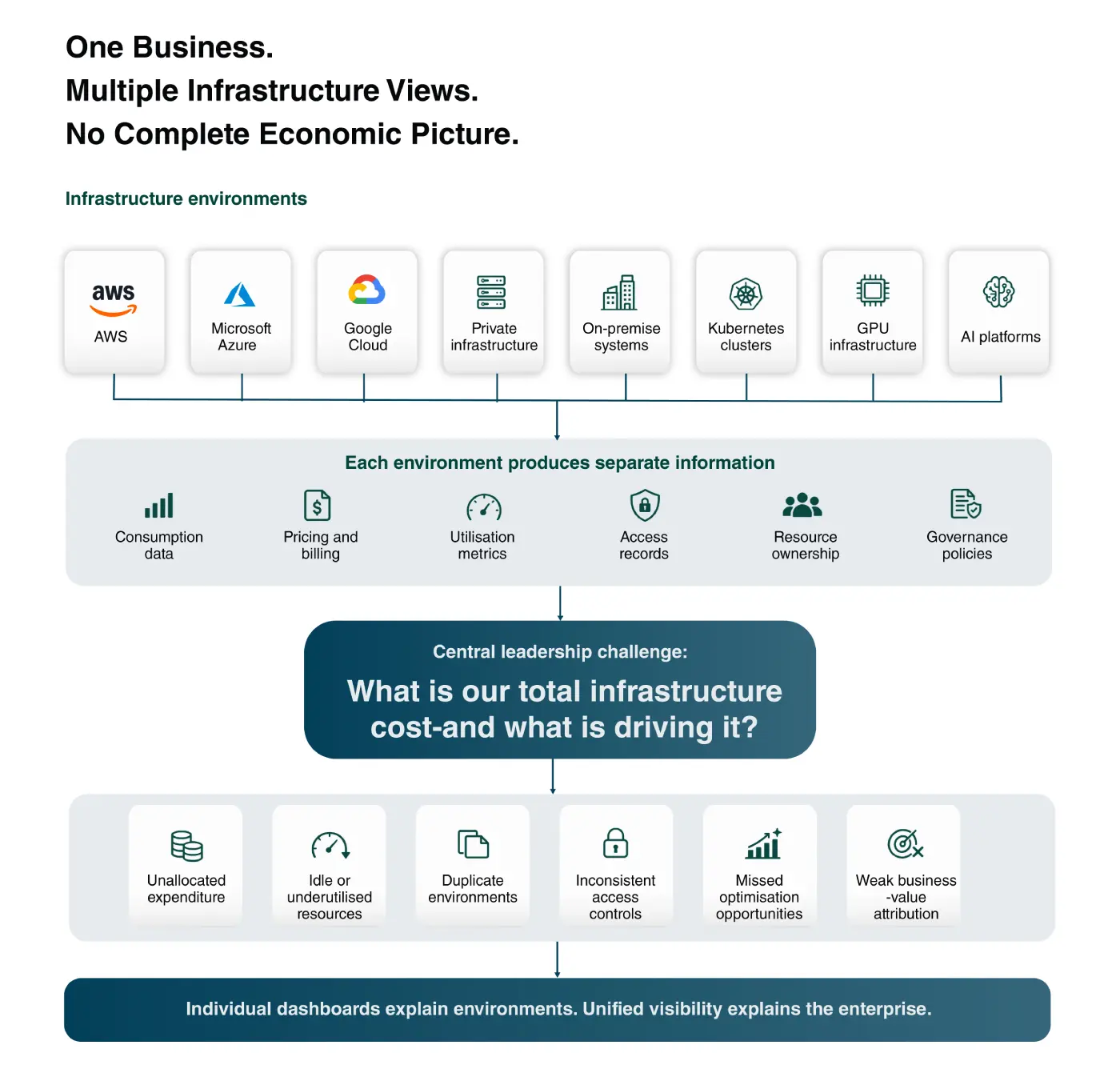
Public cloud, private infrastructure, Kubernetes, bare metal, GPU platforms and on-premise systems all have different operational characteristics.
As organisations grow across these environments, infrastructure information can become increasingly fragmented.
Provider dashboards and specialised infrastructure tools remain important, but each typically provides visibility within its own domain.
The challenge emerges when leadership and infrastructure teams need to understand the broader environment without manually reconciling multiple tools, spreadsheets and reports.
Flexera’s 2026 State of the Cloud research reports that 73% of organisations operate hybrid cloud estates. The same research identifies managing cloud spend as a leading challenge for organisations and estimates significant levels of wasted IaaS and PaaS expenditure.
The broader implication is clear: infrastructure complexity increasingly spans multiple environments, while organisations still need reliable visibility into what has been provisioned, who is using it and how effectively resources are being utilised.
Infrastructure Without Ownership Is Difficult to Govern
Visibility becomes more useful when infrastructure can be associated with an accountable owner.
Resources should, wherever practical, be connected to a business unit, project, application, environment or team.
Without clear ownership, it becomes more difficult to determine whether infrastructure is still required, whether capacity should be expanded or retired, or whether access remains appropriate.
This becomes especially important during rapid growth.
Development environments may remain active after projects have changed. GPU resources may remain allocated after experiments are complete. Kubernetes clusters may continue operating without clear ownership. Bare-metal infrastructure may remain provisioned even when workload requirements have moved elsewhere.
Clearer ownership allows infrastructure teams to ask a simple but important question:
Who is responsible for this resource, and is it still required?
That question becomes increasingly valuable as infrastructure estates grow.
AI Infrastructure Raises the Importance of Utilisation Visibility
GPU and AI environments make infrastructure visibility even more important because these resources are expensive, specialised and often shared between multiple workloads or teams.
AI workloads can also behave differently from traditional enterprise applications.
Training workloads may consume large amounts of GPU capacity for limited periods. Inference environments may require persistent capacity but experience variable utilisation. Development and experimentation environments can create temporary requirements that change quickly.
Technology teams therefore need visibility into questions such as:
- Which GPU resources are currently allocated?
- Which teams or workloads are using them?
- How effectively is the available capacity being utilised?
- Which resources are available for new workloads?
- Which environments are active, idle or awaiting decommissioning?
The objective is not necessarily to drive every GPU to continuous maximum utilisation.
The objective is to ensure that infrastructure teams can understand how expensive and scarce resources are being consumed and make informed operational decisions.
CtrlS GPU Private Cloud can provide dedicated AI infrastructure capacity, while Neutrino can support the development and operationalisation of enterprise AI applications.
As AI environments scale, the underlying infrastructure must remain visible, manageable and governable.
Governance Should Support Faster Infrastructure Consumption
Governance should not become another approval bottleneck.
The objective should be to make approved infrastructure easier and more predictable to consume while maintaining appropriate operational control.
Role-based access, standardised workflows, defined provisioning processes and auditability can help teams understand what infrastructure they can use, how they can request it and who remains responsible for it.
A well-defined operating model can also reduce dependence on manual coordination between infrastructure, platform and application teams.
Instead of every infrastructure request becoming a separate engineering exercise, organisations can establish repeatable processes for requesting, provisioning, operating and retiring infrastructure.
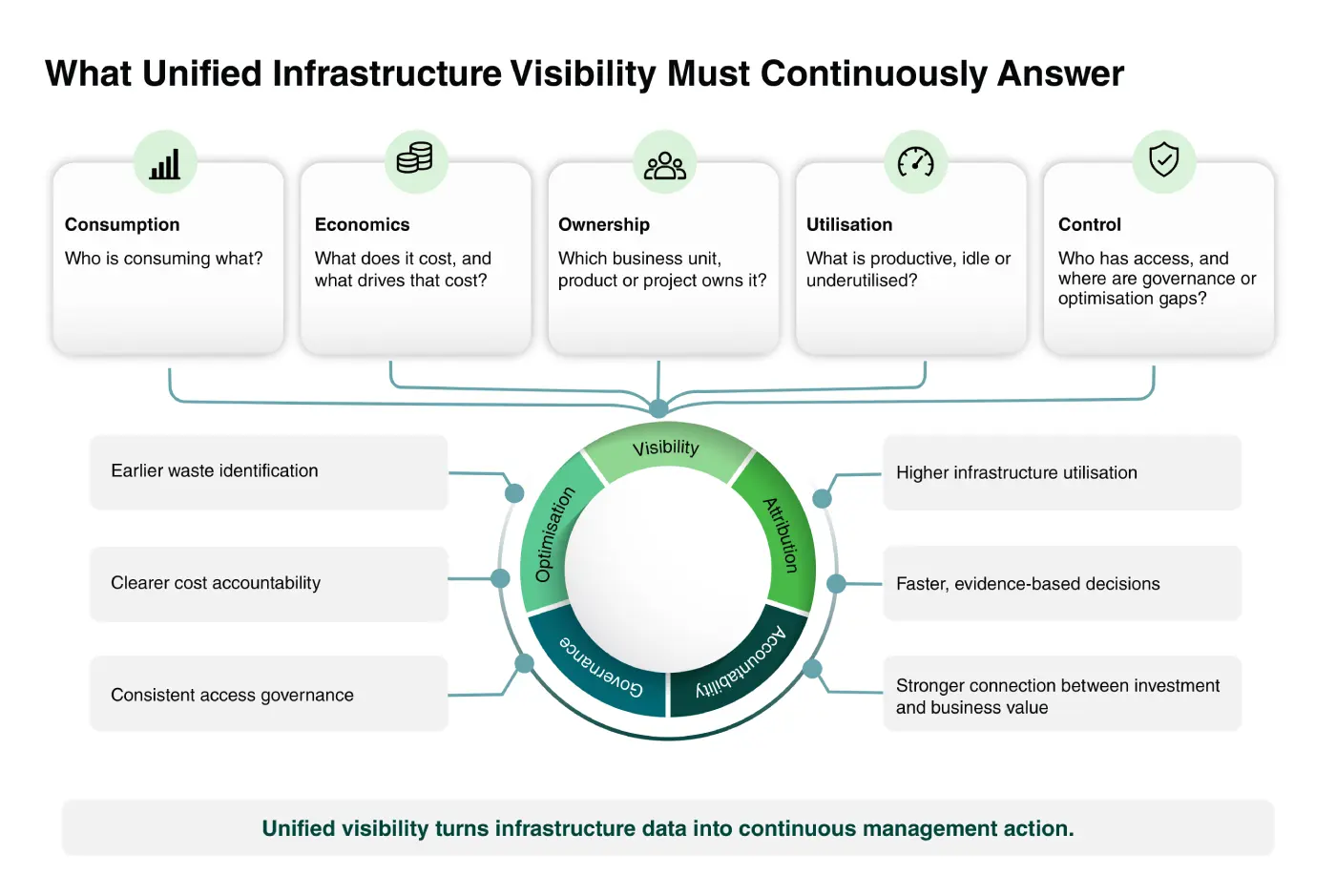
As the infrastructure estate expands, technology teams should continuously be able to answer five fundamental questions:
- Consumption: Who is consuming what?
- Utilisation: Which resources are active, idle or underutilised?
- Ownership: Which team, application or project owns the resource?
- Access: Who can access the environment?
- Operational status: What is provisioned, available, allocated or awaiting action?
Creating a Common Operating View Across Heterogeneous Infrastructure
Public cloud, private infrastructure, Kubernetes, bare metal, GPU platforms and on-premise systems will continue to coexist.
The objective is not to make every environment identical.
It is to give technology teams a more consistent way to understand and operate infrastructure as complexity increases.
CtrlS Accelerated Cloud Platform (ACP) is designed to provide a common orchestration, visibility and governance layer across heterogeneous infrastructure environments.
ACP brings infrastructure operations, Kubernetes, bare-metal and GPU environments into a common platform while supporting integration with broader cloud and enterprise environments.
This can help technology teams improve visibility into infrastructure capacity, utilisation, ownership and operational status while reducing dependence on fragmented tools and manually consolidated operational views.
The goal is not to force every workload onto a single infrastructure model.
It is to make heterogeneous infrastructure easier to operate, understand and govern as the organisation scales.
For a unicorn, the challenge is not simply building more infrastructure.
It is ensuring that visibility, accountability and operational control continue to scale with it.
Scaling infrastructure is one challenge. Maintaining visibility and control at scale is another.
Explore the CtrlS Accelerated Cloud Platform to understand how a common operational layer can support orchestration, visibility and governance across increasingly complex infrastructure environments.

Chetan Sonar, SVP – GPU Cloud & AI Orchestration, CtrlS Global
With over 21 years of experience across datacenters, cloud, managed services and AI infrastructure, he brings together deep technology expertise with business and operational leadership.
His current focus includes AI datacenter strategy, GPU cloud architecture, high-density infrastructure, AI/HPC orchestration, multi-tenant GPU platforms, performance engineering, TCO and pricing models, and the evolution of datacenters into AI factories. He is particularly interested in where engineering decisions become business decisions, connecting architecture, performance, automation, economics and customer experience.

 marketing@ctrls.in