
For a Neocloud, choosing a datacenter location is no longer simply about finding space for GPU servers. AI infrastructure has become a system-level deployment in which compute, power, cooling, network, storage, connectivity and physical infrastructure must scale together. A location that can accommodate GPU racks but cannot support the required power density, cooling architecture, network connectivity or expansion path can constrain the commercial value of the deployment.
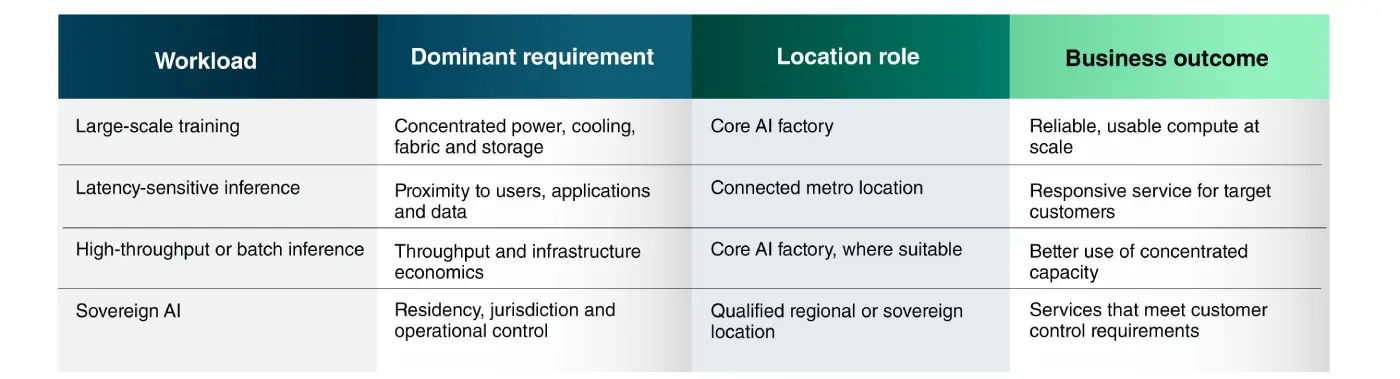
Training, inference and sovereign AI also place different demands on infrastructure. Large-scale training generally favours concentrated environments where power, cooling, storage and high-performance network fabrics can scale together. Latency-sensitive inference may benefit from being closer to users, applications and enterprise data. Sovereign workloads can introduce additional requirements around data residency, jurisdiction, access and operational control. The objective is therefore not to reproduce the same GPU footprint in every market. It is to give each location a defined role within the Neocloud infrastructure strategy.
GPU Availability Alone Does Not Make a Location AI-Ready
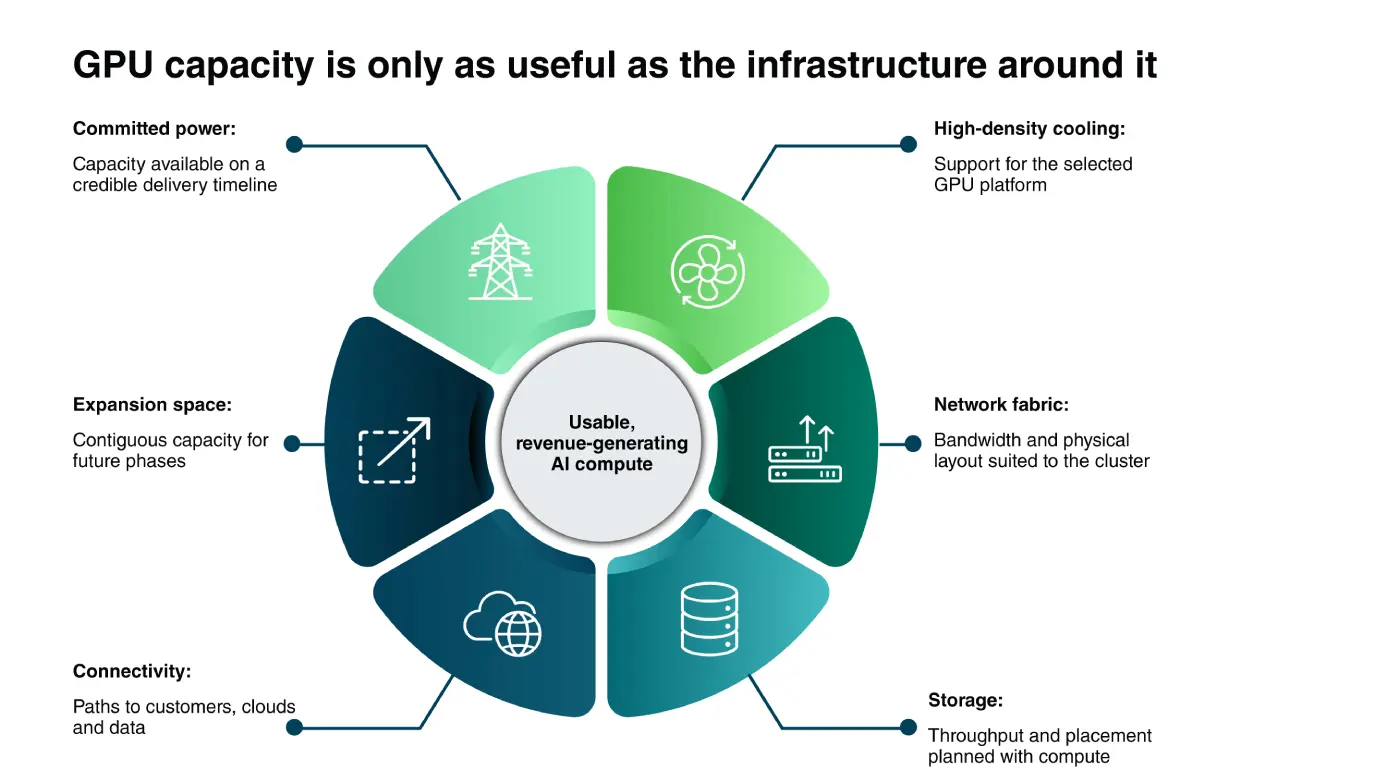
GPUs do not operate in isolation. Their effective performance depends on the infrastructure around them: power delivery, cooling, east-west networking, storage throughput, external connectivity and physical layout.
This becomes increasingly important as AI systems move from individual GPU servers towards rack-scale infrastructure. Modern systems such as NVIDIA GB300 NVL72 can require well above 100 kW per rack and depend on liquid cooling and high-performance network fabrics.
For a neocloud, site selection must account for more than available space for GPU servers. The location needs enough power, cooling, network capacity and room to expand to support the AI workloads planned for it. A poorly matched facility can restrict expansion, complicate fabric design, create cooling limitations or delay the commissioning of expensive GPU assets.
A GPU becomes commercially productive only when the datacenter infrastructure around it supports the workload it is intended to serve.
For an AI Factory, Location Strategy Begins with Megawatts
Traditional colocation discussions often begin with rack counts. Large AI deployments increasingly need to begin with power. A Neocloud planning hundreds or thousands of GPUs needs to understand not only what power is available today, but also what can be committed for future phases.
A 1 MW deployment can become 5 MW or 10 MW as customer demand grows. The site therefore needs a credible expansion path without forcing the operator to redesign or relocate the cluster every time capacity increases.
The key questions include:
- How much utility power is available and when can it be delivered?
- Can capacity expand in contiguous phases?
- What rack densities can the facility sustain?
- Can it support the required liquid-cooling architecture?
- Is there space for future GPU, network and storage expansion?
- Can connectivity scale alongside compute capacity?
For a Neocloud, time-to-power becomes time-to-revenue.
Large-Scale Training Favours Concentrated Infrastructure
Large training workloads require many accelerators to operate as one computational system. That means GPU performance alone is not enough. Training depends on high-bandwidth east-west networking, high-performance storage, consistent server configurations, sustained power and effective cooling.
Weakness in any one of these layers can reduce effective cluster output. Training-oriented locations should therefore prioritise concentrated scale: contiguous high-density space, large power blocks, liquid cooling, predictable network topology and room for storage and fabric expansion.
Physical layout also matters. Cluster expansion across distant halls can increase fiber paths, optics requirements, cabling complexity and operational effort. Where possible, large AI factories should be designed with planned expansion zones from the beginning.
The commercial metric is not simply installed GPU count. It is the amount of reliable, usable compute that the complete AI factory can deliver.
Training Capacity and Colocation Must Be Designed Together
For a Neocloud, the colocation provider becomes part of the AI infrastructure architecture. A training location should therefore be qualified across several dimensions.
- Power and electrical infrastructure: The site should provide committed power with a credible delivery timeline and a roadmap for future expansion.
- High-density cooling: The facility should support the cooling architecture required by the selected GPU platform, including direct-to-chip liquid cooling where necessary.
- Cluster layout: Rack placement, fibre pathways, cable distances, switch locations and expansion zones should be considered together with the logical fabric design.
- Storage placement: High-performance storage requires its own power, space and network connectivity and should be planned together with the GPU cluster.
- Deployment operations: Staging, equipment movement, installation support, secure access and remote hands can materially affect deployment velocity.
At Neocloud scale, operational readiness is part of time-to-market.
Inference Has a Different Location Equation
Inference does not have one deployment model. Some workloads require very low response latency. Others prioritise throughput and infrastructure economics. Latency-sensitive inference may benefit from proximity to users, enterprise applications, databases, vector stores, customer networks and cloud environments.
For these workloads, a well-connected metro datacenter can be strategically valuable even if it does not host the Neocloud’s largest GPU cluster. Important considerations include carrier diversity, cloud connectivity, private interconnects, route quality and latency to target customers.
However, not all inference needs to be distributed. High-throughput, batch or less latency-sensitive inference can remain concentrated in larger AI factories where infrastructure economics are more favourable.
Large-scale training tends to favour concentrated infrastructure. Latency-sensitive inference may benefit from placement closer to users, applications and data.
Data Gravity and Sovereignty Influence Placement
Enterprise data cannot always be moved freely or efficiently. Large datasets may sit across private datacenters, public clouds, databases and regulated environments. Moving them repeatedly to distant GPU clusters can introduce network cost, transfer time, security dependencies and operational complexity.
In some cases, placing selected GPU capacity closer to the data may be more efficient than continuously moving the data towards compute. Sovereign AI introduces additional requirements. Depending on the customer and jurisdiction, these may include where data and models are stored, where processing occurs, who administers the environment and which legal jurisdiction governs it.
A centralized AI factory may therefore be technically efficient but unsuitable for every regulated or nationally sensitive workload.
Every Location Should Have a Defined Role
A mature Neocloud does not need identical GPU infrastructure in every datacenter.
- Core AI factories can provide concentrated power, liquid cooling and large-scale cluster capacity for training, fine-tuning and high-throughput inference.
- Metro locations can position inference closer to enterprise applications, users and network ecosystems.
- Regional or sovereign locations can support data-residency, jurisdictional and regulatory requirements.
These roles are not rigid. Large AI factories can run inference, and metro sites can run smaller training environments. The purpose is simply to place infrastructure according to the dominant technical and commercial requirements of the workload.
What Neoclouds Should Expect from an AI Colocation Provider
Neoclouds should evaluate colocation providers on more than rack availability.
The key criteria include:
- Credible utility power and committed delivery timelines
- Multi-megawatt expansion capability
- High-density electrical infrastructure
- Liquid-cooling readiness
- Contiguous capacity for cluster growth
- Carrier, internet and private-connectivity options
- Appropriate fibre pathways and physical topology
- Electrical, mechanical and network resilience
- Physical security and compliance
- Remote hands and operational support
- Fast deployment and commissioning capability
These capabilities determine whether a datacenter can simply host GPU equipment or genuinely support an AI factory.
CtrlS: Building the Datacenter Foundation for AI Factories
CtrlS provides the datacenter foundation required for increasingly dense AI and cloud deployments through scalable power infrastructure, high-density environments, liquid-cooling capabilities, connectivity and operational support across its datacenter footprint.
For Neocloud operators, the objective should not be to treat every datacenter as interchangeable. Locations should be selected according to workload requirements, available power, network proximity, regulatory needs and future expansion plans.
A training cluster may prioritise concentrated megawatts, liquid cooling and contiguous capacity. An inference deployment may prioritise connectivity and proximity to customers, applications and data. A sovereign AI environment may prioritise jurisdiction, security and operational control.
For a neocloud, an AI factory’s location strategy starts with the power, cooling and connectivity needed to run and expand its workloads. Large-scale training belongs where that infrastructure can scale. Latency-sensitive inference may need to sit closer to applications, users and data, while sovereign workloads must meet jurisdictional and control requirements. Each location should serve a defined purpose and have a datacenter foundation that can support future growth.

Chetan Sonar, SVP – GPU Cloud & AI Orchestration, CtrlS Global
With over 21 years of experience across datacenters, cloud, managed services and AI infrastructure, he brings together deep technology expertise with business and operational leadership.
His current focus includes AI datacenter strategy, GPU cloud architecture, high-density infrastructure, AI/HPC orchestration, multi-tenant GPU platforms, performance engineering, TCO and pricing models, and the evolution of datacenters into AI factories. He is particularly interested in where engineering decisions become business decisions, connecting architecture, performance, automation, economics and customer experience.

 marketing@ctrls.in