
India’s enterprises have more choices about where to place AI infrastructure than they did even a few years ago. That makes the decision harder, not easier. The right location is not automatically India’s largest datacenter market, the closest facility or the city offering the lowest colocation price. AI infrastructure should sit where the workload’s applications, data, users and operating requirements align with available power, connectivity and expansion capacity. For CIOs, location is therefore a workload-placement decision before it becomes a datacenter decision.
India’s expanding datacenter market creates choice, not an obvious answer
According to Wood Mackenzie, India’s operational datacenter capacity stood at 2.2 GW in 2025 and is projected to reach 12 GW by 2030. AI-dedicated capacity is expected to expand nearly 24-fold over the same period, rising from 275 MW to 6,546 MW, as hyperscale cloud providers, enterprise digitalisation and artificial intelligence accelerate demand for compute infrastructure.
More capacity gives enterprises greater geographic choice. It does not tell them where an AI environment should run. Market size indicates ecosystem maturity and available infrastructure, but workload performance depends on a different set of relationships: where enterprise data sits, where applications run, where users make requests, how workloads access cloud platforms and how much infrastructure they will require as they scale.
The decision should therefore start with the workload, not the city.
Training, development and inference do not belong in the same location by default
Different AI workloads create different placement priorities. Large-scale training and fine-tuning place heavy demands on GPU density, power, cooling, storage throughput and east-west network performance. AI development environments must stay efficiently connected with enterprise data, cloud services and engineering workflows. Production inference can put greater emphasis on response time, depending on how applications and users consume the model.
The infrastructure implications are becoming harder to ignore. The IEA expects global datacenter electricity consumption to rise from 485 TWh in 2025 to about 950 TWh by 2030. Electricity consumption from AI-focused datacenters is projected to triple during that period. Accelerated-server electricity consumption is projected to grow by about 30% annually in the IEA’s base case.
These figures do not simply prove that AI consumes more power. They change how enterprises should evaluate location. Capacity available today matters. Capacity available for the next GPU deployment matters more.
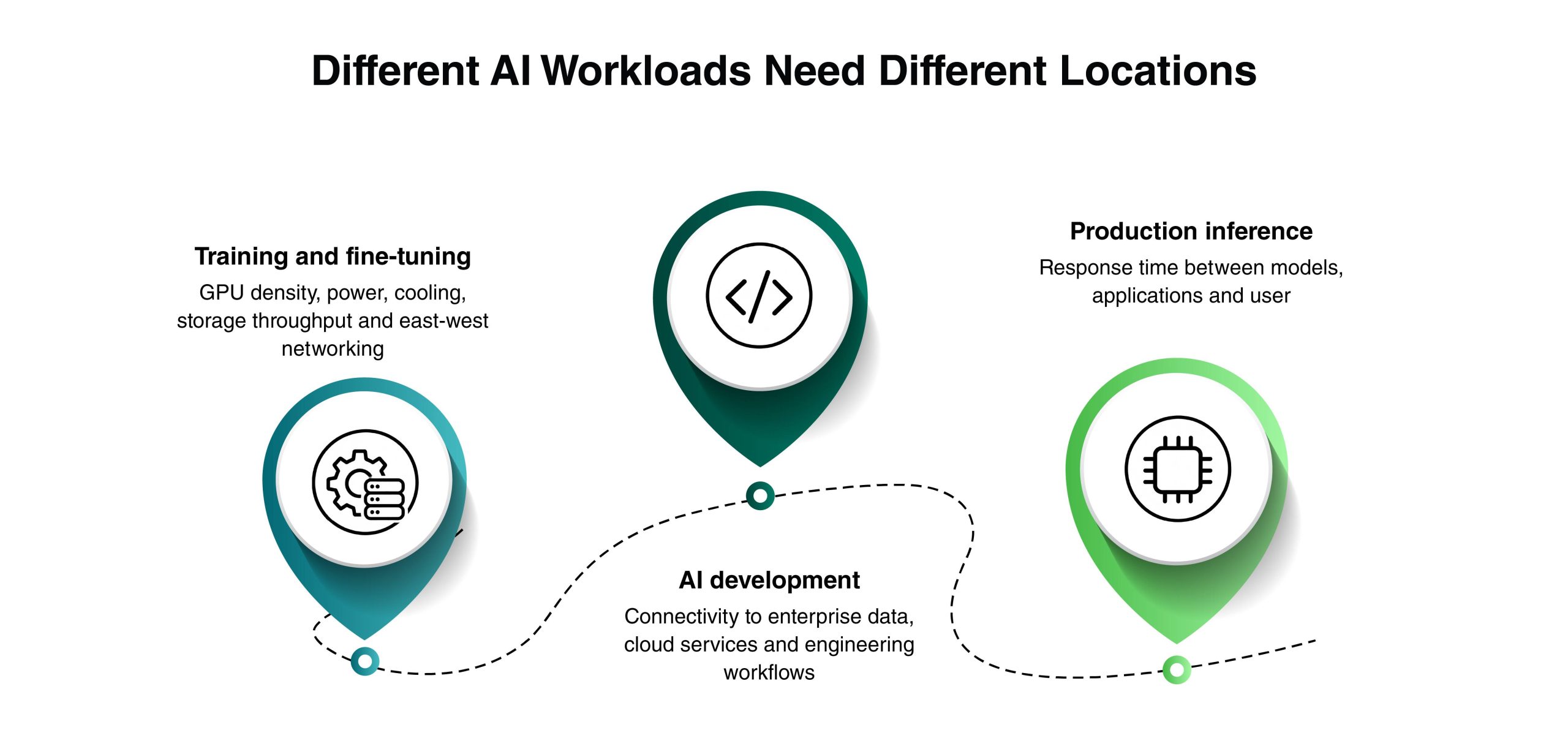
The correct location for AI is determined by what the workload needs to connect to and what it will need to become.
Proximity matters only when it improves a measurable workload path
Physical distance alone is a weak basis for placement. Enterprises need to measure the path between AI infrastructure and the systems consuming it.
Consider Microsoft’s published Azure network measurements. It shows approximately 20 milliseconds of round-trip latency between Central India and South India, around 29 milliseconds between Central India and Jio India West, and roughly 41 milliseconds between Jio India West and South India. These are Azure-network measurements rather than universal enterprise-network benchmarks, but they demonstrate that location produces measurable differences even within India.
CIOs should therefore test each candidate location against the workload’s actual dependencies:
- Application path: Measure latency between the AI environment and the applications, APIs and databases exchanging requests with it.
- Data path: Assess transfer volumes, bandwidth requirements and the cost of repeatedly moving training or inference data between locations.
- Cloud path: Evaluate connectivity to the cloud regions and services that remain part of the enterprise architecture.
- User path: Determine whether reduced response time creates a material application or customer-experience benefit.
The objective is not to minimise kilometres. It is to remove infrastructure distance where that distance creates cost or performance penalties.
A strong network location still fails if the facility cannot support the AI roadmap
Once a viable geographic location is identified, the decision must move from city to facility. A well-connected site has limited value if the required GPU environment cannot be commissioned when the business needs it.
Power availability deserves particular scrutiny. The IEA notes that datacenters can become operational within two to three years, while wider energy infrastructure often requires substantially longer planning and construction cycles. An enterprise therefore needs evidence not only of current capacity, but of when subsequent expansion blocks can actually be energised.
The same discipline applies to rack density and cooling. And the relevant question, is not whether a provider has an AI-ready facility somewhere. It is whether the chosen facility supports the configuration, connectivity and expansion schedule required by the workload. CtrlS states that its Chennai Datacenter Park supports high-density GPU deployments, alongside rear-door heat exchangers, direct-to-chip and immersion cooling.
Available MW in a market is less useful than available MW for the enterprise, on the date it needs it.
The cheapest facility can become the most expensive workload location
Colocation price alone gives CIOs an incomplete economic comparison. AI location decisions affect connectivity, cloud access, data movement, operations, expansion and potentially application performance. These costs persist long after the first rack is commissioned.
A lower-priced facility can lose its advantage if large datasets must constantly move between cities, additional network circuits are required or a future GPU expansion forces another deployment. Conversely, paying more for infrastructure closer to critical systems creates little value when the workload is insensitive to latency.
The lowest facility price therefore does not necessarily produce the lowest workload cost.
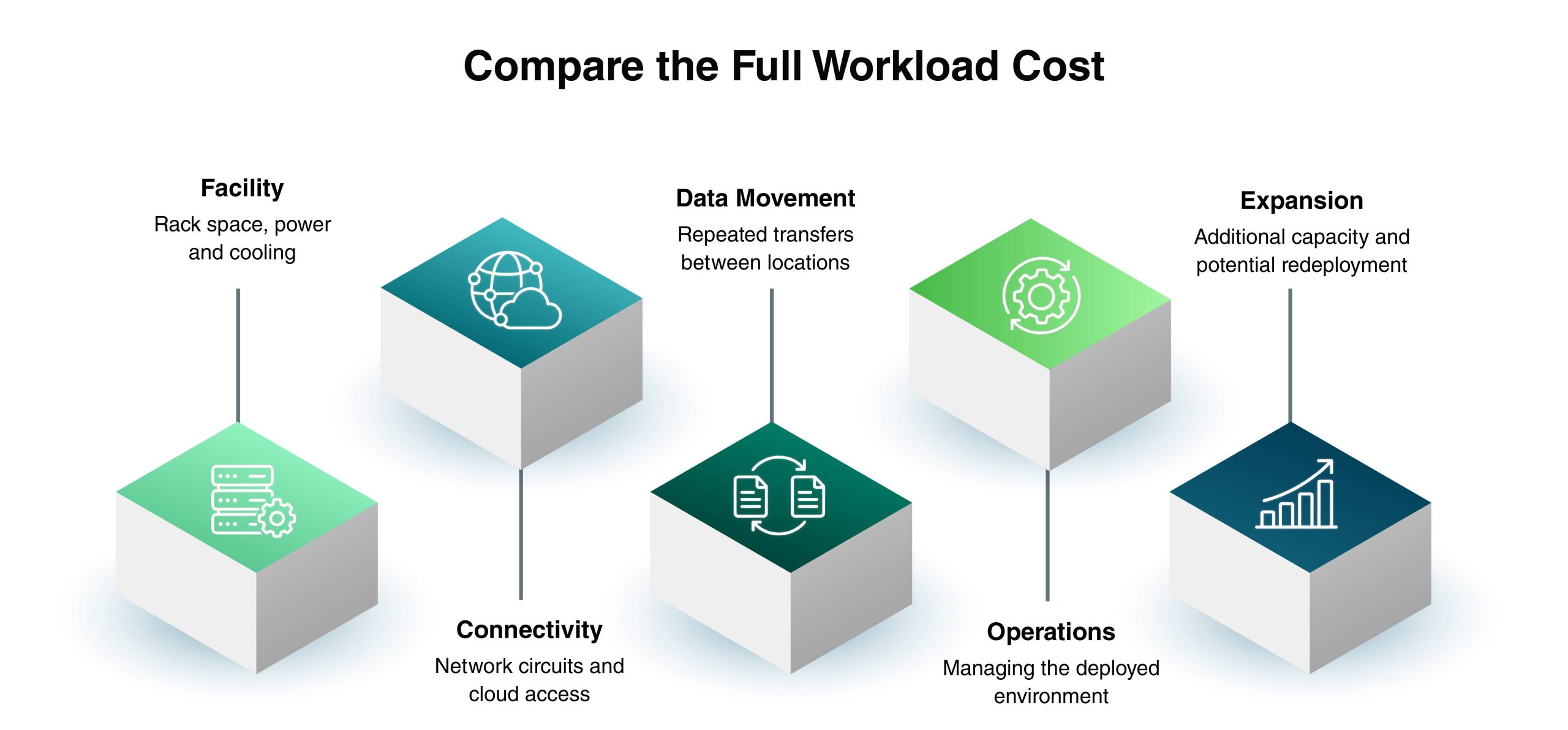
CIOs should place each AI workload where its economics and dependencies converge
Enterprises do not need one universal Indian location for AI. Training infrastructure may favour a market with large power blocks, high-density support and long-term expansion capacity. Production inference may sit closer to critical applications or customers. Development environments may follow existing engineering, data and cloud architecture. Resilience requirements may justify capacity in another geographic market.
CtrlS’ role in that decision is to help enterprises test these requirements across suitable Indian facilities, using evidence on power, cooling, density, connectivity and capacity rather than a generic footprint argument.

Nikhil Rijhwani, Vice President – Sales and City CEO, CtrlS Datacenters
with over 20 years of experience growing digital infrastructure businesses in India. He leads sales and cross-functional teams serving hyperscalers, neoclouds, enterprises and government institutions. His expertise spans datacenter economics, capacity monetization and strategic partnerships. Through business transformation, he helps build scalable infrastructure that supports India’s digital economy.

 marketing@ctrls.in