
Summarize with:
read in < 1 min
Neocloud capacity is typically discussed through megawatts of power, GPU counts and infrastructure scale. These measures establish the size of a deployment but reveal little about the useful AI output it can deliver. Two facilities with comparable electrical capacity and GPU configurations can deliver different levels of training or inference performance. As AI infrastructure investments grow, Neoclouds need to evaluate capacity through another dimension: how much productive compute their infrastructure delivers for every megawatt consumed.
The distinction matters as AI drives unprecedented demand for electrical infrastructure. The International Energy Agency’s 2026 outlook projects global datacentre electricity consumption to increase from 485 TWh in 2025 to 950 TWh by 2030. Electricity consumption from AI-focused datacentres is expected to triple. Securing power remains fundamental to expansion, but using that power productively is becoming equally important.
Installed GPUs and Megawatts Cannot Establish Productive AI Capacity
Power availability determines the electrical infrastructure a Neocloud can deploy, while GPU counts indicate its installed accelerator resources. Neither establishes the volume of useful work completed. GPU utilisation provides another perspective but can remain high even when communication delays, memory constraints or inefficient software limit actual throughput. Understanding productive capacity requires measuring completed AI work rather than relying on the operational activity of individual components.
Facility efficiency introduces another measurement boundary. Power Usage Effectiveness (PUE) measures total facility energy consumption relative to IT equipment energy consumption. The Uptime Institute’s 2025 Global Data Center Survey reported a weighted-average PUE of 1.54. However, PUE does not measure the efficiency of computing equipment or the useful work produced. A facility can improve its PUE by reducing cooling and electrical overheads, while the GPUs deliver the same workload throughput. PUE alone cannot establish how efficiently those GPUs complete an AI task.
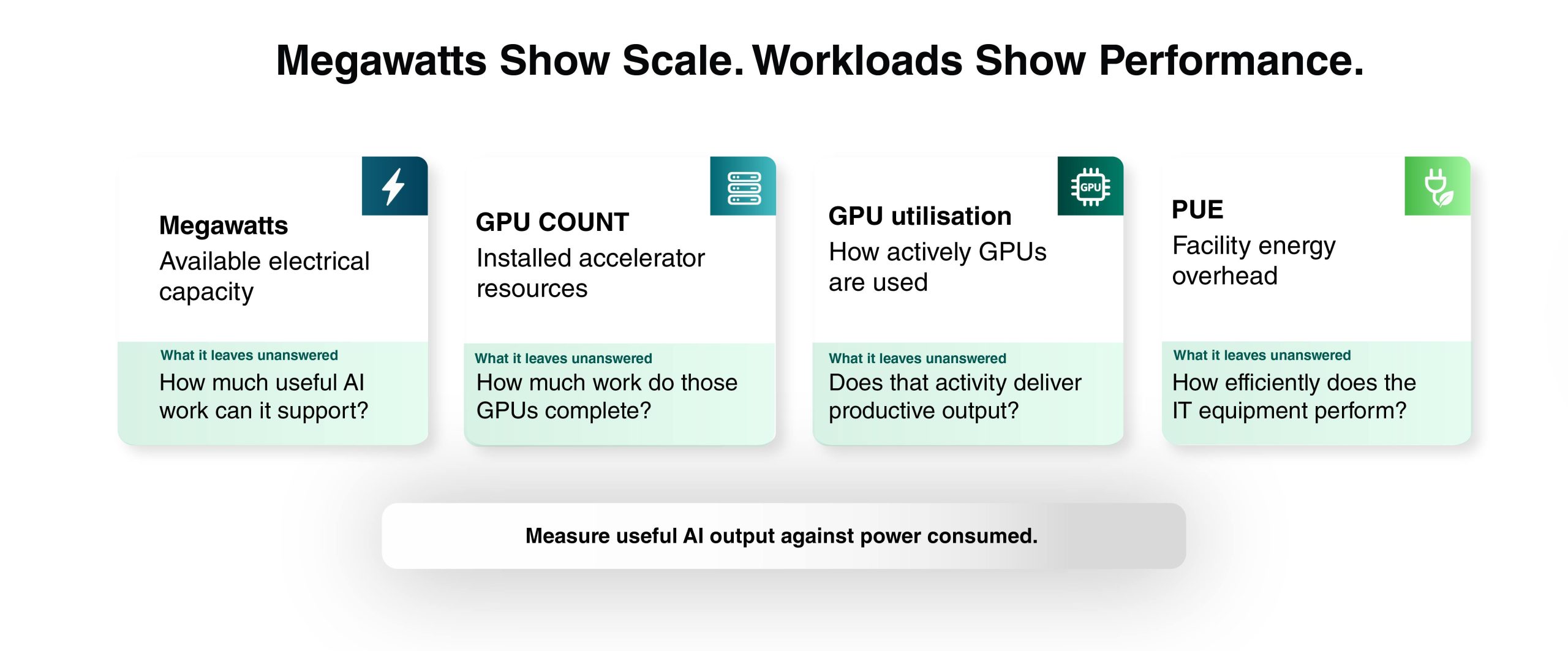
Infrastructure capacity establishes what can be deployed. Productive compute establishes what that deployment can deliver.
Measure How Much AI Work Each Megawatt Delivers
A more complete capacity assessment must relate useful workload performance to the power consumed across a defined infrastructure boundary. For AI training, relevant measurements include time to reach a specified model-quality target and total energy consumed. For inference, they include completed requests or generated tokens within defined latency and quality requirements. These measures establish whether improvements in energy efficiency translate into meaningful workload performance.
The distinction between power and energy is equally important. Compute per megawatt relates sustained workload throughput to average power consumption, while compute per unit of energy measures completed work against electricity consumed. Both require consistent workload configurations and measurement boundaries.
For practical evaluation, training performance can be assessed through tokens processed per second, time to complete a defined training run and energy consumed to reach a specified model-quality target. Inference performance can be assessed through generated tokens per second, requests processed within defined latency thresholds and energy consumed per unit of useful output.
Metrics such as tokens per kilowatt-hour or completed requests per kilowatt-hour can provide additional visibility into energy efficiency. However, these measurements must be interpreted alongside throughput, latency, model quality and service-level requirements. A higher output-per-energy ratio is meaningful only when the quality and performance of the delivered workload remain comparable.
Power and Cooling Determine Sustainable GPU Capacity
Productive GPU capacity depends on electrical infrastructure capable of supporting sustained operating loads. Power distribution, equipment limits and protection systems determine how accelerators can operate under changing workload conditions. GPU power management can improve efficiency in certain configurations, but reducing consumption may also affect throughput. Neoclouds must therefore evaluate performance gains against actual energy savings.
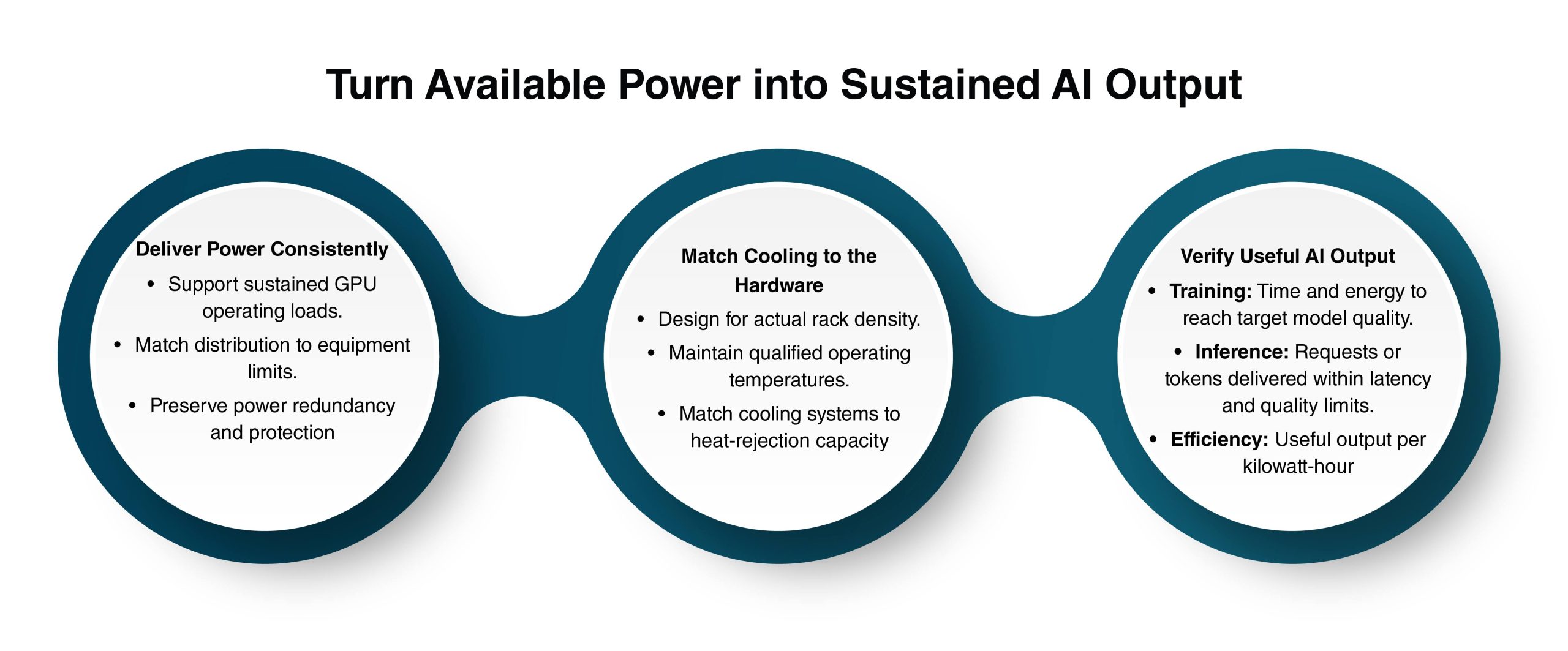
Cooling capacity is equally important because accelerator performance depends on maintaining qualified thermal conditions. Higher rack densities require cooling systems designed around actual equipment specifications, heat loads and operating temperatures. Liquid cooling can support high-density deployments, but its effectiveness depends on equipment compatibility, coolant temperatures and heat-rejection infrastructure. ASHRAE’s datacentre guidance reinforces the need to align facility cooling conditions with IT equipment requirements.
Cooling architecture must also reflect the specific GPU platform and its thermal characteristics. Direct-to-chip liquid cooling, immersion cooling, rear-door heat exchangers and conventional air cooling offer different approaches to managing heat. The appropriate choice depends on rack power density, hardware qualification, coolant requirements, operating conditions and the facility’s heat-rejection capabilities. No single cooling architecture is universally optimal across all AI workloads.
Improving efficiency must not compromise reliability and adding more GPUs must not compromise power redundancy, thermal headroom or equipment protection. The objective is to improve sustained workload performance within qualified operating conditions.
Networking, Storage and Software: The Hidden Determinants of GPU Productivity
Power and cooling establish the conditions in which GPUs can operate, but the infrastructure supporting them determines how effectively their processing capabilities are utilised. Networking, storage and software can become significant bottlenecks, particularly in large-scale distributed AI training and inference environments.
High-speed networking is essential for communication between GPUs distributed across servers and racks. Network congestion, communication latency and insufficient interconnect bandwidth can increase synchronisation overheads and leave accelerators waiting for data from other GPUs. In distributed training environments, these delays can affect overall cluster throughput even when individual GPUs report high utilisation.
Storage infrastructure plays an equally important role in delivering datasets, model parameters and checkpoints at the required speed. Insufficient storage throughput, high input/output latency or inefficient data pipelines can prevent GPUs from receiving data quickly enough to sustain productive operation. Checkpointing and data-loading overheads can further reduce effective workload throughput.
Software orchestration, GPU scheduling, memory management and workload optimisation also influence how much useful output is delivered by installed accelerators. Efficient parallelisation and resource allocation can improve sustained performance without necessarily increasing the electrical capacity of the deployment.
Consequently, improving compute per megawatt requires looking beyond the datacentre facility and GPU specifications. It requires evaluating the complete infrastructure stack, from power delivery and cooling to networking, storage and software orchestration.
Neoclouds and Datacentre Partners Must Validate Efficiency Through Shared Measurements
Compute-per-megawatt assessments require coordination across infrastructure ownership boundaries. Datacentre partners manage the facility systems supporting power delivery, cooling and operational resilience. Neoclouds manage accelerator configurations, networking, storage, software and workload performance. Neither party independently controls every factor influencing useful AI output.
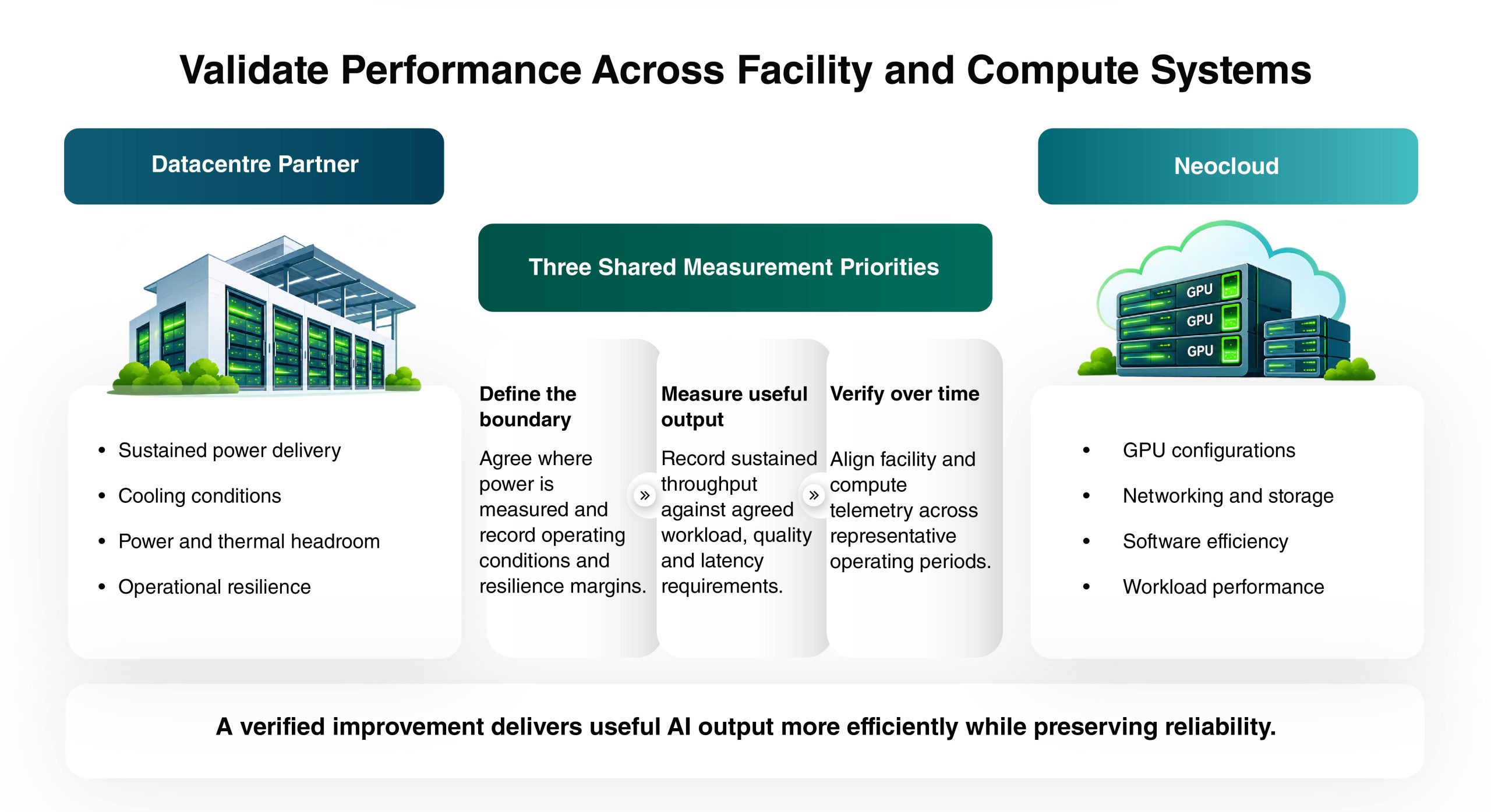
A credible assessment requires agreement on three measurement priorities:
- Power and operating conditions: Establish the measurement boundary, energy consumption, rack-level power, cooling conditions and required resilience margins.
- Workload performance: Record sustained training or inference throughput against defined workload configurations, quality requirements and service levels.
- Operational consistency: Compare results over representative operating periods using aligned telemetry from facility and computing systems.
These measurements help both parties distinguish verified performance improvements from theoretical equipment specifications. They also provide a stronger basis for evaluating new hardware configurations, infrastructure upgrades and expansion requirements.
Plan India’s AI Capacity Around Workload Performance
For Neoclouds expanding in India, compute efficiency must become part of broader infrastructure economics. Electricity prices, power availability, local climate and water constraints influence deployment decisions across markets. Cooling choices must balance sustained rack performance with energy and water consumption. Phased expansion also requires electrical and mechanical infrastructure that can accommodate changing accelerator densities.
India’s operating environment makes this balance particularly important. High ambient temperatures and seasonal variations influence cooling-system design and heat-rejection requirements. Water availability and consumption must also be considered when evaluating cooling architectures, particularly in regions facing water stress. The objective should be to optimise overall resource efficiency rather than focusing exclusively on electrical efficiency.
The commercial objective is not to maximise a single efficiency ratio. It is to deploy infrastructure that delivers reliable workload performance at sustainable operating costs while preserving expansion flexibility.
Building for the Next Generation of Productive AI Capacity
At CtrlS, we help Neocloud companies turn their GPU investments into productive capacity by engineering power delivery and cooling around their deployment requirements. Our cooling approach matches rack density, qualified hardware and thermal requirements, with direct-to-chip and immersion options for demanding configurations. This ensures companies can choose the right cooling solution without compromising the workload performance. We support this foundation with a 99.995% uptime SLA across our Rated-4 facilities.
For Indian deployments, we address high ambient temperatures through cooling designs specified for 45°C conditions, with design PUE as low as 1.2 – 1.35 (designed).
As Neocloud infrastructure evolves, we will continue aligning power, cooling and operational design with the demands of successive GPU generations. Our priority is to help Neocloud players turn infrastructure investment into sustained AI output, with performance validated jointly and efficiency assessed under real operating conditions.

Vipul Kumar, Senior Vice President – Edge & Network Business, CtrlS Datacenters
Vipul is a seasoned telecom and datacenter leader with over two decades of rich experience spanning submarine cable systems, edge datacenters, and network infrastructure ecosystems. He is passionate about building sustainable, compliant, and scalable digital infrastructure that empowers regional enterprises, SMEs, and hyperscale players alike. As Senior Vice President – Edge & Network Business at CtrlS, he leads initiatives that bridge connectivity and compute — from fiber and network deployments to strategic partnerships and business development, building the network foundation and ecosystem partnerships that power CtrlS’s pan-India edge datacenter expansion.

 marketing@ctrls.in