
Summarize with:
read in < 1 min
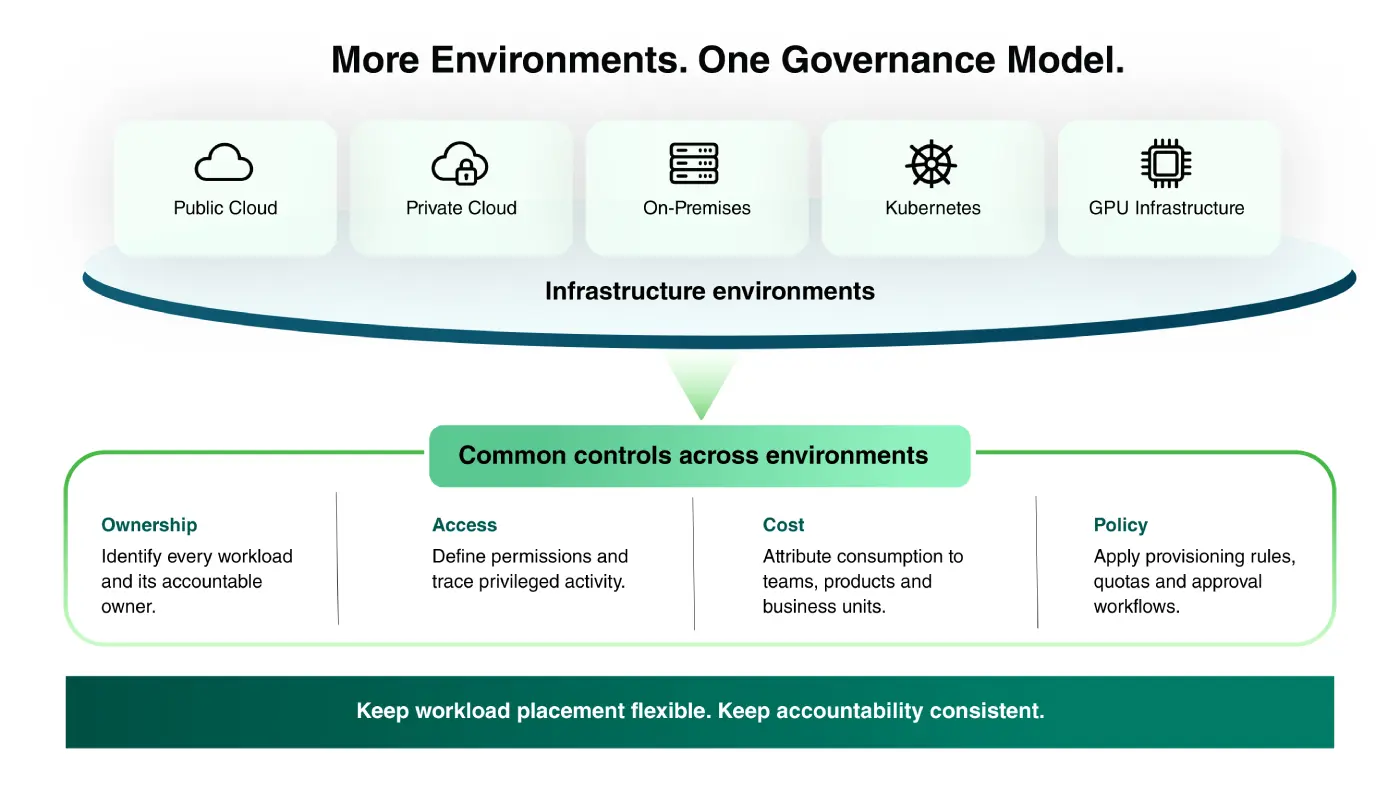
Fast-growing companies add infrastructure as their needs change. Product teams adopt public cloud services, established applications stay on private infrastructure, and AI teams bring in GPU capacity. Each choice can make sense on its own. The business risk emerges when leaders can no longer see what they operate, who owns it, what it costs or which policies apply. Businesses can preserve workload placement flexibility by governing infrastructure through a common operating model.
Growth Spreads Infrastructure Across More Environments
Flexera’s 2026 State of the Cloud Report found that 73% of surveyed organisations operated hybrid environments. For leaders, the implication is that governance must accommodate new environments as the business adds them. Flexera Website
Soonicorns can set common rules while their infrastructure choices are still taking shape. Separate cloud accounts, developer environments and early GPU deployments are the places to establish ownership, access and provisioning standards. Unicorns face a different task. They must apply those standards across existing clouds, business units, product teams and contracts. Their first priority is to reconcile what they already operate and establish who can make decisions across it.
Fragmented Visibility Makes Accountability Harder
Each environment can be well managed while the business struggles to account for the estate as a whole. Monitoring systems capture different signals, access models assign permissions differently, and operating procedures vary by team. Native tools offer depth within each environment. Leadership needs a view across them to establish whether it can locate every workload, trace privileged access and verify that teams apply common policies consistently.
Billing illustrates the same problem. The FinOps Foundation’s FOCUS specification standardises cost and usage data to support allocation, forecasting and reconciliation. A shared format makes charges easier to compare, but the business still needs to assign each cost to a team or product. CtrlS ACP supports that operating discipline through utilisation tracking, budgets, cost allocation and chargeback or showback, giving finance and infrastructure teams a common view of consumption across supported environments.
Cost Visibility Should Guide Workload Placement
Attributing spend changes the decisions leaders can make about where workloads run. They can assess which applications benefit from public cloud flexibility, which warrant private infrastructure, and where idle capacity can absorb new demand. That assessment needs spending trends by workload, actual utilisation and service requirements. A rising bill can reflect higher customer demand, inefficient resource use or capacity held for a justified resilience requirement. Each calls for a different decision.
Flexera found that 85% of respondents identified managing cloud spend as a leading challenge. Respondents estimated cloud waste at 29%. For a growing business, the practical question is which costs are rising fastest and whether demand or service needs explain the increase. Flexera Website
AI Makes Capacity Allocation A Governance Decision
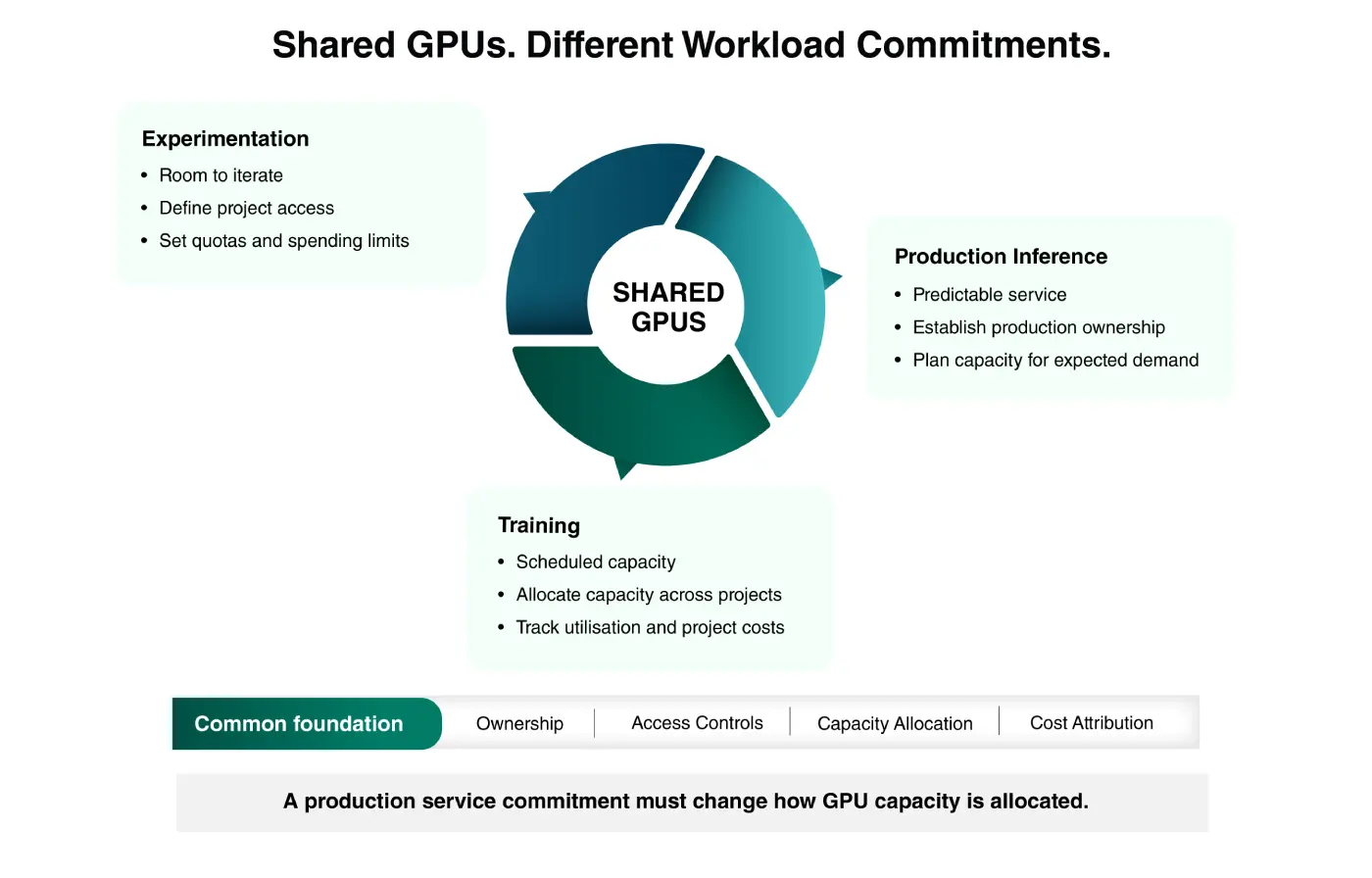
Shared GPU capacity brings competing demands into the same operating environment. Experiments need room to iterate, training jobs need scheduled capacity, and production inference needs predictable service. In the FinOps Foundation’s 2026 survey, 98% of respondents reported managing AI or planning to. As AI enters the infrastructure budget, leaders must decide where GPU workloads run, who can access capacity, how projects receive allocations and how the business attributes costs. FinOps Website
The move into production tests whether those decisions hold up under real demand. Before a pilot becomes a service, teams must establish its production owner, approve access to infrastructure and data, and plan capacity for expected demand. CtrlS GPU Private Cloud addresses the need for private GPU capacity, while Neutrino supports enterprise AI adoption. ACP provides the shared infrastructure controls for provisioning, access, quotas and utilisation as teams move from experimentation to production.
An AI project’s claim on shared GPU capacity should change when it takes on a production service commitment.
Common Rules Must Carry Through to Action
A common operating model starts with knowing what exists, where it runs and who owns it. Governance establishes access, budget and policy requirements. Optimisation uses cost and utilisation data to prioritise changes against workload needs. Execution gives teams a consistent way to provision, resize or retire resources. Leaders can test whether these steps work together by asking for evidence in four areas.
- Inventory and ownership. Can teams locate workloads across environments and identify who owns each one and who has access?
- Cost and utilisation. Can finance compare costs across environments, attribute spend to teams or business units, and identify where costs are rising fastest? Can infrastructure teams distinguish idle resources from capacity deliberately held in reserve?
- Policy and provisioning. Can teams provision resources through a consistent workflow and verify that access rules and quotas are enforced across environments? Can they show who approved each exception?
- Cloud, GPU and AI governance. Can teams apply the same ownership, access and spending rules to cloud applications, shared GPU capacity and production AI workloads?
CtrlS ACP Pairs Common Controls with Operations
CtrlS ACP brings self-service provisioning and governance together across CtrlS infrastructure, customer environments and four public clouds. Its scope includes private cloud, Kubernetes, bare metal, on-premises systems and GPU environments. Teams can request supported resources through a common portal, while platform and security leaders use role-based access, tenant isolation, quotas and audit records to govern how those resources are consumed.
CtrlS delivers ACP with Managed Services, bringing ongoing infrastructure operations into the engagement. The first priority is to assess where common controls would improve the decisions the business already makes. Measure the share of spend assigned to owners, check which workloads lack usable utilisation data, and identify where provisioning bypasses approved workflows. Use that baseline to choose the first environments and workflows to bring under common governance before approving the next major capacity commitment.
Explore CtrlS ACP · Request Your Visibility & Governance Assessment

Manzar Saiyed, Vice President - Service Delivery, CtrlS Datacenters
With over 15 years of rich experience in project and program management, Manzar has been instrumental in planning and executing mid to large size complex initiatives across different technologies and geographies. At CtrlS, he is responsible for solutioning and bidding for large system integration projects across emerging markets.

 marketing@ctrls.in