
Introduction: Hyperscalers Move Fast—Their Infrastructure Must Keep Pace
AI models are doubling compute demand every six months. Yet most data centers still take 18–24 months to go live. For hyperscalers, that lag isn’t just inefficiency—it’s lost revenue, missed SLAs, and delayed AI rollouts.
Traditional data center (DC) planning, which often unfolds over 18 to 24 months, no longer works. The stakes are too high: without AI-ready infrastructure, slow-moving deployments leads to deferred AI rollouts, missed SLAs, and stunted edge expansions.
This article explores why legacy planning models fail and proposes a modern, accelerated planning paradigm designed for hyperscalers – one that drives faster go-to-market.
The Speed Mismatch: Traditional DC Planning vs Hyperscaler Velocity
Traditional DC planning unfolds with meticulous detail, in sequential, waterfall style – often spanning over 18 to 24 months. It moves at a glacial pace compared to the pace at which hyperscalers now operate. The tech landscape—fueled by AI, machine learning, and data at scale—demands infrastructure ready in 6 to 12 months, not years.
Gartner projects global spending on data center systems will grow 42.4% in 2025, the fastest-growing IT sector, largely driven by demand for AI-optimized servers and infrastructure. Hyperscalers, who are among the top investors, must be ready to deploy infrastructure faster than ever before.
Why Traditional Timelines Break—And What Do Hyperscalers Need Instead
A. Scale & Complexity
Hyperscalers deploy hundreds of megawatts of power and manage vast server fleets, often across multiple regions. Traditional sequential planning processes break under this weight. The scale demands parallel execution across design, build, and deployment phases.
Solution: Modular data center designs and concurrent project workflows allow faster time to market. Each module or unit is pre-designed, enabling quick scaling across multiple sites. This enables agility without compromising on the capacity or flexibility required for hyperscale operations.
B. Rapid Technology Cycles
As new technologies emerge, AI-optimized GPUs, liquid cooling, and ultra-low-latency fabrics change the landscape mid-project. Hyperscalers face rapidly evolving hardware and cooling demands, while traditional DC planning is slow to adapt.
Solution: Build flexible, technology-agnostic infrastructure templates. These allow hyperscalers to quickly integrate cutting-edge components like AI-optimized chips, direct-to-chip liquid cooling systems, and high-density fabrics without needing full redesigns.
C. Unpredictable Demand Surges
Unforeseen events—like the sudden success of a new AI model, a viral app, or a global game release—can cause demand to surge unexpectedly. Traditional demand forecasting is often too rigid and slow to react to these spikes.
Solution: Implement dynamic demand planning with real-time AI forecasts. Having pre-approved, rapidly deployable capacity pools that can scale as needed without significant delays can mitigate these unpredictable surges.
D. Supply Chain Volatility
With demand for chips, cooling systems, and fiber components skyrocketing, hyperscalers face significant supply chain risks. McKinsey estimates $5.2 trillion of the $6.7 trillion data center spend by 2030 will be focused on AI-driven infrastructure, putting immense strain on already volatile supply chains.
Solution: Build vertically integrated, pre-bonded supply ecosystems that give hyperscalers more control over their supply chains, reducing dependency on external vendors and creating more reliable delivery timelines.
E. Workflow Bottlenecks
Planning for site approvals, power connectivity, fiber infrastructure, and zoning often happens sequentially, creating delays. These bottlenecks can stall the overall deployment timeline.
Solution: Adopt integrated, fast-tracked design-build-operate models, where multiple workflows run concurrently – anchored by an integrated PMO (Project Management Office). Additionally, collaboration with local authorities and utilities can help minimize delays during the approval stages.
F. Sustainability & Regulation
As hyperscalers continue to scale, net-zero mandates and new green building codes are forcing older DCs into expensive retrofits. Sustainability is no longer optional—it’s a regulatory requirement.
Solution: Incorporate sustainability by design. From the initial planning phase, hyperscalers can leverage AI-driven energy efficiency, circular cooling solutions, and carbon-neutral operations to meet both regulatory requirements and corporate goals.
The Cost of Delay: What Legacy Planning Can Costs Hyperscalers
Delaying infrastructure projects doesn’t just result in inefficiency—it has direct financial implications. Slow planning and outdated workflows translate to missed opportunities, operational inefficiencies, and unnecessary costs. Here are a few impacts:
- Missed cloud contracts: Slow infrastructure development means hyperscalers lose out on crucial cloud service contracts and AI partnerships.
- SLA underperformance: In AI-heavy environments, latency is critical. Delays in infrastructure deployment often lead to missed service level agreements, especially for AI inference and edge reliability.
- Delayed revenue realization: Every month of delay pushes back revenue generation and customer onboarding for AI-powered services.
- Higher per-MW CapEx: As traditional processes delay rollouts, the cost per megawatt of power increases. This also adds to operational complexity and CapEx volatility.
In a hyperscale world, where AI-optimized servers are expected to make up for a majority of the data center market by 2025, delays could easily cost hyperscalers billions.
Toward a New Data Center Planning Model for Hyperscale AI
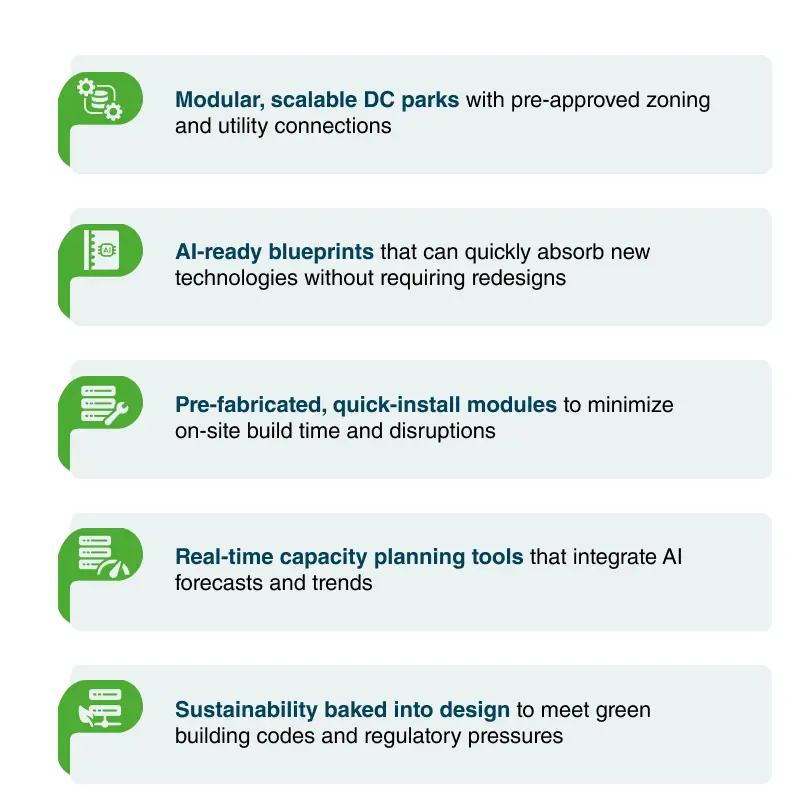
To support the demands of AI-driven operations, hyperscalers need a new approach to data center planning. Key elements of this new planning model include:
- Modular, scalable DC parks with pre-approved zoning and utility connections
- AI-ready blueprints that can quickly absorb new technologies without requiring redesigns
- Pre-fabricated, quick-install modules to minimize on-site build time and disruptions
- Real-time capacity planning tools that integrate AI forecasts and trends
- Sustainability baked into design to meet green building codes and regulatory pressures
CtrlS, for example, offers ready-to-deploy Rated-4 facilities equipped with high-speed fiber, liquid cooling, and built-in sustainability.
What’s more – Gartner’s 2025 Hype Cycle emphasizes technologies like DCIM, microgrids, and direct-to-chip liquid cooling as essential for hyperscale infrastructure moving forward. These tools are foundational for hyperscalers aiming to deliver sustainable, AI-optimized services
Conclusion: Flip the Model or Fall Behind
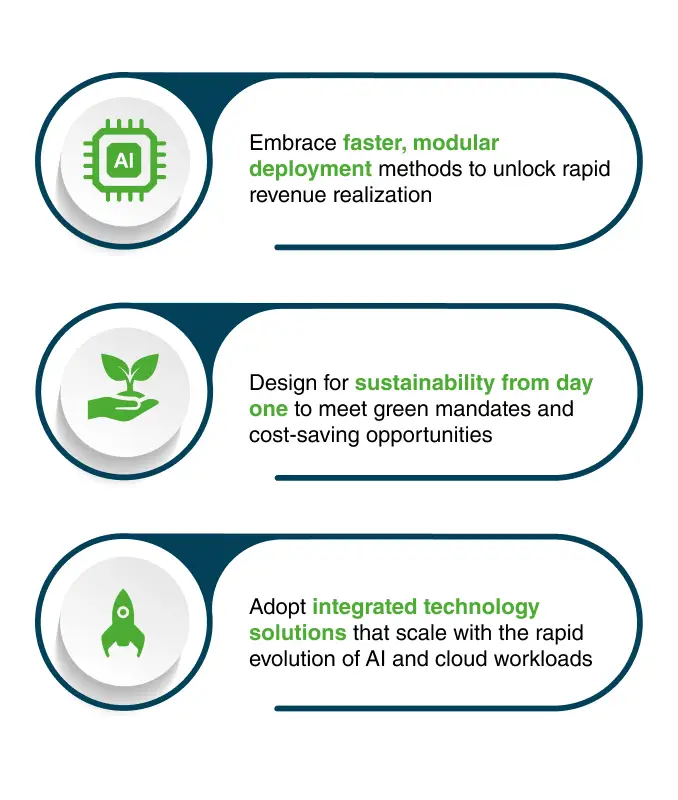
In the age of AI, hyperscalers can no longer afford to build data centers at the same pace as they did in the past. To win in this new landscape, hyperscalers must:
CtrlS, for example, offers ready-to-deploy Rated-4 facilities equipped with high-speed fiber, liquid cooling, and built-in sustainability.
What’s more – Gartner’s 2025 Hype Cycle emphasizes technologies like DCIM, microgrids, and direct-to-chip liquid cooling as essential for hyperscale infrastructure moving forward. These tools are foundational for hyperscalers aiming to deliver sustainable, AI-optimized services
Conclusion: Flip the Model or Fall Behind
In the age of AI, hyperscalers can no longer afford to build data centers at the same pace as they did in the past. To win in this new landscape, hyperscalers must:
For hyperscalers, accelerating go-to-market is already a board-level priority to ensure faster revenue, greener growth, and competitive edge. Players that fail to modernize their data center planning risk falling behind in the race to support next-gen AI-driven services.
Want to explore hyperscale-ready deployment models? Let’s talk about modular datacenters built for AI and speed.

Ruchika Sharma - Vice President – Business Development, CtrlS Datacenters.
where she leads growth initiatives, strategic partnerships, and market expansion across India’s hyperscale Rated-4 datacenter ecosystem. With a deep understanding of technology infrastructure and client engagement, she is committed to advancing sustainable, scalable solutions that strengthen CtrlS’s leadership in digital infrastructure.

 marketing@ctrls.in