
One walks into any enterprise IT conversation in India and the word ‘agent’ usually comes up. Not the sales kind, but the software kind. The agents that once just used to answer questions inside an app are now turning into systems that take actions themselves; from raising a ticket, reconciling an invoice, rewriting codes, even chasing an approval through three different systems before a human even notices.
According to Gartner, by the end of 2026, about 40% of enterprise applications are expected to carry built-in task-specific AI agents. This marks a huge difference when compared to just under 5% a year before. In India, an EY survey found that nearly a quarter of business leaders are already running agentic AI in some form, with 91% of leaders citing deployment speed as the key factor in their buy-vs-build decisions.
That’s the exciting part of the story.
But there’s also a quieter part. Where will all these applications run?
An AI agent isn’t a chatbot which is slightly smarter. AI agents consume infrastructure like a different type of workload altogether. And many of India’s infrastructure conversations haven’t kept pace with the adoption conversation.
Why AI agents don’t run like chatbots
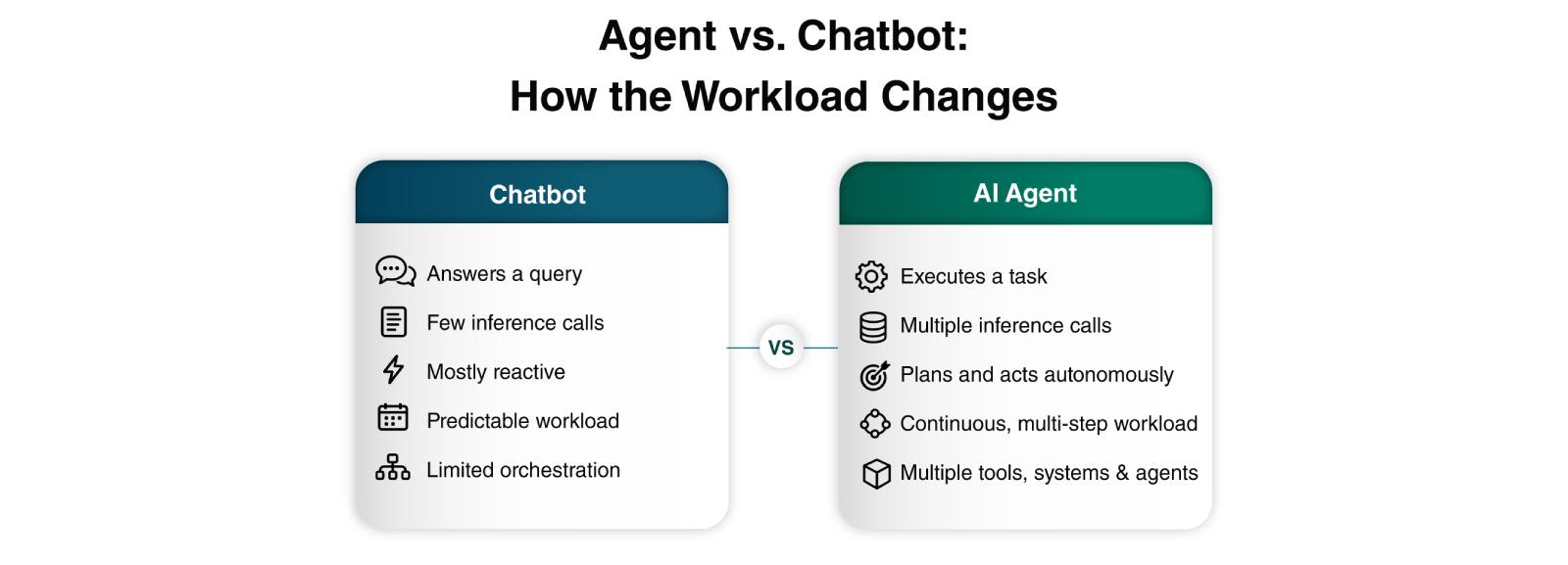
A chatbot simply answers a question. Whereas, an AI agent plans a task, picks a tool, retrieves a document, checks its own output, sometimes hands it over to another agent to verify something, and often keeps doing this unattended, operating quietly in the background. Instead of a handful of big, predictable inference calls, you get a constant stream of smaller ones stacked with reasoning steps a chatbot never needed.
That shift is evident in enterprise IT spending. As per Gartner, inference spending is expected to surpass training spending in 2026, with inference reaching $23.3 billion against $19.0 billion for training in AI-optimized IaaS environments. That’s worth noting as running AI has become a bigger cost for enterprises than building it.
Gartner also expects, by 2027, one-third of agentic AI implementations will combine agents with different skills to manage complex tasks. This only adds to the orchestration and compute sitting underneath every task an agent completes.
The challenge includes running compute continuously, at low latency, wired tightly into live enterprise data. This is a different architecture from the batch-style infrastructure most companies built for occasional training or early chatbot pilot.
India’s real bottleneck isn’t ambition
Forrester made a point earlier this year that’s worth noting; India’s constraint with AI has been rarely about talent or imagination. It’s whether an enterprise can count on getting the power, cooling and GPU capacity it needs, when it needs it, and at a cost it can actually plan around.
Many promising pilots by Indian enterprises have stalled not because the model underperformed, but because there was no reliable infrastructure to run them at scale after the pilot phase.
IDC’s estimates show why this matters at a system level. Global AI infrastructure spending is said to reach roughly $487 billion in 2026, marking about 53% year-over-year growth, with power availability now the single most important operational constraint heading into the year. Datacenter commissioning is increasingly driven by utility capacity rather than the lead times of hardware. India is directly facing that constraint, with new capacity often announced faster than the grid can power it.
Nasscom’s 2026 Strategic Review frames the shift well. AI has moved from optional to core infrastructure, and agentic systems specifically are pushing AI from a support role into an execution role, embedding efficiency, governance and adaptability into how enterprises actually operate.
When an agent is the one executing the process, an outage isn’t just an inconvenience; it’s the entire business process coming to a standstill. According to Nasscom’s broader AI Adoption Index, India’s AI market is expected to grow at 25-35% CAGR over the next three to four years, as tracked across 500 companies in seven sectors that together form 75% of the country’s GDP. That’s the demand curve the infrastructure layer now has to keep pace with.
What an agent-ready infrastructure layer truly needs
A handful of things separate infrastructure built for agents from infrastructure that merely happens to run them:
- Planned capacity, not spot capacity: Enterprises need assurance of GPU and compute availability over quarters, not a scramble for whatever’s free that week.
- Power and thermal density: Continuous, dense compute needs facilities designed for high-density racks and efficient cooling, not a converted server room stretched past its limits.
- Data residency and governance: With agents acting autonomously on live business data, and India’s DPDP Act and RBI’s evolving AI governance expectations both in play, compute increasingly needs to sit where the data is legally required to stay, with a clean audit trail attached.
- Distributed, low-latency inference: Agents interacting with people and systems in real time need inference sitting close to where decisions actually happen, not centralised hundreds of kilometres from the branch, the factory floor or the customer.
- Availability that matches the stakes: Because agents act without a human checking every step, uptime expectations start to look a lot more like Rated-4, fault-tolerant infrastructure than a shared, best-effort cloud instance.
This is exactly the layer India’s datacenter industry is now racing to build – gigawatt-scale campuses, GPU-as-a-service partnerships, sovereign compute programmes, and facilities engineered specifically for the power density and reliability AI workloads demand, rather than retrofitted for them after the fact.
It’s the same thinking behind CtrlS’s own approach as India’s largest Rated-4 datacenter company, as we build the power, cooling and uptime headroom that always-on, agent-driven compute actually needs, with a footprint spread close to where India’s enterprises operate rather than concentrated in one place.
India’s AI agent story is still being written, and the ambition behind it is genuine. What decides how much of that ambition actually ships isn’t which model an enterprise picks. It’s whether the infrastructure underneath it was built for this workload, or just happened to be lying around when the workload showed up.

Priya Patil, VP & National Head - Strategic Accounts, CtrlS Datacenters
Priya is the National Head of Strategic Colocation at CtrlS, with deep expertise in the IT & ITeS industry. She drives scalable growth through strong sales strategy, customer relationships, and IT service management. Known for her consultative approach, Priya builds high-value partnerships while blending strategic vision with operational excellence to deliver sustainable impact across regions.

 marketing@ctrls.in