
Summarize with:
read in < 1 min
India’s AI infrastructure strategy must focus on where intelligence is delivered as much as where compute is concentrated. Core datacenters provide the scale required for demanding AI workloads.
Hyperscale datacenters provide the scale needed for AI training and other compute-intensive workloads. The next phase of AI adoption will increasingly depend on how efficiently AI capabilities can be delivered. Those capabilities must reach businesses, applications and end users across the country.
This creates a fundamental distinction in the evolution of AI infrastructure: AI training drives the concentration of compute, while AI inference increasingly creates the need to distribute intelligence closer to the point of consumption.
But enterprises adopting AI across branches, service centers and regional operations face another requirement: delivering responses within the time and cost their applications can support. Regional edge datacenters become important where proximity improves that delivery.
India’s distributed demand makes inference placement a business decision
India’s digital market reaches well beyond its largest datacenter locations. Colliers reported that Mumbai held 41% of capacity across the seven largest markets in April 2025. TRAI recorded 448.08 million rural internet subscriptions within a national total exceeding 1.11 billion in June 2026.
These figures describe different markets, but establish an important condition: digital access is geographically dispersed, while substantial infrastructure capacity remains concentrated.
That distribution does not justify deploying inference in every city. It requires enterprises to examine where location affects service delivery. A regional customer support operation, a retail network and a document-processing platform have different response requirements. Their infrastructure should reflect those differences.
The opportunity lies in developing an infrastructure architecture that combines centralised compute economics with regional deployment flexibility.
Training concentrates, inference distributes
The infrastructure requirements of AI training and inference are fundamentally different.
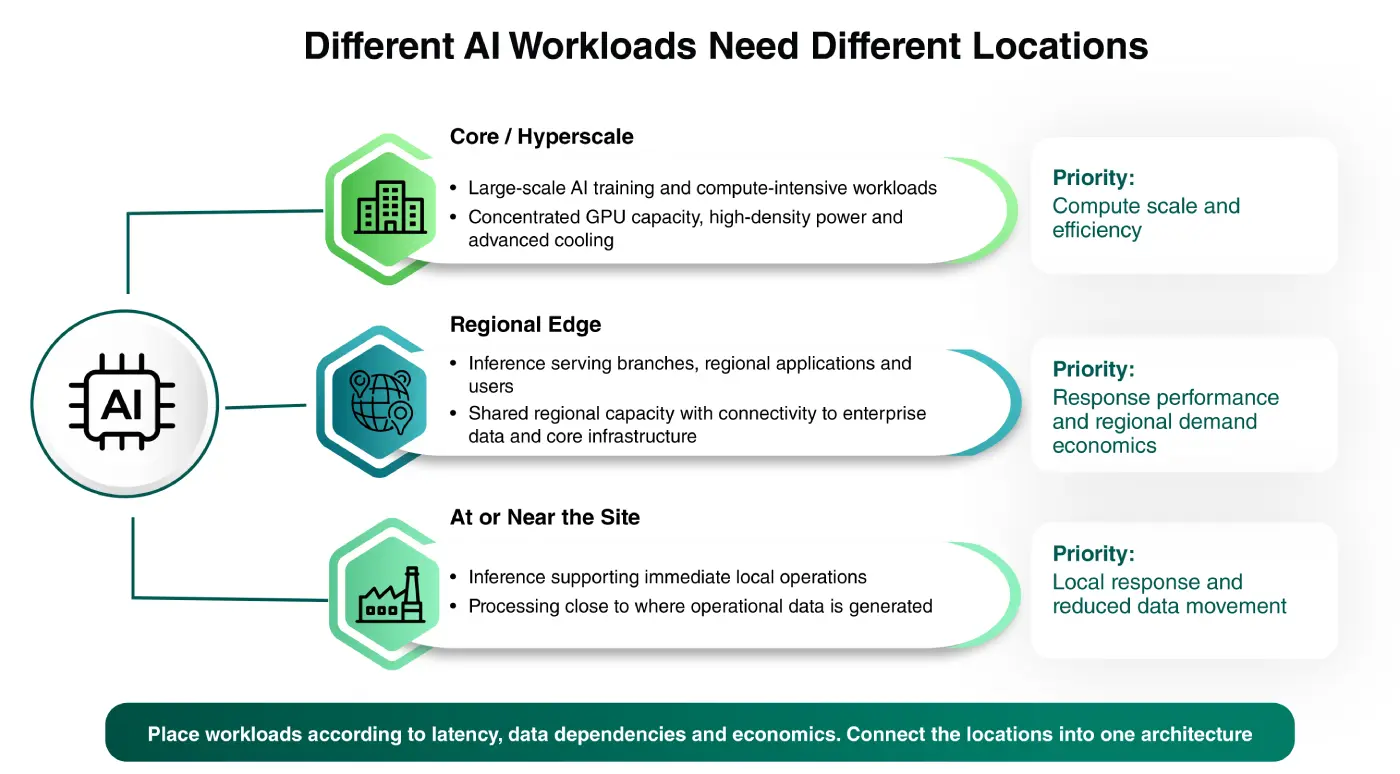
AI training typically requires large, concentrated GPU clusters, high-density power infrastructure, advanced cooling and high-performance interconnects. This naturally favours hyperscale AI datacenters capable of delivering economies of scale.
Inference, however, is concerned with executing trained models and delivering responses to applications and users. Depending on the workload, inference can operate from centralised cloud environments, regional datacenters or infrastructure deployed closer to the point of consumption.
For example:
Enterprise knowledge assistants may operate efficiently from centralised or regional infrastructure.
Voice AI and conversational applications can benefit from predictable, low-latency network paths.
Video analytics can benefit from regional processing that reduces unnecessary movement of large data streams.
Industrial and operational AI applications may require processing at or near the point of data generation.
The appropriate deployment model depends on application architecture, latency requirements, data dependencies and workload economics.
The emerging opportunity is not to replace hyperscale infrastructure with edge datacenters, but to create a complementary architecture in which centralised and distributed compute operate together.
Faster GPUs are not substitutes for delays in the network
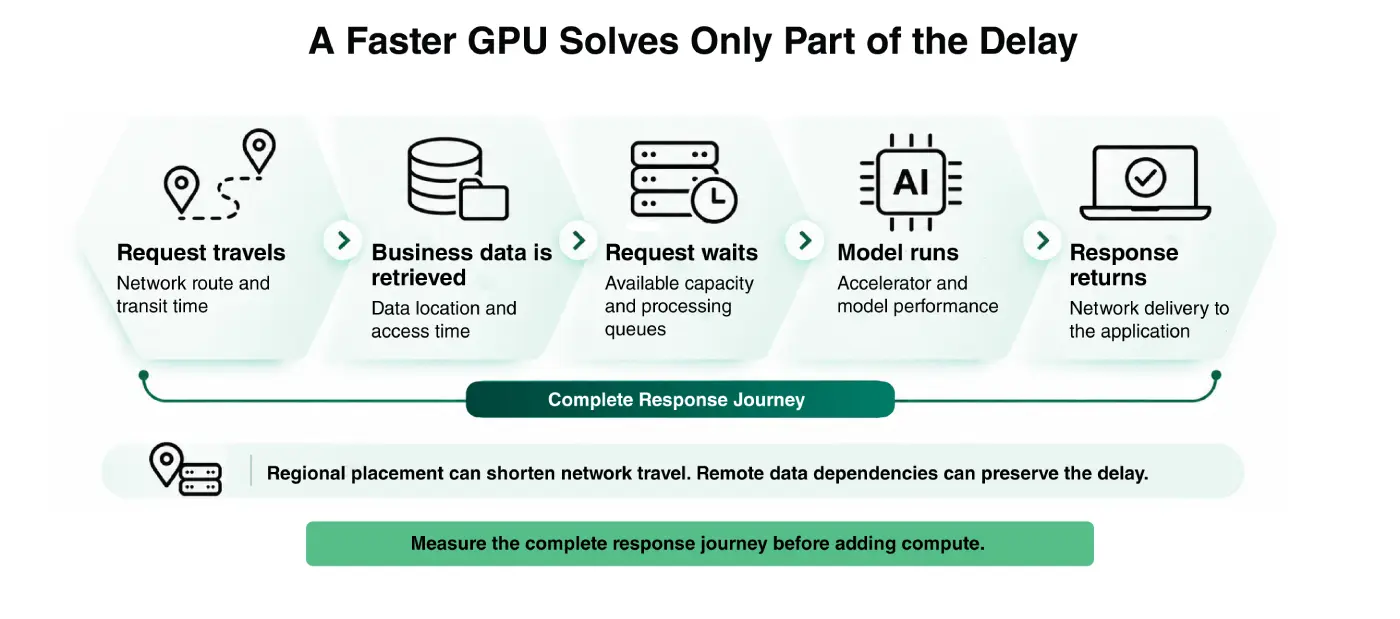
An inference response depends on the complete application path. Requests travel across networks, retrieve business data, enter processing queues and return results. Accelerator performance influences only part of that sequence.
A faster model server may deliver little improvement when network transit or remote data access dominates response time. Infrastructure teams must identify the actual constraint before committing additional compute expenditure.
The business consequences depend on the workload. Conversational delays can interrupt a voice assistant’s usefulness. Continuous video transfers can increase bandwidth requirements before analytics produces an actionable result.
In the inference era, connectivity is no longer simply a transport layer connecting datacenters. It is becoming an integral component of AI service delivery.
Enterprises must evaluate the combined performance of compute, connectivity, data accessibility and application architecture rather than viewing GPU performance in isolation.
Regional edge must earn its place through measurable improvement
Regional edge datacenters offer a deployment option between distant core facilities and infrastructure installed at individual operating sites. They can aggregate suitable workloads closer to regional demand while providing a professionally operated hosting environment.
This approach is important where several branches or applications share a regional service requirement. An edge datacenter’s value depends on actual network routes, data dependencies and demand concentration, rather than geographic distance alone.
Distribution also introduces costs that leaders must assess explicitly. Additional locations require capacity planning, model deployment, monitoring and security controls. Smaller regional pools may achieve lower utilisation than consolidated infrastructure. Moving inference closer while leaving essential application data far away can preserve the original delay.
The business case for regional inference must therefore be established through measurable operational and financial outcomes.
Three tests should govern that comparison:
Response performance: Regional placement must improve end-to-end service against a defined application target.
Data movement and connectivity economics: Processing closer to demand should reduce relevant data transfers, network transit or egress expenditure without creating additional dependencies elsewhere.
Demand economics: Regional usage must justify capacity commitments, operating costs and the required expansion headroom.
Ultimately, the next competitive advantage in AI infrastructure may not come from deploying more GPUs, but from delivering every successful inference at the right cost, latency and scale.
Reliable facilities turn regional proximity into deployable capacity
Proximity becomes commercially useful only when the facility can sustain the workload. Enterprises still need dependable power, suitable cooling, resilient connectivity, physical security and operational support. These requirements become more consequential as inference supports routine customer interactions and business decisions.
High-density AI infrastructure also introduces specific considerations around rack power availability, thermal management, cooling architecture and network capacity. Carrier-neutral facilities offer an additional advantage by allowing enterprises to evaluate multiple connectivity providers and design network architectures around their application requirements.
The combination of reliable datacenter infrastructure and diverse network interconnection becomes particularly important for distributed AI environments.
CtrlS’ regional footprint gives enterprises a practical starting point
CtrlS has Patna, Kolkata and Lucknow as operating edge locations, providing established regional options beyond the largest metros.
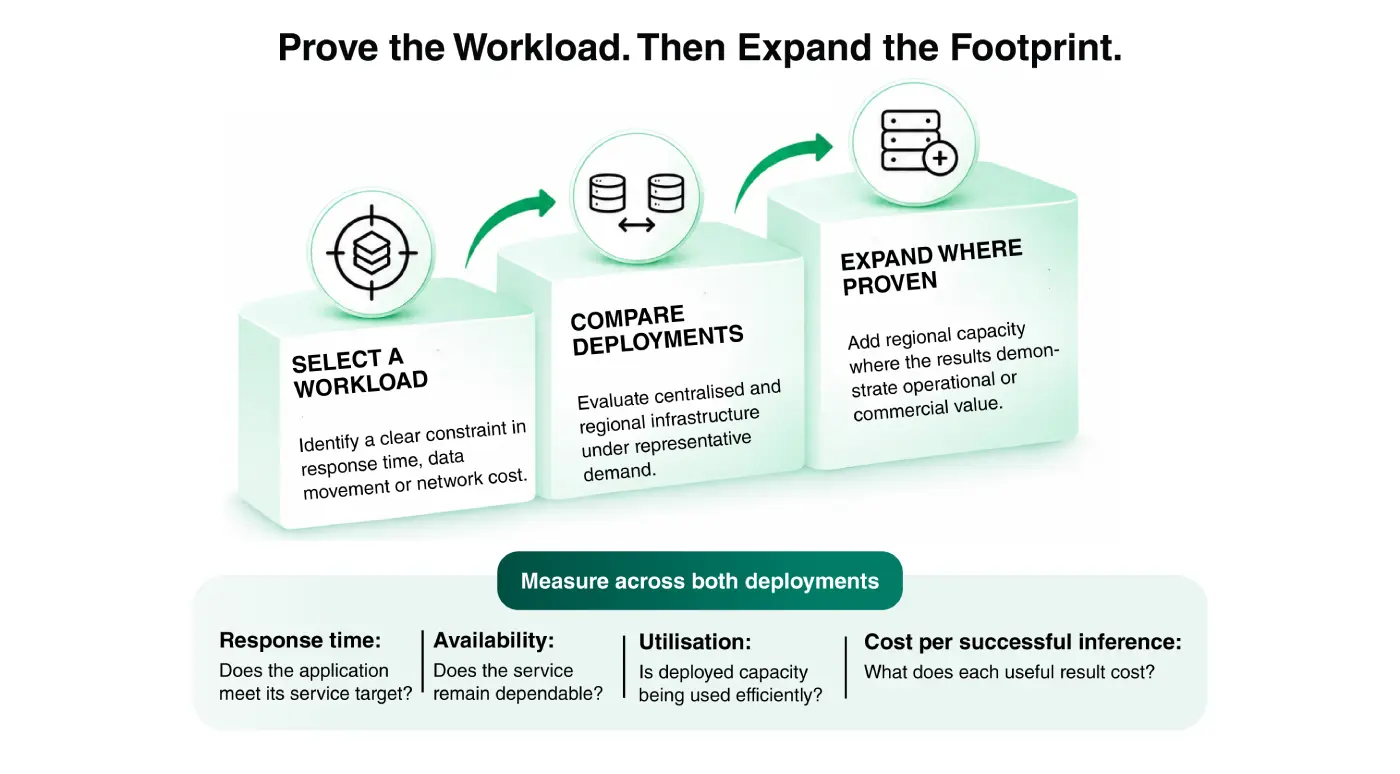
The broader opportunity is to connect regional infrastructure with hyperscale compute environments, cloud platforms, network providers and enterprise locations through a resilient connectivity architecture. For enterprises, the starting point should be to identify a workload where application performance, data movement or network economics present a clearly understood constraint.
A regional and centralized deployment can then be evaluated under representative demand.
The evaluation should measure response times, availability, utilization and cost per successful inference. Centralized infrastructure should remain the preferred option wherever its scale and economics deliver the best outcome. Where regional deployment demonstrates measurable operational or commercial advantages, edge infrastructure can provide the flexibility to expand capacity closer to demand.
The next phase of AI will be defined by where intelligence creates value
India’s AI infrastructure opportunity will not be determined solely by how much compute the country builds, but by how efficiently that intelligence can be delivered to businesses and users across the country.
Hyperscale datacenters will continue to provide the foundation for large-scale AI training and compute-intensive workloads. Regional edge infrastructure will play a complementary role wherever proximity, connectivity and data locality improve application performance and operating economics.
The future architecture will therefore be neither entirely centralized nor universally distributed. It will be a carefully designed combination of hyperscale compute, regional inference capabilities and resilient connectivity.
For infrastructure providers, the opportunity is to move beyond conventional colocation and connectivity propositions towards enabling an integrated AI delivery ecosystem.
The next phase of India’s AI adoption will depend not just on building intelligence, but on delivering it reliably, efficiently and economically wherever businesses and users need it.

Vipul Kumar, Senior Vice President – Edge & Network Business, CtrlS Datacenters
Vipul is a seasoned telecom and datacenter leader with over two decades of rich experience spanning submarine cable systems, edge datacenters, and network infrastructure ecosystems. He is passionate about building sustainable, compliant, and scalable digital infrastructure that empowers regional enterprises, SMEs, and hyperscale players alike. As Senior Vice President – Edge & Network Business at CtrlS, he leads initiatives that bridge connectivity and compute — from fiber and network deployments to strategic partnerships and business development, building the network foundation and ecosystem partnerships that power CtrlS’s pan-India edge datacenter expansion.

 marketing@ctrls.in