
Summarize with:
read in < 1 min
A bank screening a digital payment for fraud has to reach a decision within the time a customer expects the payment to take. The check may depend on current account activity, device signals and a model that scores the transaction. India has digitised payments, lending, insurance and investing. As institutions embed AI across those services, the infrastructure carrying its decisions becomes part of the customer experience. Leaders should design around how quickly each decision must arrive, how it can be reviewed and how the business will operate when a dependency fails.
Digital Scale Compresses the Decision Window
India’s payment volumes make response times an operating concern. The Unified Payments Interface processed more than 24,162 crore transactions worth around ₹314 lakh crore in FY 2025–26, according to the Ministry of Finance. Transaction volume grew about 30% year on year. Institutions should size fraud checks for their own peak traffic and measure what customers experience when requests queue. Ministry of Finance · PIB UPI statistics
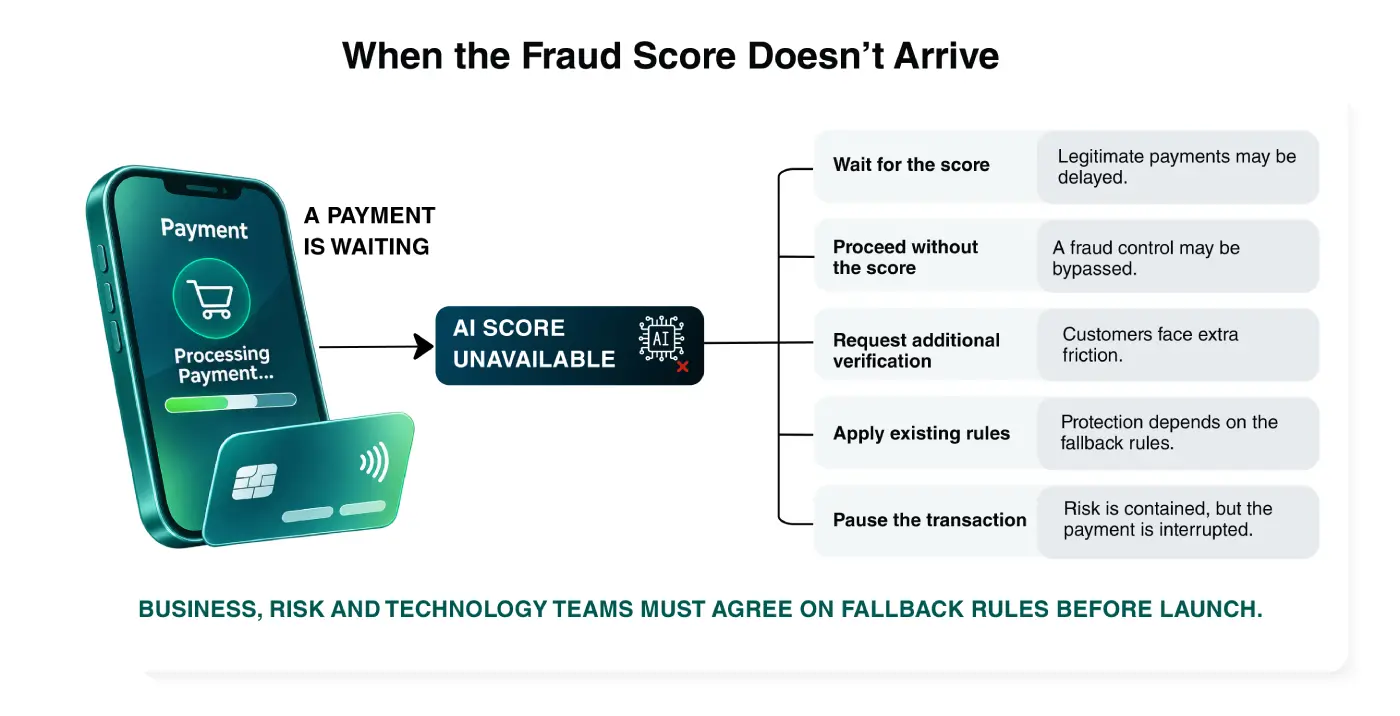
AI can spot unusual combinations of signals alongside existing rules and help investigators prioritise cases. The trade-off becomes visible when a fraud score arrives late or fails to return. Waiting can delay legitimate payments. Proceeding without the score can remove a control the bank depends on. Asking every affected customer to verify their identity can create friction across otherwise routine payments. Risk and technology teams should agree in advance when to fall back to existing rules, request additional verification or pause a transaction.
Different Decisions Carry Different Risks
Credit, insurance and compliance teams need to review what drove an AI recommendation. Lenders can use lawfully obtained data, with consent where required, to assess repayment capacity for small businesses and self-employed borrowers with thin credit files. Insurers can extract information for underwriting and flag claims inconsistencies while routing routine cases faster. Anti-money-laundering teams can spot unusual transaction networks, review documents and prioritise alerts for investigators. These tools can free specialists to focus on complex cases and leave sensitive decisions with authorised reviewers.
Personalisation brings AI into everyday financial decisions. Banks can offer multilingual support, contextual guidance and spending insights using customer information within defined privacy boundaries. Product recommendations also need suitability checks, especially when the service uses past behaviour to suggest a financial commitment. Institutions should define which customer data each service can use and who can access it.
Governance needs to cover how models perform after launch. The RBI-appointed FREE-AI Committee set out 26 recommendations in its 2025 report. Institutions should monitor performance and test for bias, retain enough evidence to explain consequential decisions and assign responsibility for correcting errors. Human reviewers need the authority and information to intervene when a recommendation warrants scrutiny. RBI FREE-AI Committee report · RBI release
Agentic AI raises the stakes because it can act across systems. Assembling loan documents or gathering fraud evidence requires controlled read access. Posting a reconciliation adjustment changes a financial record and calls for narrower permissions, transaction limits and approval rules. Log who authorised the action and verify whether it completed before retrying after a connection failure.
A financial institution should decide how a service behaves without its AI component before putting that component in the transaction path.
Prove One Workflow Before Scaling AI
Start with one high-volume workflow and give its business owner responsibility for launch criteria. In payment fraud screening, agree on acceptable response times, fraud detection and unnecessary verification rates before testing. Run peak traffic, then simulate a slow data service, an unavailable model and a failed network route. Check whether the bank applies the intended fallback and whether investigators can reconstruct what happened. Expand AI’s role when the workflow meets those criteria under both normal and degraded conditions.
Decision Risk Sets the Infrastructure Design
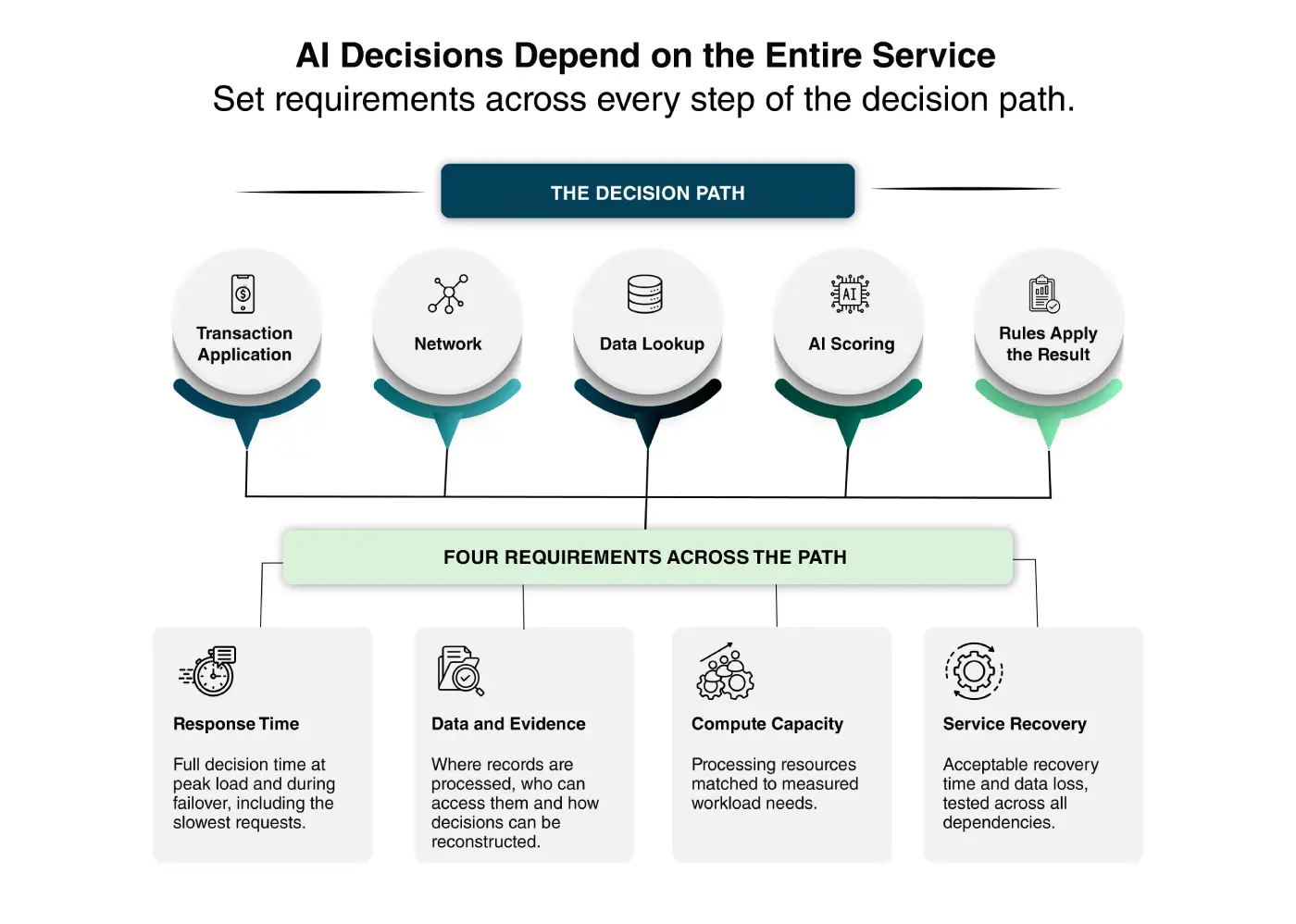
Start with the business decision and work backwards through its dependencies. For payment screening, that includes the transaction application, network, data lookup, scoring service and the rules that apply the result. Business, risk and technology teams should agree on requirements for the full service and test them before launch.
- Set an end-to-end latency budget. Measure the full decision path at peak load and during failover. Track slower requests as well as the median, since delays can concentrate in a small share of transactions.
- Define data boundaries and evidence. Map where sensitive records are processed, logged and recovered. Specify who can access them and what evidence the institution needs to reconstruct a decision.
- Match compute to the workload. Benchmark transaction scoring on conventional processors where appropriate. Reserve accelerator capacity for workloads whose performance warrants it, such as model training or selected generative AI inference.
- Set recovery targets for the service. Agree how quickly it must resume and how much data loss it can tolerate. Test the application, data, connectivity and scoring service together.
CtrlS Supports Resilience and Workload Growth
CtrlS gives BFSI institutions a basis for designing primary and recovery environments around those targets. Our Hyderabad portfolio includes Rated-4 datacenter infrastructure, which addresses resilience at the facility layer. When comparing recovery sites, assess route diversity, shared dependencies and whether replication can meet recovery targets.
CtrlS Cloud Connect offers private connectivity to major cloud platforms. A bank can use that connectivity to design a private path between colocated systems and cloud services where its data policies permit. The bank should verify contracted service levels, measure round-trip latency and test how traffic shifts when a path fails.
CtrlS also gives institutions room to introduce denser compute as workloads change. Our AI infrastructure specifications describe power socket provision of up to 250 kW per rack. Cooling options include direct-to-chip and immersion. A BFSI should can use these specifications to shortlist sites for accelerator workloads, then confirm the deliverable rack density and cooling configuration for its deployment.
Physical separation is another design choice. A bank may need to isolate the infrastructure hosting payment data from the environment used to develop models. Dedicated space can give it a physical boundary, while network segmentation and identity controls determine which systems and people can cross it. The infrastructure partner should show how those boundaries extend to maintenance access, monitoring and the recovery site.

Mayur Gautam, SVP - Colocation Sales, CtrlS Datacenters
Mayur is a seasoned leader with extensive experience in leadership, business development, and strategic sales within the IT services industry. During his tenure at CtrlS, he has held multiple leadership roles, driving business growth, building high-performing teams, and providing strategic and operational oversight across IT service management. His expertise spans new client acquisition, revenue growth, key account management, and long-term customer relationships. He has a strong track record of identifying new opportunities, negotiating and strengthening customer engagement to drive sustained business growth.

 marketing@ctrls.in