
Summarize with:
read in < 1 min
A successful AI pilot proves that a use case can work under defined conditions. Production requires the organisation to sustain it across users, enterprise data, changing models and business workloads. That transition exposes infrastructure, governance and operational requirements that experimentation can leave unresolved. The leadership priority is to establish a repeatable operating model alongside the use case, so technical success can become a dependable business service.
A working pilot leaves production requirements unproven
AI experimentation has become easier through model APIs, open-source models, retrieval tools and workflow frameworks. Enterprise adoption, however, involves a broader commitment. McKinsey’s 2026 survey found that nearly nine in ten respondents reported regular AI use in at least one business function, while only 44% reported enterprise-wide scaling. These findings establish the distance between adoption and scale. McKinsey
Production changes what the organisation must prove before committing further investment. A pilot may demonstrate useful answers with selected documents and a small user group. Deployment adds concurrent demand, live permissions, service expectations and recurring expenditure. Someone must own application quality, approve changes and respond when performance deteriorates. If those responsibilities remain unresolved, a technically successful application still lacks a clear route into business operations.
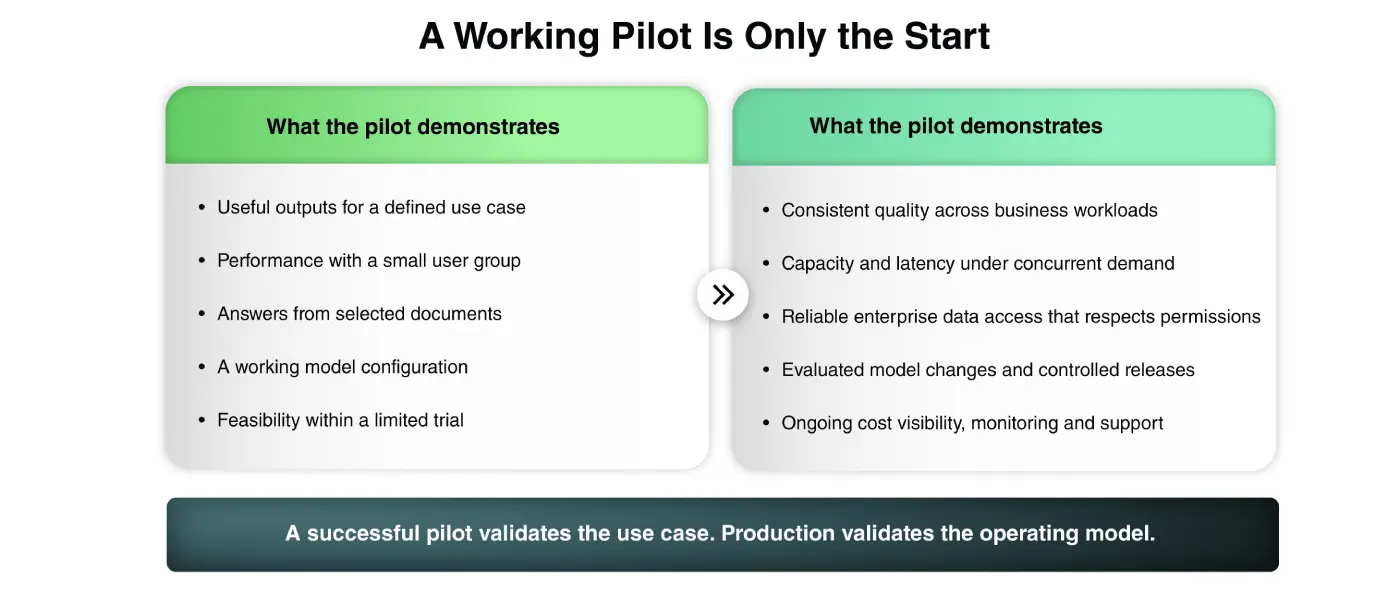
Production depends on the complete operating environment
Infrastructure decisions must follow the workload’s production requirements. An application consuming external model APIs has different capacity responsibilities from one hosting models on dedicated GPUs. Both still depend on reliable networking, storage, identity services and application infrastructure. Private or hybrid deployment introduces further integration requirements. Teams must establish expected demand, latency targets, availability and recovery requirements before selecting the environment and committing to its cost.
Operational readiness also requires a defined process for releasing and supporting the application. Model versions, prompts, retrieval settings and data connections can all change its behaviour. Teams need evaluation criteria, controlled releases, monitoring and rollback procedures. Discovering these requirements after pilot approval creates additional engineering work and delays business value. Reusable deployment patterns allow subsequent initiatives to inherit capabilities that the organisation has already validated.
Enterprise data requires permission-aware AI access
Enterprise information makes AI more useful because it supplies business context that general models lack. Connecting knowledge bases, customer records and operational systems also extends existing access obligations into the application. Retrieval must respect each user’s permissions. Changes to source documents and access rights must reach search indexes and downstream stores. Deployment decisions must account for where information is processed, retained and exposed.
Agents require further controls because they can act on information as well as retrieve it. Deloitte’s 2026 enterprise AI research found that only one in five companies had mature governance for autonomous AI agents. That finding concerns agents specifically, but it reinforces a practical priority: define permitted actions, approval thresholds and audit requirements before granting access to operational systems. Data access and action authority require separate decisions. Deloitte US
Model flexibility must preserve quality and economics
Model selection becomes an ongoing operating decision as workloads and usage change. Different applications require different balances of accuracy, latency, deployment control and cost. McKinsey’s 2026 survey found that about 20% of respondents reported AI operating costs, including token costs, constraining usage. Leaders therefore need expenditure visibility at workload level, alongside evidence of the business outcome delivered. Aggregate spending reveals little about which applications deserve expansion. McKinsey
A common interface and model routing can reduce integration work when teams change commercial or open-source models. Each change still requires evaluation against the application’s quality, security and performance criteria. Cost comparisons should include retrieval, storage, infrastructure, monitoring and support alongside model consumption. The operating model should make these trade-offs visible, allowing teams to select suitable models while preserving consistent release and accountability requirements.
Shared governance creates a repeatable production path
Governance accelerates delivery when it gives teams reusable controls and clear decisions. Approved models, controlled connectors and standard deployment workflows reduce repeated engineering and review work. For soonicorns, the priority is establishing this foundation before experimentation fragments across teams. For unicorns, it is bringing distributed initiatives under consistent visibility and accountability. Both need shared standards that accommodate different workload requirements and deployment environments.
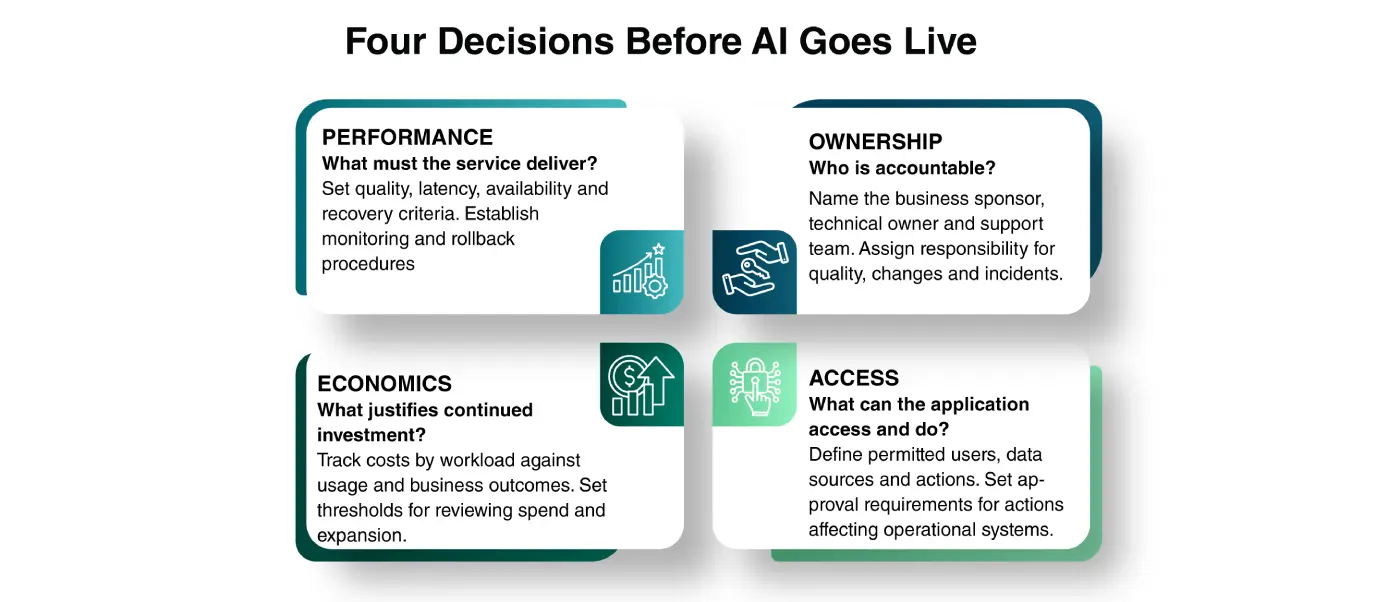
Build the production path alongside the pilot
CtrlS Neutrino addresses several requirements through one enterprise AI framework. Its published include permission-aware enterprise search, routing across commercial and open-source models, workflow development, observability, audit trails and sovereign deployment options. These capabilities support a shared foundation for moving AI into production. Enterprises must still define their policies, validate application behaviour and assign operating responsibilities around that foundation.
Supporting infrastructure decisions can include ACP for infrastructure visibility and governance, and GPU Private Cloud where dedicated GPU capacity is required. The immediate leadership decision is to fund production readiness alongside experimentation and make ownership explicit before rollout. Getting an AI pilot to work proves the use case. Getting it into production proves the operating model.

Venkat Subrahmanyam, Vice President – Service Delivery, Managed Services, CtrlS Datacenters
With over 18 years of experience driving large-scale technology transformation and business growth, Venkat is a results-oriented leader who has led complex, multi-domain programs across datacenter services, cloud, cybersecurity, and infrastructure operations. He brings deep expertise in end-to-end transition and transformation, ensuring measurable ROI, governance excellence, and delivery efficiency. Venkat has extensive experience managing MeitY portfolios, aligning operations with regulatory and national digital mandates. Known for his strategic influence, he mentors high-performing teams and builds strong C-suite partnerships.

 marketing@ctrls.in