
Chennai has always been known for building things that last. The city has spent decades earning its reputation as India’s industrial powerhouse; from automotive assembly lines to healthcare campuses to financial services back-offices. And now it’s writing a new chapter, where Global Capability Centres, AI-led manufacturing, digital banking, and Industry 5.0 are reshaping the city’s digital future.
But there’s one question that rarely comes up in the boardroom, even though it probably should – as businesses pour money into AI, cloud, and automation, is the foundation ready for it?
According to JLL, India’s data-centre capacity crossed 1 GW in 2024 and is projected to reach 1.8 GW by 2027, a 77% increase in three years. Chennai accounts for approximately 21% of India’s datacenter capacity.
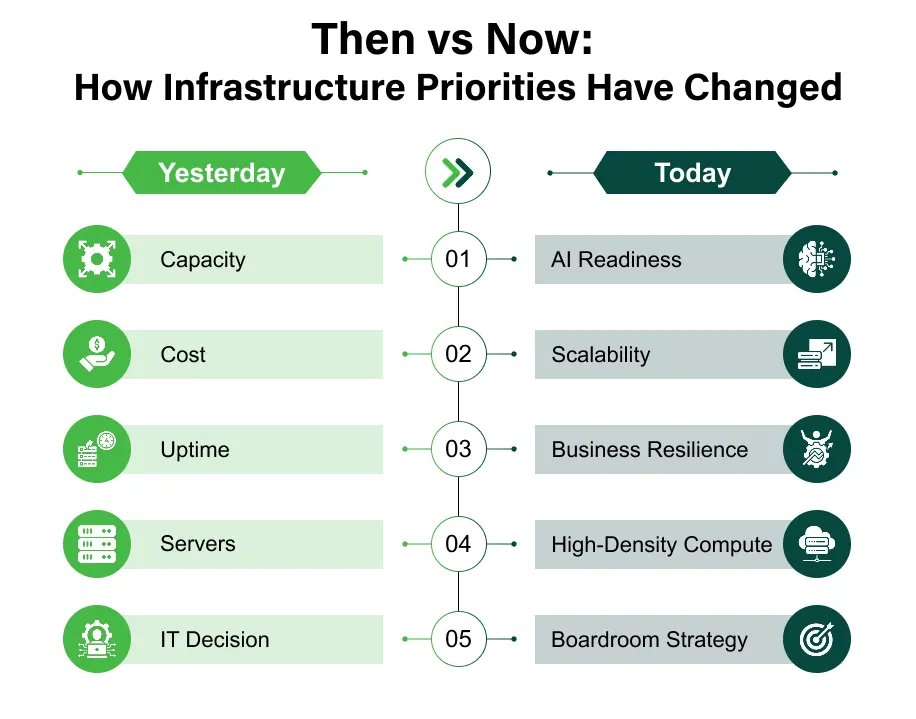
Why Infrastructure Stopped Being an IT Conversation
There was a time when infrastructure decisions came down to three questions. How much capacity? How much it costs? And how reliable is the uptime?
Gartner’s latest July 2026 forecast puts worldwide IT spending at $6.37 trillion in 2026, up 14.2% from 2025. Datacenter systems are the fastest-growing segment, with spending projected to rise 62.5% to approximately $822 billion.
The reason isn’t too hard to guess. AI workloads are changing what infrastructure needs to do, and enterprises everywhere are racing to keep pace. Gartner describes the effort to build the compute capacity required for AI as the largest infrastructure project ever attempted by humanity.
India is very much part of that story, and a big one. Gartner forecasts end-user spending on public cloud services in India at $17.5 billion in 2026, with IaaS and PaaS among the fastest-growing segments. IaaS is projected to grow 40% and PaaS 25.4%, as organisations invest in AI-ready infrastructure, high-performance compute, high-speed networking and scalable storage.
Globally, IDC expects public-cloud spending to surpass $1 trillion in 2026, with PaaS the fastest-growing deployment model at more than 37%. Growth is being driven in part by AI platforms, application modernization and data-intensive workloads. In other words, the money isn’t just following the AI boom; it’s following the infrastructure and platforms required to operationalize it.
Closer to home, EY’s GCC Pulse Survey found that 83% of India’s Global Capability Centres are already investing in GenAI, while 58% are currently investing in agentic AI, with another 29% planning to invest within a year.
Chennai, with its expanding GCC presence across BFSI, healthcare, and manufacturing, sits right in the middle of that shift. EY also highlights cybersecurity and governance as important areas of focus for GCCs. This is increasingly relevant as India’s Digital Personal Data Protection framework raises the bar for how organisations collect, process, secure and govern digital personal data.
Simply put, infrastructure has increasingly become a boardroom decision, not just an IT strategy. Organisations that keep building future initiatives on yesterday’s digital infrastructure are racking up something concerning — infrastructure debt: the widening gap between what a business wants to do and what its infrastructure can actually support. In a data-centre context, that debt can show up as power, cooling, connectivity or physical-design constraints that limit tomorrow’s workloads.
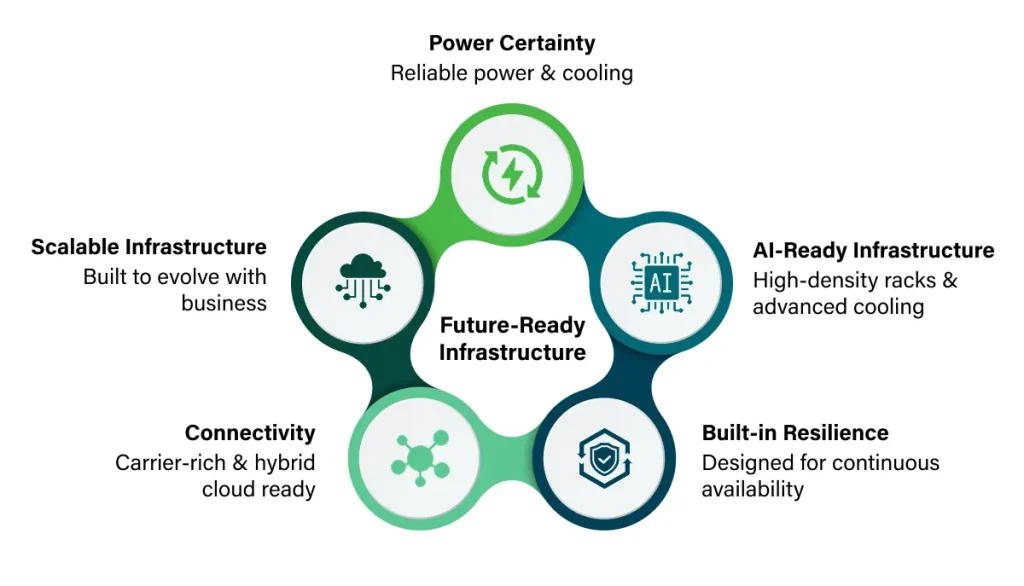
Five Priorities for Future-Ready Infrastructure
Power Certainty: For AI workloads, power certainty increasingly means not only reliable utility supply, but also secured capacity, power quality, scalable electrical distribution, adequate backup generation and a cooling architecture capable of supporting rising rack densities. As AI increases power density, future-ready infrastructure must also address energy efficiency, renewable power sourcing and water-efficient cooling.
AI-Ready Infrastructure: High-density racks, direct-to-chip liquid cooling, rear-door heat exchangers, advanced air cooling, high-capacity power distribution and high-speed networking are becoming increasingly important as AI workloads move from pilots to production. The transition from conventional enterprise densities to much higher AI rack densities means power delivery, cooling, networking, floor design and structural capacity increasingly need to be planned as one integrated infrastructure layer.
Built-in Resilience: Every hour of downtime can have significant implications for revenue, customer trust and reputation. Future-ready resilience goes beyond power redundancy to encompass cooling, network paths, physical security, operational processes and, where required, geographic diversity and disaster recovery. For regional hubs such as Chennai, resilience should also account for local climate and geographic risks.
Uncompromised Connectivity: Hybrid and multi-cloud strategies depend heavily on the quality, diversity and scalability of connectivity. Chennai’s submarine cable ecosystem, carrier diversity and expanding terrestrial fibre connectivity give it a strong connectivity advantage, particularly for enterprises and cloud platforms requiring diverse, low-latency routes. Cloud connectivity and route diversity are increasingly strategic infrastructure considerations, not simply network features.
Infrastructure That Scales With Business: Technologies arrive faster than business strategies. Infrastructure that can keep pace with this change without a full redesign every time is what defines true future-readiness. The ability to scale power, cooling, space and connectivity in phases is becoming as important as the capacity available on day one.
The Questions Every CIO Should Be Asking
Before the next infrastructure decision gets made, it’s worth the effort to think with a few honest questions:
- Is our infrastructure actually ready for AI, or just adjacent to it?
- Can it scale at the pace our business is growing, not the pace it grew last year?
- Is resilience designed in, or bolted on after something breaks?
- Does it strengthen security, compliance and data governance?
- Can it genuinely support a hybrid and multi-cloud strategy end to end?
- Is it energy- and water-efficient as AI density increases?
Looking Ahead
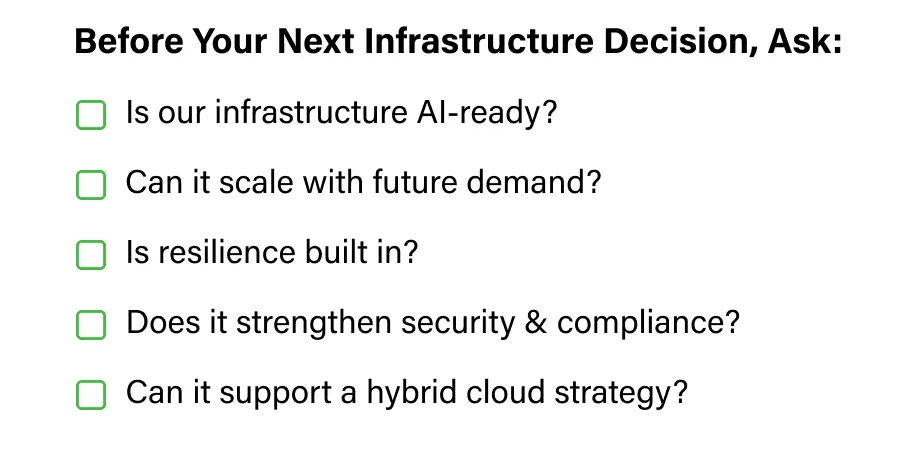
If you answered “No” to any of these, your infrastructure may already be limiting future growth.
Chennai’s digital economy isn’t slowing down, and neither are the expectations placed on its infrastructure. Future-ready infrastructure isn’t just about keeping the lights on; it is about enabling innovation, absorbing shocks, meeting regulatory and governance requirements, improving energy and resource efficiency, and scaling without constant reinvention.
Wilson K Thomas, SVP - Datacenter Business, CtrlS Datacenters
With over two decades of experience, Wilson specializes in enabling digital infrastructure for hyperscalers, neo-clouds and enterprises across India. He has led the origination, structuring and closure of 1,000+ strategic datacenter transactions, spanning colocation, built-to-suit, powered shell and high-density AI/HPC deployments. His expertise spans datacenter commercialization, leasing strategy, go-to-market models and long-term client acquisition, with deep experience across power, cloud and infrastructure ecosystems. Working closely with CXOs, infrastructure, investment, design, power and operations teams, he helps align commercial objectives with scalable, compliant infrastructure. He is passionate about positioning India as a global hub for hyperscale and AI infrastructure.

 marketing@ctrls.in