
A GPU shortlist establishes compute capability. It leaves the suitability of the deployment environment unresolved. An enterprise training models, serving customer responses and processing operational data may use similar accelerators across those projects. Yet each application places different demands on power, cooling, storage and connectivity. CIOs should define those workload requirements before choosing a datacenter. Otherwise, they risk buying compute that the surrounding infrastructure cannot consistently support, connect or expand.
A GPU shortlist cannot establish deployment suitability
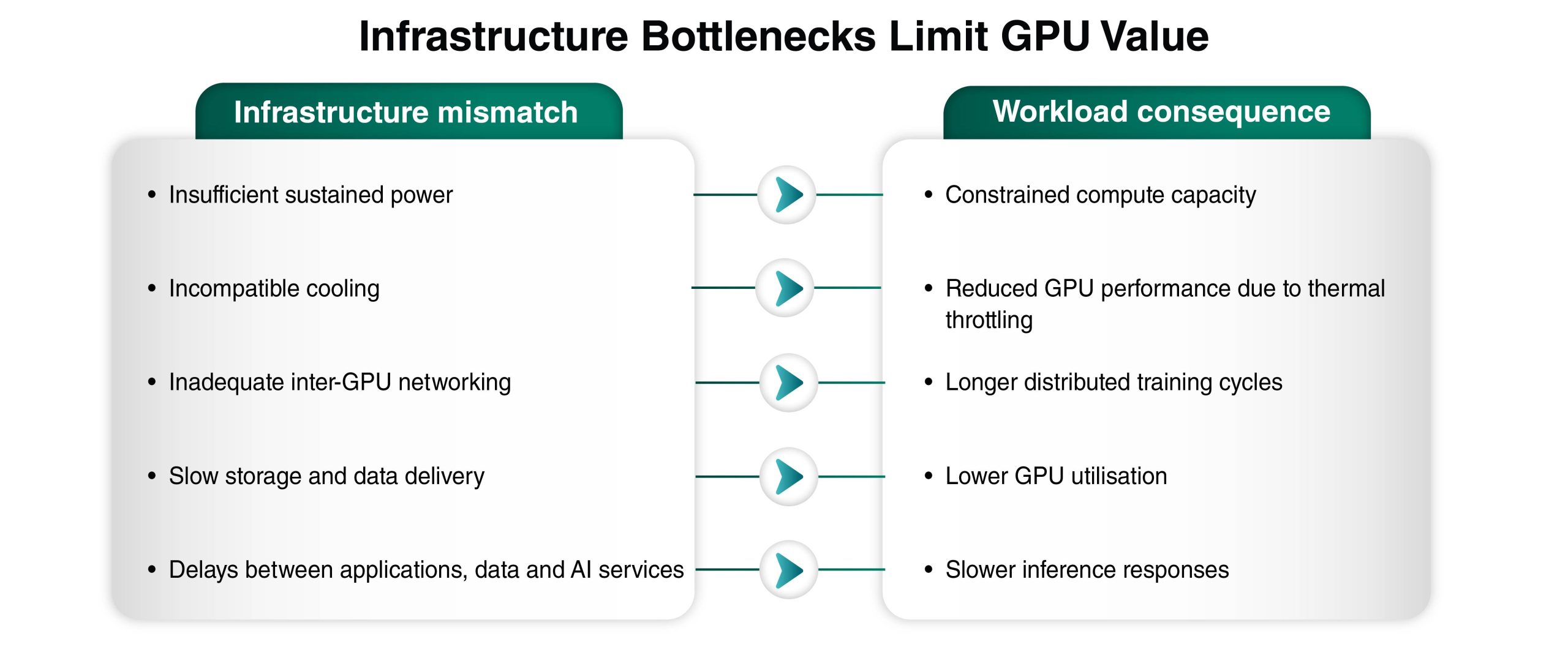
GPU memory, processing performance and software compatibility matter, but they describe only part of the system. NVIDIA’s enterprise architecture guidance connects accelerator capacity with high-speed networking, scalable storage, and power and cooling. The implication for infrastructure planning is direct: selecting suitable GPUs does not establish that the proposed environment can sustain their operation. Hardware selection and facility assessment must proceed together, against the requirements of the intended application. docs.nvidia.com
The facility decision also reaches beyond the equipment installed inside a rack. An AI service depends on access to enterprise data, connections to business applications and capacity for later deployment phases. Choosing a location before examining these dependencies can force costly compromises after procurement. Teams may need additional connectivity, a revised cooling design or another site to accommodate growth. These are some of the consequences of an incomplete decision.
The workload determines which constraint matters first
Every deployment needs a clear operating requirement before the enterprise compares facilities. Define where data resides, how frequently it moves, what performance the application must deliver and how demand will change. A scheduled training job and an interactive customer application have different tolerances for delay. Similarly, a small fine-tuning deployment and a large distributed training cluster should not inherit identical infrastructure assumptions simply because both use GPUs.
Workload labels alone cannot establish those requirements. Training can be data-intensive, while distributed inference can demand substantial communication between compute nodes. NVIDIA distinguishes compute traffic, storage connectivity and customer uplinks because each serves different performance and operational needs. The CIO’s task is to translate the actual application into infrastructure requirements, then identify which dependency could prevent it meeting its target. That establishes priorities for facility assessment. docs.nvidia.com
The infrastructure decision must establish what the application can deliver, not merely what the GPU can compute.
Infrastructure mismatches reduce the value of compute investment
Large distributed training places sustained power, heat removal and cluster communication under scrutiny. NVIDIA identifies high-bandwidth, low-latency networking as critical to communication between GPUs across nodes. For an enterprise, the consequence of inadequate supporting infrastructure is longer training cycles or constrained throughput. The location decision may therefore favour dependable capacity and expansion readiness over proximity to end users, depending on the cluster’s scale and architecture. docs.nvidia.com
Time-sensitive inference requires a different assessment because the network path forms part of the application’s response time. Capable GPUs cannot eliminate delays between the service, its data sources and the systems calling it. CIOs should therefore assess connectivity against the complete response target. This does not mean every inference deployment requires an edge site. Placement should follow measured performance requirements, with geographic proximity treated as one factor in that assessment.
Data delivery can constrain workload before compute becomes the limiting factor. NVIDIA advises sizing storage networking so data movement does not restrict GPU utilisation. If ingestion, retrieval or repeated reads cannot keep pace, the enterprise receives less useful output from its compute investment. However, responsibility spans storage, network and platform design. A datacenter assessment must establish the facility’s contribution without assuming that colocation alone resolves every performance bottleneck. docs.nvidia.com
Facility comparisons must follow measurable workload requirements
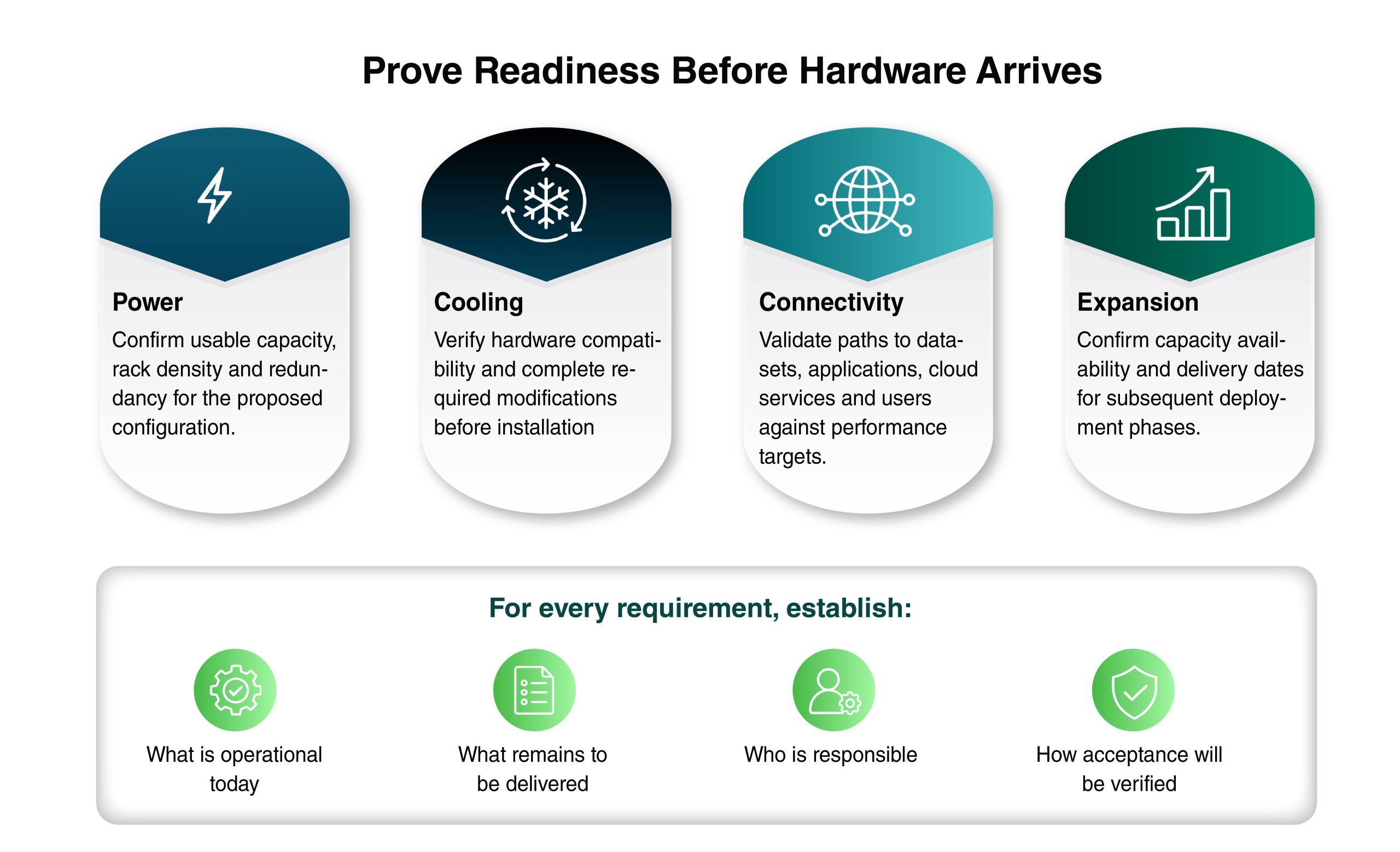
The required shift is to compare facilities against an agreed deployment specification. Infrastructure teams should establish acceptance criteria before commercial discussions narrow the shortlist. This gives procurement, application owners and infrastructure leaders a common basis for evaluating trade-offs. It also exposes whether a proposal meets the first deployment’s needs while creating constraints for subsequent phases. The comparison should address four connected requirements:
- Power: Confirm usable capacity at the required rack density, including redundancy and the proposed equipment configuration.
- Cooling: Verify compatibility with the selected hardware and identify modifications needed before installation.
- Connectivity: Assess paths to datasets, business applications, cloud services and users against performance targets.
- Expansion: Establish what later phases require and when supporting capacity can become available.
Readiness must be proven for the actual deployment phase
An “AI-ready” description cannot substitute for evidence about the proposed hall and deployment date. CIOs need to distinguish operational infrastructure from capability that still requires construction, commissioning or third-party delivery. A facility may support the initial racks while leaving expansion dependent on future work. Those dependencies belong in the delivery plan, with clear responsibilities and acceptance conditions, before hardware arrival becomes a deadline the infrastructure cannot meet.
Readiness is a commitment to support a defined deployment on a defined date.
Choose the location and colocation model that fit the portfolio
One capable facility may support several workloads effectively, simplifying operations and limiting unnecessary data movement. Alternatively, different requirements may justify separate locations or configurations. CtrlS offers rack space, caged racks, dedicated halls or floors, and dedicated buildings; its AI infrastructure offering describes high-density power, liquid cooling and network capabilities. These provide options for assessment, with suitability established through facility-specific evidence. The CIO’s priority is to approve the workload requirements and acceptance criteria before committing to the location and colocation model.

Nikhil Rijhwani, Vice President – Sales and City CEO, CtrlS Datacenters
with over 20 years of experience growing digital infrastructure businesses in India. He leads sales and cross-functional teams serving hyperscalers, neoclouds, enterprises and government institutions. His expertise spans datacenter economics, capacity monetization and strategic partnerships. Through business transformation, he helps build scalable infrastructure that supports India’s digital economy.

 marketing@ctrls.in