
Rising cloud spend is not automatically a problem. For a fast-growing company, higher infrastructure costs can reflect more customers, more applications, larger engineering teams, new analytics platforms and expanding AI workloads. The problem begins when the business cannot explain what is driving that increase.
At scale, cloud cost management must move beyond tracking the monthly bill. Leaders need to know which workloads created the spend, who owns them, how effectively resources are being used and whether the expenditure is creating business value.
Cloud Spend Can Grow Rationally While Cost Control Weakens
Cloud consumption naturally expands with the business. More development environments appear. Kubernetes estates grow. Storage and data movement increase. New cloud accounts are provisioned. AI adds expensive and irregular compute demand. Flexera’s 2025 State of the Cloud report found organizations expected cloud spend to rise by 28%, while estimating that 27% of cloud expenditure was wasted. 2026 State of the Cloud | Insights from cloud leaders & practitioners
Those numbers highlight the distinction leaders need to make. Growth and inefficiency can exist at the same time. Cutting expenditure indiscriminately risks constraining productive workloads. Accepting every increase as the cost of growth creates the opposite problem, this is how inefficiency bulges. The better question is whether the organization can separate justified consumption from avoidable waste.
Cost growth is not the warning sign. Unexplained cost growth is.
That distinction becomes more important as companies move from soonicorn to unicorn scale. Provisioning often expands faster than the processes used to assign ownership, enforce tagging or evaluate utilization.
Cloud Complexity Grows Faster Than the Ability to Attribute Spend
Rapid growth distributes infrastructure decisions across more teams. Developers create resources. Platform teams operate shared services. Business units consume common infrastructure. Kubernetes further abstracts the underlying compute. Multi-cloud environments add different pricing structures, commitments and management models across AWS, Azure and Google Cloud.
The invoice ultimately consolidates those decisions into one financial number. It does not automatically explain them.
For a soonicorn, the immediate risk is allowing poor ownership practices to become embedded. Idle development environments, inconsistent tagging and overprovisioning remain manageable when the estate is small. As the company expands, those practices become much harder to unwind.
For a unicorn, the problem shifts from visibility to organizational accountability. Infrastructure may already span multiple business units, accounts, products and shared platforms. Leadership needs to understand not only where money went, but who controlled the decisions that created the cost.
The FinOps Foundation’s 2025 survey covered organizations responsible for approximately $69 billion in public-cloud spend. After workload optimization, full allocation of cloud spending and accurate forecasting ranked among practitioners’ leading priorities. The State of FinOps Report 2025
The implication is clear: mature cloud management is increasingly an attribution problem before it becomes an optimization problem.
A Cloud Bill Shows Spend; Cost Intelligence Explains It
A billing dashboard can show that expenditure increased. Cost intelligence explains why.
That requires moving from provider-level totals toward business context. A useful operating view should connect infrastructure consumption with applications, projects, products, environments and accountable teams. AWS guidance, for example, recommends allocating costs through dimensions such as business units, product lines and environments, supported by consistent account and resource tagging.
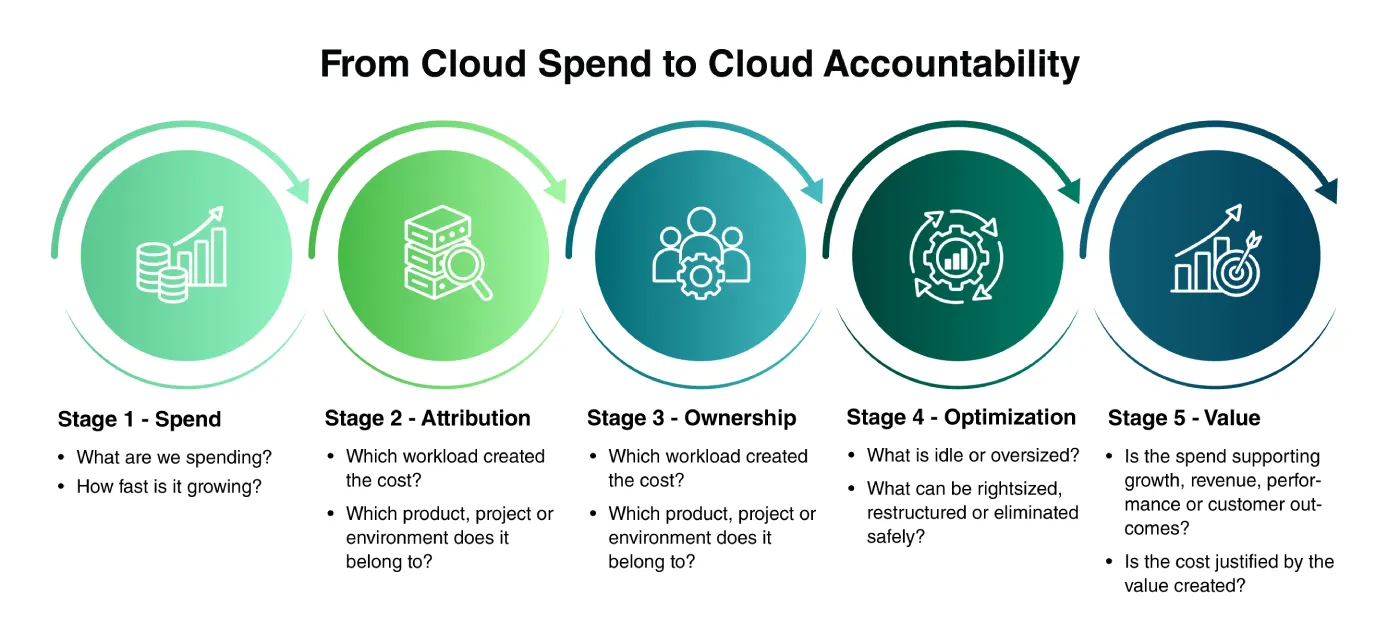
Leaders should be able to move through a simple chain:
- Spend → workload: Which applications, clusters or services generated the increase?
Workload → owner: Which team, project or business unit is responsible for that consumption?
Owner → efficiency: Are those resources utilized appropriately, or are they idle or oversized?
Efficiency → value: Is the expenditure supporting growth, revenue, customer experience or another defined business outcome?
Without these links, optimization becomes a search for the largest number rather than the weakest economics.
Visibility Creates Value Only When Someone Owns the Outcome
Better dashboards do not create accountability by themselves. Costs need responsible owners.
Show back and chargeback provide two mechanisms for establishing that ownership. AWS defines show back as reporting expenditure against responsible entities such as business units, applications or cost centres. Chargeback goes further by assigning those costs through internal financial processes.
The distinction matters because visibility changes behavior only when teams can connect technical decisions with their economic consequences.
A product team should understand what its environment costs. A platform team should see how shared services are being consumed. Finance should be able to forecast expenditure using the same categories engineering uses to operate infrastructure.
At scale, cost visibility must evolve into cost accountability.
The objective is not to punish teams for spending. It is to let finance, engineering and business leaders make decisions using the same economic view.
Continuous Optimization Starts After Ownership Is Established
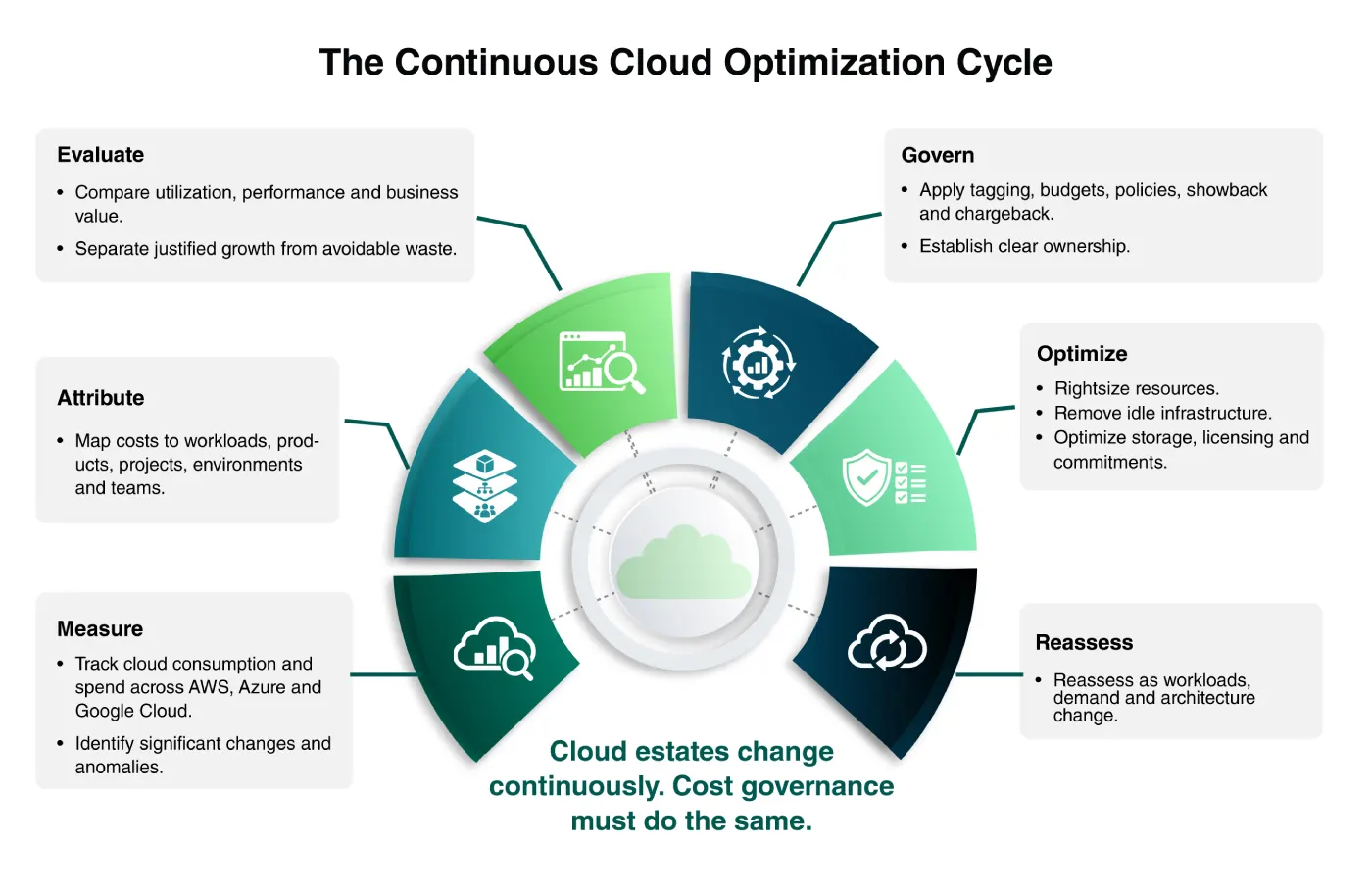
Once organizations can attribute expenditure, optimization becomes more precise. Rightsizing, idle-resource removal, storage optimization, licensing, commitments and workload placement can then be evaluated without treating every reduction as a success.
Cloud environments change too quickly for optimization to remain a periodic cost-cutting exercise. Development environments appear and disappear. Application demand changes. Commitments expire. AI experiments create irregular consumption. Yesterday’s correctly sized resource can become tomorrow’s waste.
That requirement becomes harder in multi-cloud environments because AWS, Azure and Google Cloud expose costs differently. Leadership, however, still requires one business answer: what are we spending across the cloud estate, what is driving it, and what should change?
Flexera’s 2026 research shows the direction of travel. While 85% of organizations still identified cloud-spend management as a major challenge, FinOps practices were increasingly shifting from pure cost control toward measurable business value.
Mature Cloud Governance Connects Every Important Cost to a Decision
The end state is not simply a lower cloud bill. It is an organization that can explain its cloud economics.
Leaders should be able to answer what they are spending, what changed, which workload drove the change, who owns it, whether it is efficiently utilized, what can be optimized safely and how expenditure will change as the business scales. Most importantly, they should understand what business value the infrastructure supports.
For soonicorns, the priority is establishing this discipline before complexity hardens. For unicorns, it is creating consistent accountability across an already distributed estate.
CtrlS Cloud Optimize is designed around this broader operating requirement. It combines cloud cost analysis with rightsizing, software licensing optimization, tagging, governance and business-unit or project-level chargeback across complex cloud environments. This service is an ongoing managed cloud-engineering model, with governance guardrails that remain active beyond the initial optimization exercise.
Where the visibility requirement extends across GPU, Kubernetes, cloud and other infrastructure, CtrlS Accelerated Cloud Platform adds utilization visibility, budgeting and chargeback/show back capabilities across environments.
The priority for growing companies is therefore not to ask how aggressively cloud expenditure can be reduced. It is to build enough visibility and ownership to know what should be reduced, what should be protected and what is worth spending more on.

Ratnapradeep Aravelli, Vice President , Engineering.
With over 16 years of experience across AI, cloud and platform engineering, he brings together deep architecture expertise with the leadership to build high-performing engineering teams and take products from idea to enterprise scale.
His current focus includes AI cloud platforms, GPU and HPC orchestration, unified control planes across multiple hypervisors and public clouds, LLM serving infrastructure, multi-tenant platforms for regulated industries, AIOps and predictive workflow automation, FinOps, and engineering excellence through DevSecOps and SRE. He builds platforms that run themselves, where AI shifts operations from reacting to problems to preventing them.

 marketing@ctrls.in