
The cloud often feels invisible. Applications load instantly, data syncs seamlessly, and digital services operate quietly in the background of everyday life.
But every digital interaction ultimately depends on a very physical layer of infrastructure: datacenters powered by electricity, cooled by complex thermal systems, and connected through thousands of kilometers of fiber and subsea cables.
Every financial transaction, healthcare system, AI workload, and government service ultimately runs on these facilities.
Recent developments in West Asia brought this reality sharply into focus. Reports of digital disruptions in the region following fire incidents and drone strike concerns triggered conversations across the global technology community.
At the same time, analysts highlighted the vulnerability of subsea internet cables passing through the Strait of Hormuz – a critical connectivity corridor carrying significant volumes of global internet traffic, including connections supporting India’s digital ecosystem.
For many organizations, these developments raised an important question:
What happens when the unexpected hits digital infrastructure?
This is where the idea of Black Swan events becomes relevant to the world of datacenters.
When the Unexpected Becomes Reality
A Black Swan event refers to something rare, difficult to predict, and capable of causing widespread disruption.
For digital infrastructure, these events can take many forms.
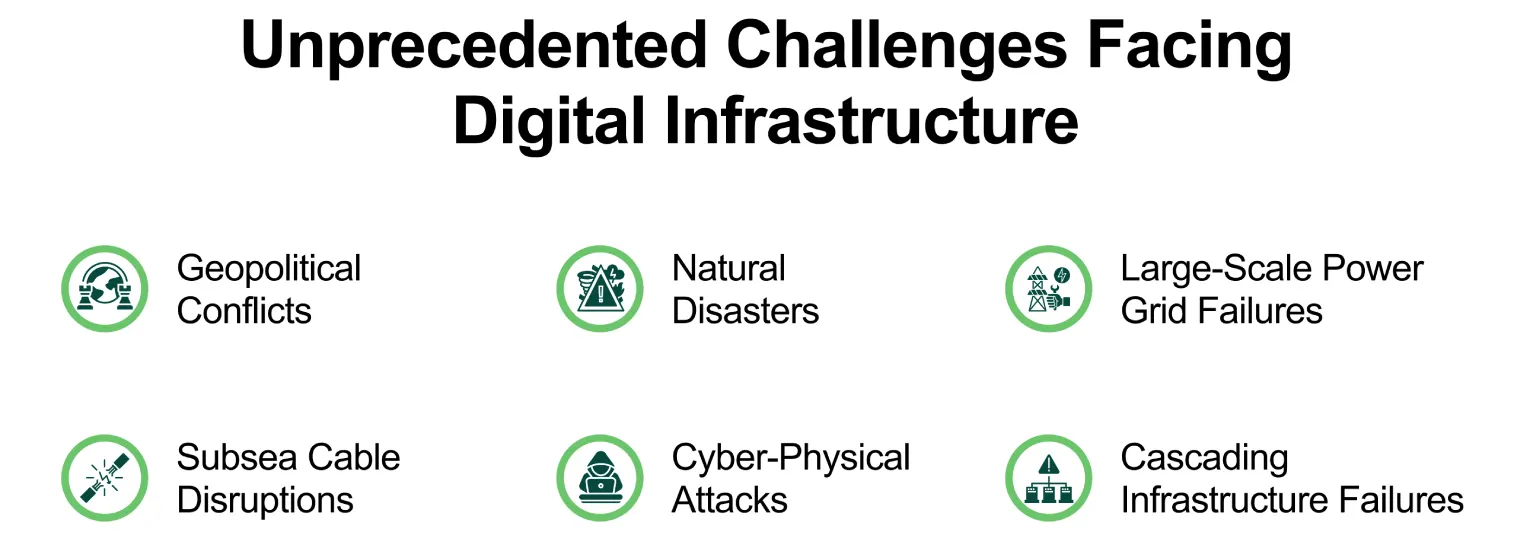
While these scenarios may seem unlikely on a day-to-day basis, the scale of the digital economy means their impact can be enormous.
Modern datacenters therefore operate on a fundamental principle:
Assume that somewhere, at some point, something will fail.
The goal of resilient infrastructure is not to eliminate every possible risk. Instead, it is to ensure that when disruptions occur, digital services continue operating.
Resilience is not an afterthought. It is designed into the infrastructure from the beginning.
Resilience Starts Before Construction
Preparation for extreme events begins long before the first server is installed.
Site selection is one of the most critical decisions in datacenter resilience.
Operators evaluate a wide range of factors before building a facility.
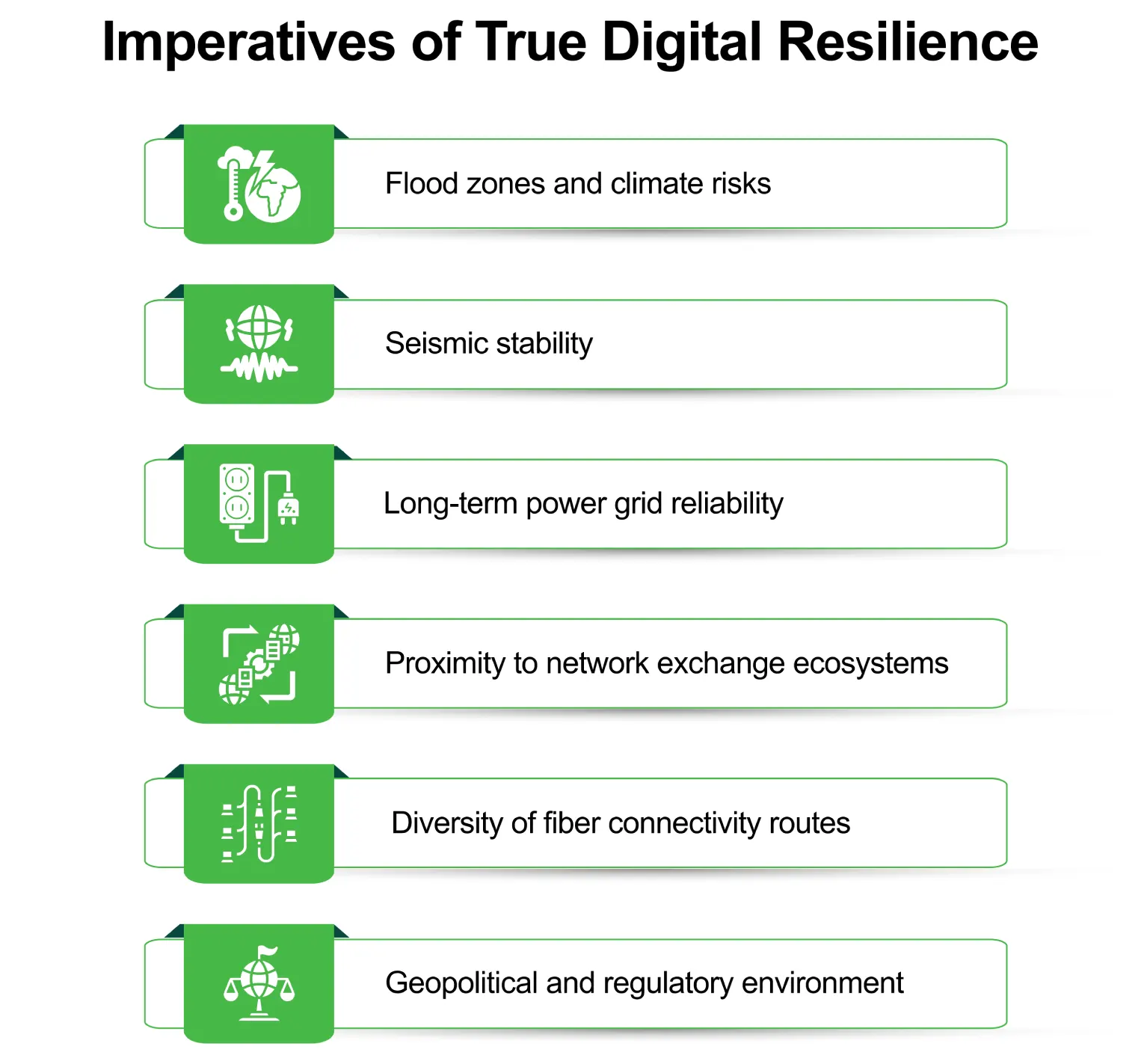
Choosing the right location ensures access to stable power infrastructure, strong network ecosystems, and diverse connectivity paths.
In many ways, resilience begins with geography.
As global organizations rethink concentration risk, geographic diversification of infrastructure is becoming an increasingly important strategy.
No Single Point of Failure
Once a datacenter is operational, resilience is engineered into every layer of infrastructure.
Power systems are designed with multiple levels of redundancy. Utility feeds are supported by large UPS systems and backup generators capable of sustaining operations during extended outages.
In many hyperscale environments, redundancy architectures follow N+1, 2N, or even 2N+1 configurations, ensuring that critical systems remain operational even if multiple components fail simultaneously.
Cooling systems are built with similar redundancy. As computing densities increase, particularly with AI and GPU workloads – thermal stability becomes critical. Datacenters deploy advanced cooling architectures and backup capacity to maintain optimal operating temperatures even during infrastructure faults.
Connectivity is also diversified.
More than 95% of global internet traffic travels through subsea cables, making these routes one of the most critical and fragile components of the global digital ecosystem.
Datacenters therefore connect through multiple fiber routes and network providers, ensuring that if one route is disrupted, whether due to physical damage, maritime activity, or regional conflict – traffic can be rerouted automatically.
Inside the facility, workloads are distributed across clusters, racks, or even multiple datacenters. If one environment experiences disruption, workloads can shift seamlessly to alternate infrastructure.
This layered architecture ensures there is no single point of failure capable of bringing down the entire system.
Practicing for the Worst
Infrastructure resilience is not only about engineering.
It is equally about operational readiness.
Datacenter operators regularly conduct:
- disaster recovery drills
- simulated power outages
- failover testing across infrastructure layers
- incident response simulations
These exercises ensure that both systems and teams are prepared to respond quickly when unexpected disruptions occur.
Monitoring platforms continuously track the health of power, cooling, and networking infrastructure, enabling operators to detect anomalies early.
Predictive maintenance tools further reduce risk by identifying potential equipment failures before they escalate into service disruptions.
In resilient datacenter environments, preparedness becomes part of daily operations.
Hardening Infrastructure for Extreme Risks
As digital infrastructure becomes increasingly critical to national economies, the industry is also exploring new approaches to physical resilience.
One emerging model is the bunker-style datacenter.
These facilities are designed with reinforced structures and enhanced physical security, sometimes located underground or within heavily fortified environments.
Such infrastructure is engineered to withstand extreme conditions, from severe weather events and natural disasters to geopolitical instability, while maintaining operational continuity.
While not every facility needs this level of fortification, bunker-style datacenters illustrate how the industry is evolving to address an increasingly complex risk landscape.

India’s Emerging Role in Infrastructure Diversification
Recent geopolitical tensions have also accelerated conversations around infrastructure diversification.
When disruptions occur in one region, whether due to conflict, environmental risks, or connectivity issues – global enterprises increasingly seek alternative locations to maintain operational continuity.
This shift is drawing attention to India’s growing role in the global digital infrastructure ecosystem.
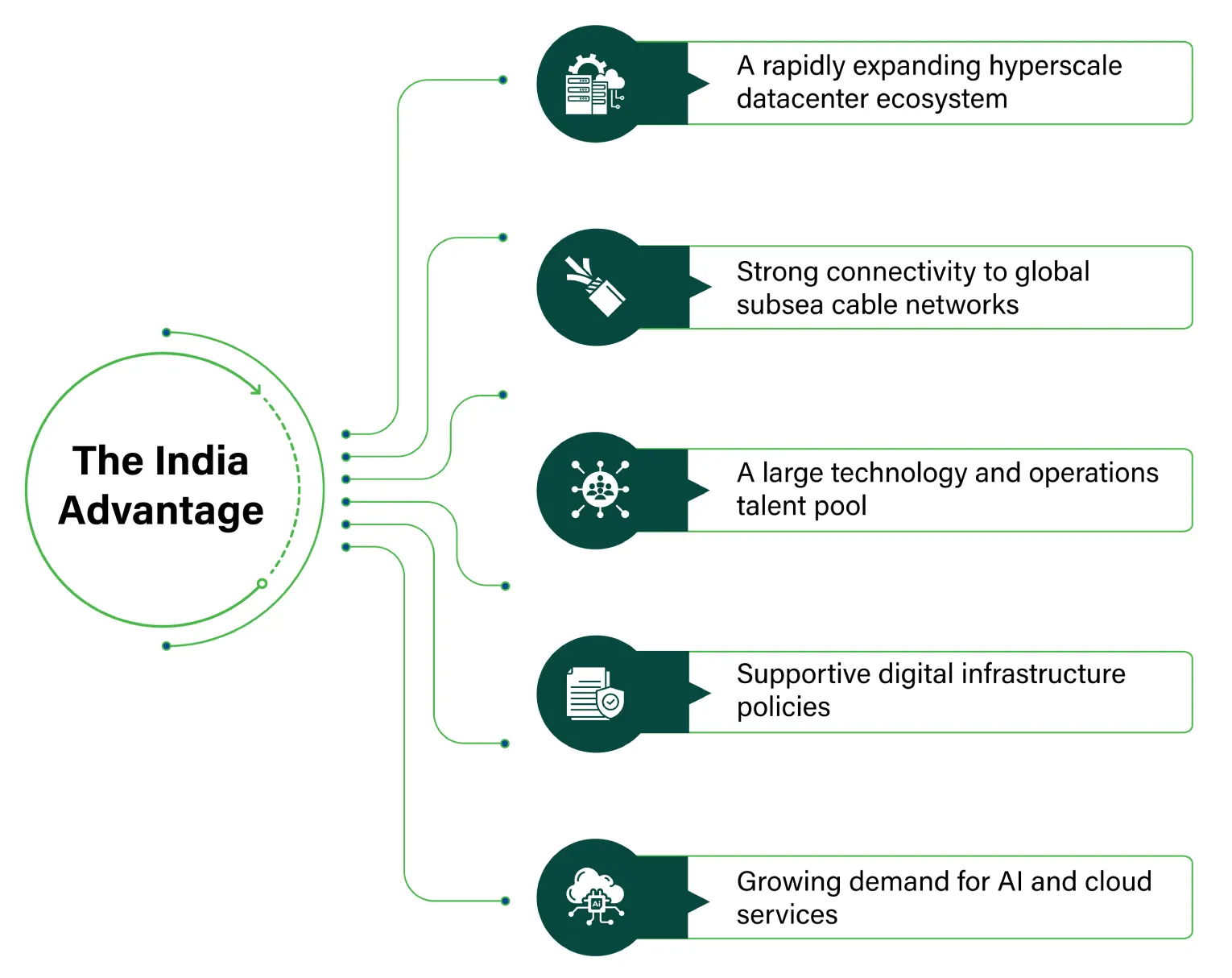
For global organizations looking to diversify infrastructure risk, India is becoming an increasingly attractive location for disaster recovery, redundancy, and distributed cloud deployments.
Geographic diversification ensures that when disruption occurs in one region, digital services can continue operating from another.
How Enterprises Can Strengthen Infrastructure Resilience
As organizations reassess infrastructure strategies, several principles are emerging as essential for maintaining digital continuity in an unpredictable world.
Geographic diversification of infrastructure
Rather than concentrating workloads within a single region, enterprises are increasingly distributing infrastructure across multiple geographies. This ensures that if disruption occurs in one location, services can continue operating from alternate environments.
High-availability datacenter architecture
Facilities designed with high redundancy standards — including advanced power, cooling, and connectivity architectures — help ensure that infrastructure continues functioning even during component failures.
Network diversity and connectivity resilience
Multiple network providers and fiber routes reduce dependency on a single connectivity path. This becomes particularly important in regions where subsea cables carry large volumes of global internet traffic.
Disaster recovery and failover readiness
Organizations are strengthening cross-region failover capabilities, ensuring workloads can move rapidly between datacenters during disruptions.
Operational preparedness
Regular infrastructure testing, monitoring, and disaster recovery drills help ensure that both systems and teams are ready to respond when unexpected events occur.
Together, these strategies form the foundation of resilient digital infrastructure capable of sustaining critical services even in uncertain conditions.
What This Means for Captive Datacenter Environments
For enterprises operating captive datacenters, Black Swan events are reshaping infrastructure strategy.
While captive facilities are designed for control and predictability, today’s risks extend beyond internal systems to power, connectivity, and geopolitical stability.
This raises a critical question: Can a single captive environment withstand large-scale, unpredictable disruptions?
Building hyperscale levels of redundancy, geographic diversity, and disaster recovery capability requires significant investment and operational complexity.
As a result, many organizations are adopting a hybrid approach – complementing captive infrastructure with resilient, third-party datacenter ecosystems.
This enables:
- Geographic Diversification
- Stronger disaster recovery
- Reduced concentration risk
In an unpredictable world, resilience is no longer just about control. It’s about continuity across environments.
Built for the Unpredictable
The digital economy today runs on infrastructure that must remain available at all times.
Financial systems, healthcare platforms, government services, AI workloads, and e-commerce platforms all depend on the uninterrupted functioning of datacenters.
When Black Swan events occur, the difference between disruption and continuity lies in preparation.
Resilient datacenters are built on multiple layers of protection:
- redundant power architecture
- resilient cooling systems
- diverse connectivity routes
- automated failover systems
- operational readiness through continuous testing
- geographic infrastructure distribution
Together, these elements create infrastructure capable of sustaining services even during extreme disruption scenarios.
Because in a world where uncertainty is constant, resilience is no longer just an engineering objective.
It has become a strategic requirement for the digital economy.
The datacenters that will define the future will not simply deliver scale or performance.
They will deliver continuity under uncertainty – infrastructure designed not just for the expected, but for the unimaginable.
Supporting Infrastructure Continuity with CtrlS
At CtrlS Datacenters, resilience has always been central to infrastructure design.
Our Rated-4 datacenter architecture delivers some of the highest levels of redundancy available in the industry, ensuring critical workloads remain operational even during multiple infrastructure failures.
CtrlS infrastructure supports continuity through:
- Rated-4 datacenter design with 99.995% uptime SLA
- Hyperscale campuses designed for mission-critical workloads
- Carrier-neutral connectivity with access to multiple global networks
- Direct connectivity to international submarine cable systems
- Infrastructure designed for cross-region disaster recovery deployments
With India emerging as an important hub for global digital infrastructure, CtrlS enables organizations to strengthen resilience through geographically diversified deployments that support long-term business continuity.

Sankarraman Subbaraman, Vice President - Pre Sales, CtrlS Datacenters
With over two decades of rich industry experience, Sankar is responsible for developing and executing comprehensive techno-commercial strategies to maximize business growth. His role encompasses a deep-dive competitor analysis, new client acquisition, and the cultivation of strategic partnerships within the partner ecosystem. He is instrumental in delivering tailored datacenter solutions that exceed client and stakeholder expectations.

 marketing@ctrls.in