
AI infrastructure conversations have been dominated by one constraint: access to GPUs. That is changing. As organisations secure accelerated compute, the harder question is whether they can prove that expensive capacity is being used productively. GPU availability solves scarcity. It does not solve utilisation, allocation, ownership or cost accountability. As AI estates grow, the operating discipline around GPUs will increasingly determine whether infrastructure investment creates value or simply creates more capacity to manage.
Securing GPU Capacity Solves Scarcity, Not GPU Economics
GPU infrastructure is becoming too large a financial commitment to manage primarily through capacity planning. IDC estimates global AI infrastructure spending will reach $497 billion in 2026, around 56% higher than the previous year. Servers account for the overwhelming majority of current AI infrastructure investment. The implication for technology leaders is straightforward: acquiring compute is increasingly becoming a capital-allocation decision, not merely an infrastructure decision.
Yet capacity ownership does not guarantee capacity productivity. Gartner’s 2026 GPU Optimization Playbook says expensive enterprise GPU clusters often operate below 15% to 20% efficiency. That gap matters because every poorly allocated GPU carries an opportunity cost. Another workload could use it. Another team may be waiting for it. Additional infrastructure may be purchased because existing capacity appears constrained when the real problem is how resources are allocated.
The first AI infrastructure problem was getting GPUs. The next is proving that the GPUs already available are being used well.
Poor GPU Economics Often Begin with Poor Visibility
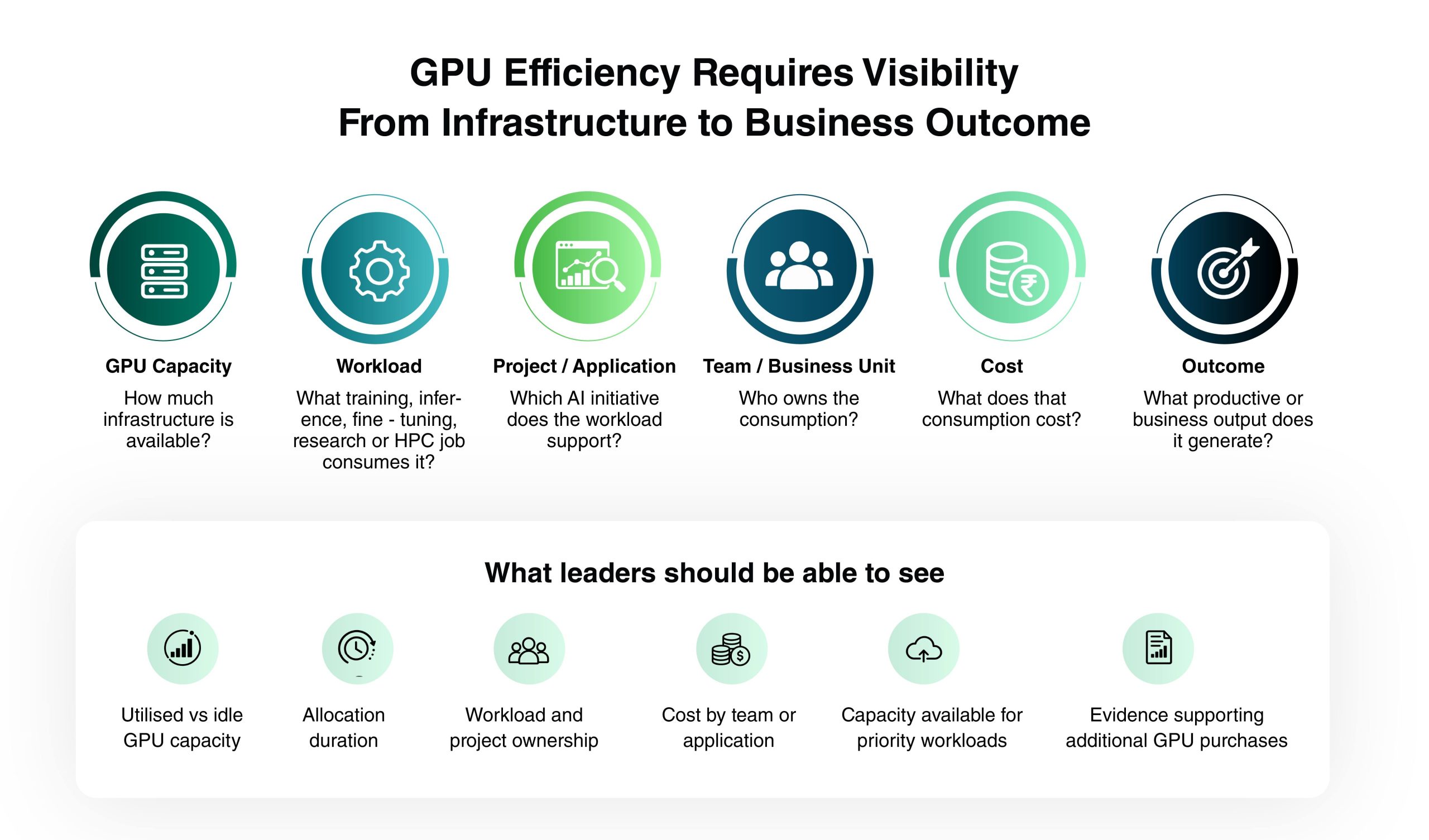
Utilisation problems are difficult to solve when organisations cannot connect infrastructure consumption to workloads and owners. Knowing that a GPU has been allocated is not enough. Leaders need to understand whether it is actively computing, how long the allocation remains open, which workload consumes it, and which team owns that workload.
This becomes particularly important as AI environments expand beyond a few specialised teams. A useful visibility chain should connect GPU capacity to cost. Without that, infrastructure teams see resource demand while finance sees aggregate expenditure. Neither has enough context to determine whether additional GPUs reflect real capacity constraints or inefficient consumption.
The operating model should therefore answer these basic questions:
- Which GPUs are active, idle or reserved, and for how long?
- Which teams, applications and AI programmes are consuming capacity?
- Which workloads are waiting because capacity has been allocated elsewhere?
- What does each workload cost, and who is accountable for that expenditure?
Visibility does not optimise infrastructure by itself. It creates the evidence required to optimise it.
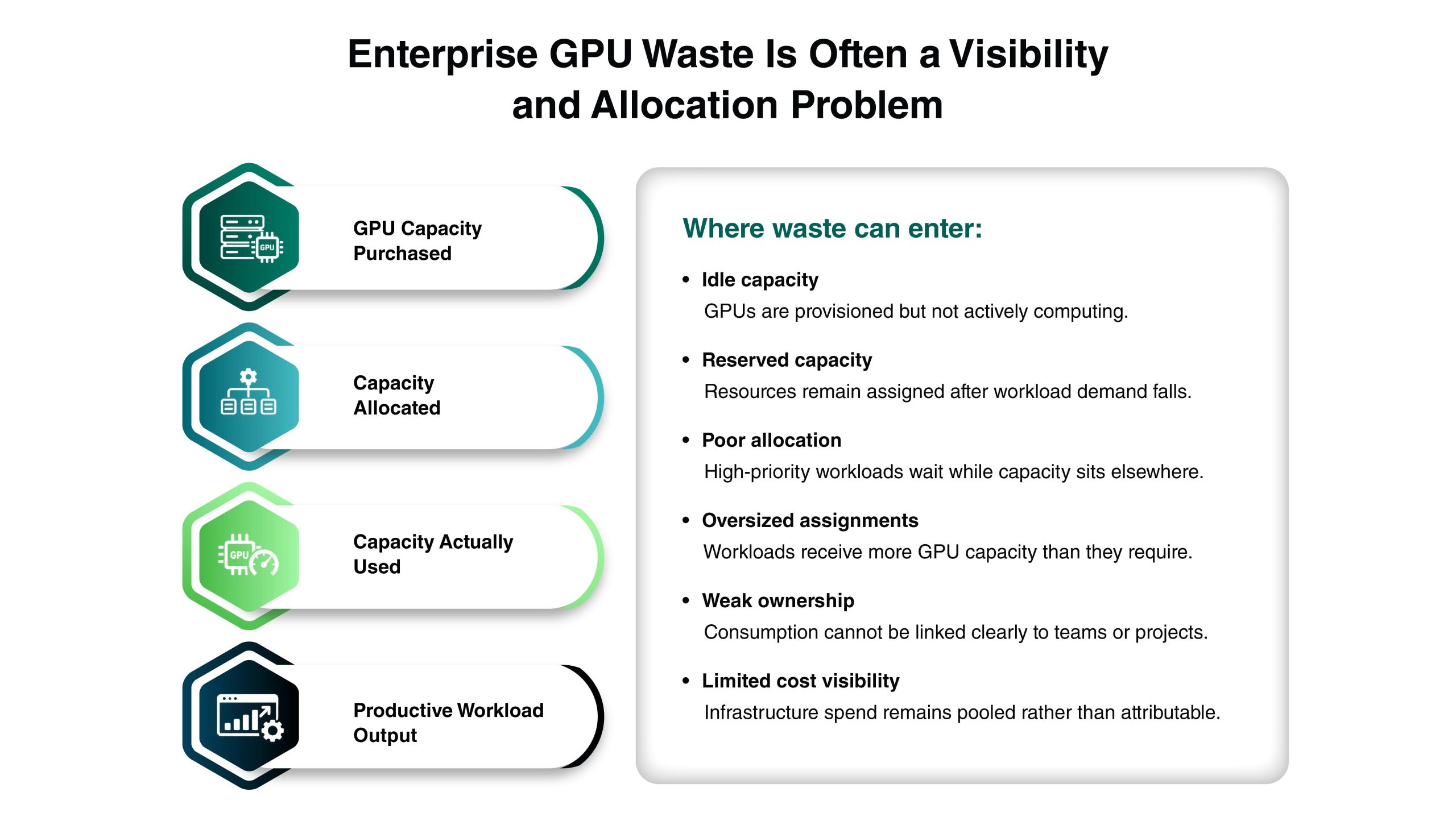
Scale Turns GPU Management into an Allocation Problem
GPU management becomes harder when more teams compete for the same resource pool. For a Soonicorn building its first substantial AI estate, the priority is establishing ownership, access controls and allocation rules before informal practices become embedded. Cost attribution is easier to introduce while the number of teams, projects and clusters remains manageable.
For larger unicorns and enterprises, the problem shifts from control to coordination. Training teams, inference services, researchers and product groups can simultaneously require capacity. Infrastructure leaders must decide which workload receives priority, how long capacity can remain reserved, and when resources should return to the shared pool. Allocation therefore becomes a business-policy decision as much as a scheduling decision.
That distinction matters because different workloads behave differently. Training may require large GPU pools for sustained periods. Fine-tuning can consume smaller, intermittent allocations. Inference prioritises availability and variable demand. Research environments value flexibility, while HPC jobs may require tightly coordinated resources. GPU VMs, Kubernetes, containers, SLURM and bare metal can all appear within the same organisation.
A single utilisation percentage cannot explain those differences.
Cost Attribution Turns GPU Consumption into Accountability
GPU utilisation becomes commercially useful when someone owns the consumption. The State of FinOps 2026 found that 98% of surveyed organisations now manage AI spend. The study included 1,192 respondents representing more than $83 billion in annual cloud spend, signalling how quickly AI economics have moved into mainstream technology-finance management.
The practical requirement is to connect consumption with responsibility.
That connection changes the capacity conversation. Teams requesting additional GPUs can be evaluated against existing utilisation and workload priority. Finance can distinguish strategic AI investment from persistent idle capacity. Infrastructure leaders can make purchasing decisions using evidence rather than aggregate demand.
A GPU cost that cannot be connected to a workload, owner or outcome cannot be properly governed or optimised.
This is also why utilisation should not be treated as a target percentage. A GPU estate operating close to capacity may leave insufficient headroom for production workloads. Conversely, lower aggregate utilisation may be justified by service-level requirements or demand variability. The better measure is whether infrastructure produces sufficient useful output while preserving capacity for priority workloads.
Better Allocation Can Create Capacity Before More GPUs Are Purchased
Better scheduling can materially change the economics of existing infrastructure. NVIDIA demonstrated this in 2026 by running three NIM inference workloads on approximately 1.5 H100 GPUs instead of three dedicated H100 GPUs, while retaining 91% to 100% of baseline throughput in its test environment. The result is vendor-specific rather than a universal benchmark, but it illustrates the economic effect of finer-grained allocation.
The implication is not that every enterprise should fraction GPUs. It is that apparent capacity shortages should be tested before they trigger another purchase. Organisations need to understand whether the constraint comes from genuine workload demand, static allocation, idle reservations, scheduling policies or infrastructure architecture.
Gartner makes a related distinction in its 2026 AI infrastructure research: high GPU utilisation does not necessarily mean an AI cluster is delivering high productive output. Infrastructure teams also need measures connected to workload output and efficiency.
Governance Should Make GPUs Easier to Consume and Harder to Waste
GPU governance should not become another approval layer. Its purpose is to create transparent rules for consuming scarce infrastructure. Role-based access, standard provisioning, workload prioritisation, utilisation visibility, cost attribution and auditability should operate as one model.
With that model in place, AI teams know what capacity they can request. Platform teams can see where resources move. Finance can understand ownership. Technology leaders can distinguish real capacity pressure from avoidable waste.
Before approving the next expansion of GPU infrastructure, leaders should be able to answer eight questions: how much capacity exists, how much is being used, who consumes it, which workloads run on it, what those workloads cost, what remains idle, who has access and whether more capacity is genuinely required.
CtrlS Accelerated Cloud Platform provides an operating model through provisioning, utilisation visibility, access governance and cost attribution.

Ratnapradeep Aravelli, Vice President , Engineering.
With over 16 years of experience across AI, cloud and platform engineering, he brings together deep architecture expertise with the leadership to build high-performing engineering teams and take products from idea to enterprise scale.
His current focus includes AI cloud platforms, GPU and HPC orchestration, unified control planes across multiple hypervisors and public clouds, LLM serving infrastructure, multi-tenant platforms for regulated industries, AIOps and predictive workflow automation, FinOps, and engineering excellence through DevSecOps and SRE. He builds platforms that run themselves, where AI shifts operations from reacting to problems to preventing them.

 marketing@ctrls.in