
Summarize with:
read in < 1 min
For Neocloud providers, securing megawatts of electricity is an important milestone. But it does not necessarily mean those megawatts are ready to power GPU infrastructure. At CtrlS, we view AI infrastructure readiness as a complete engineering and operational responsibility, extending from power availability and high-density datacenter design to cooling, networking, commissioning and eventual GPU deployment.
As AI infrastructure investments accelerate, the distinction between power that has been secured, infrastructure that has been installed, and capacity that is operationally ready becomes increasingly important. For Neocloud providers making substantial investments in GPU infrastructure, this distinction directly influences deployment timelines, capital efficiency, customer commitments and revenue realization.
Secured Power Is the Starting Point, Not the Finish Line
As discussed in our earlier article, The Megawatt Bottleneck, access to secured electricity capacity is becoming an important differentiator for AI infrastructure development. However, securing electricity is only one part of the equation.
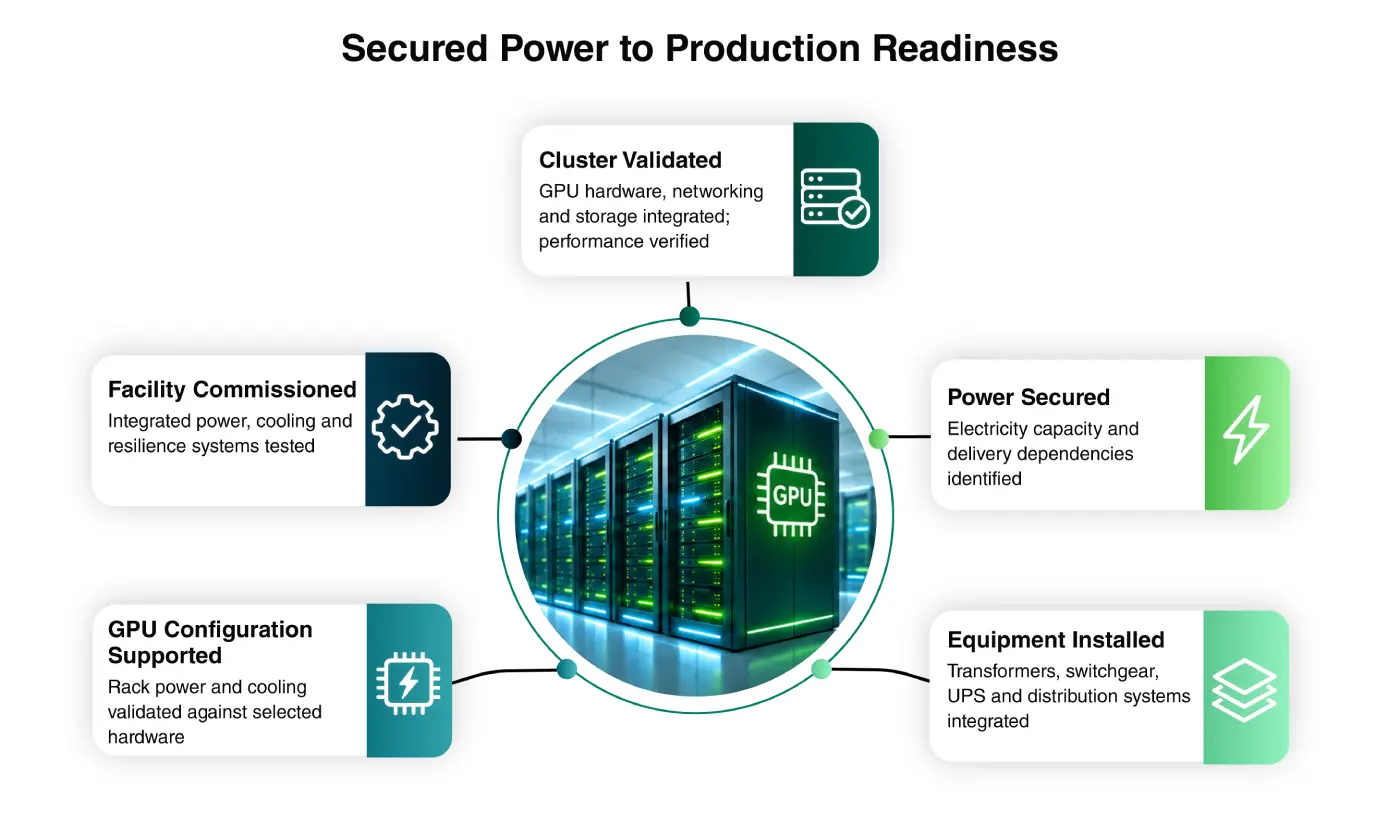
Between a utility connection and a GPU rack lies a complex chain of electrical infrastructure, including transformers, medium and low-voltage switchgear, UPS systems, backup generators, power distribution equipment and protection systems. These components must be appropriately designed, integrated, commissioned and maintained to support the required IT load and resilience architecture.
CtrlS’s approach is to evaluate infrastructure readiness across this entire delivery chain, rather than treating secured power capacity as equivalent to immediately deployable IT capacity.
This distinction is particularly relevant for Neocloud providers whose GPU procurement and customer contracts may be governed by specific deployment milestones. Our objective is to align the infrastructure design, project execution and operating requirements with the customer’s actual GPU deployment roadmap, while clearly identifying dependencies that may influence delivery.
Equipment Readiness Determines the Real Deployment Schedule
A datacenter may have secured power and completed significant construction work, yet still face dependencies involving electrical equipment procurement, testing, installation or commissioning.
The International Energy Agency’s 2026 research highlights continuing supply-chain constraints, including extended lead times for transformers and other critical electrical equipment. For large-scale AI deployments, these constraints reinforce the importance of early infrastructure planning and supplier coordination.
At CtrlS, our infrastructure strategy emphasizes evaluating critical equipment availability alongside power and facility readiness. This includes understanding which components are already operational, which have been procured, and which remain dependent on manufacturing, delivery or commissioning milestones.
Factory Acceptance Testing (FAT), Site Acceptance Testing (SAT) and integrated systems testing represent different stages of equipment validation. Completing one stage does not automatically establish readiness across the entire infrastructure chain.
The practical measure of readiness is not whether individual equipment has been ordered or delivered, but whether the integrated infrastructure can safely and reliably support the intended GPU load.
For Neocloud customers, visibility into these milestones is essential for realistic capacity planning and commercial commitments.
GPU Density Requires Infrastructure Designed Around the Hardware
AI infrastructure is fundamentally changing traditional datacenter design assumptions. GPU clusters introduce significantly higher power densities, concentrated thermal loads and additional requirements for electrical distribution, cooling, networking and operational resilience. The infrastructure supporting a conventional enterprise rack may not be suitable for a high-density GPU deployment without modification.
CtrlS’ AI-ready infrastructure strategy recognizes that different GPU configurations require different facility-level engineering considerations. We develop and support high-density infrastructure designs that incorporate advanced power distribution and cooling approaches, including direct-to-chip liquid cooling and other liquid-assisted technologies, depending on the specific facility and deployment requirements.
Rack density and cooling compatibility must be validated against the actual GPU hardware, OEM specifications and selected site configuration.
Liquid cooling, for example, introduces additional infrastructure elements such as Coolant Distribution Units (CDUs), secondary coolant networks, manifolds, piping, leak detection, temperature controls and operational monitoring. These systems must work in coordination with the electrical infrastructure, and their implementation requires careful consideration of maintenance procedures, failure scenarios and operational responsibilities.
For CtrlS, the objective is not simply to accommodate higher rack power densities. It is to establish an infrastructure architecture that is appropriate for the workload, maintainable throughout its operating lifecycle and capable of supporting future expansion within defined engineering limits.
GPU Readiness Extends Beyond Power and Cooling
Power and cooling may determine whether GPU hardware can be installed, but they do not independently establish whether a GPU cluster is ready for production. Large AI and HPC environments also require appropriately designed networking, storage connectivity and infrastructure management.
Depending on the workload, this may involve InfiniBand or Ethernet-based fabrics, high-bandwidth storage networking, management connectivity, cabling, transceivers and supporting network equipment. These dependencies become particularly important when customers are deploying tightly coupled training clusters or expanding an existing GPU environment.
CtrlS’s infrastructure planning approach considers these requirements early in the design process, with the relevant responsibilities defined between CtrlS, equipment suppliers, system integrators and customers. This helps identify requirements that could otherwise emerge late in the deployment cycle and affect commissioning or cluster readiness.
Facility acceptance and GPU cluster acceptance must also be treated as separate milestones. Even after power and cooling infrastructure has been commissioned, the GPU environment may require additional installation, integration and performance validation before customer workloads can enter production.
Existing Datacenter Capacity Can Accelerate Deployment When the Configuration Fits
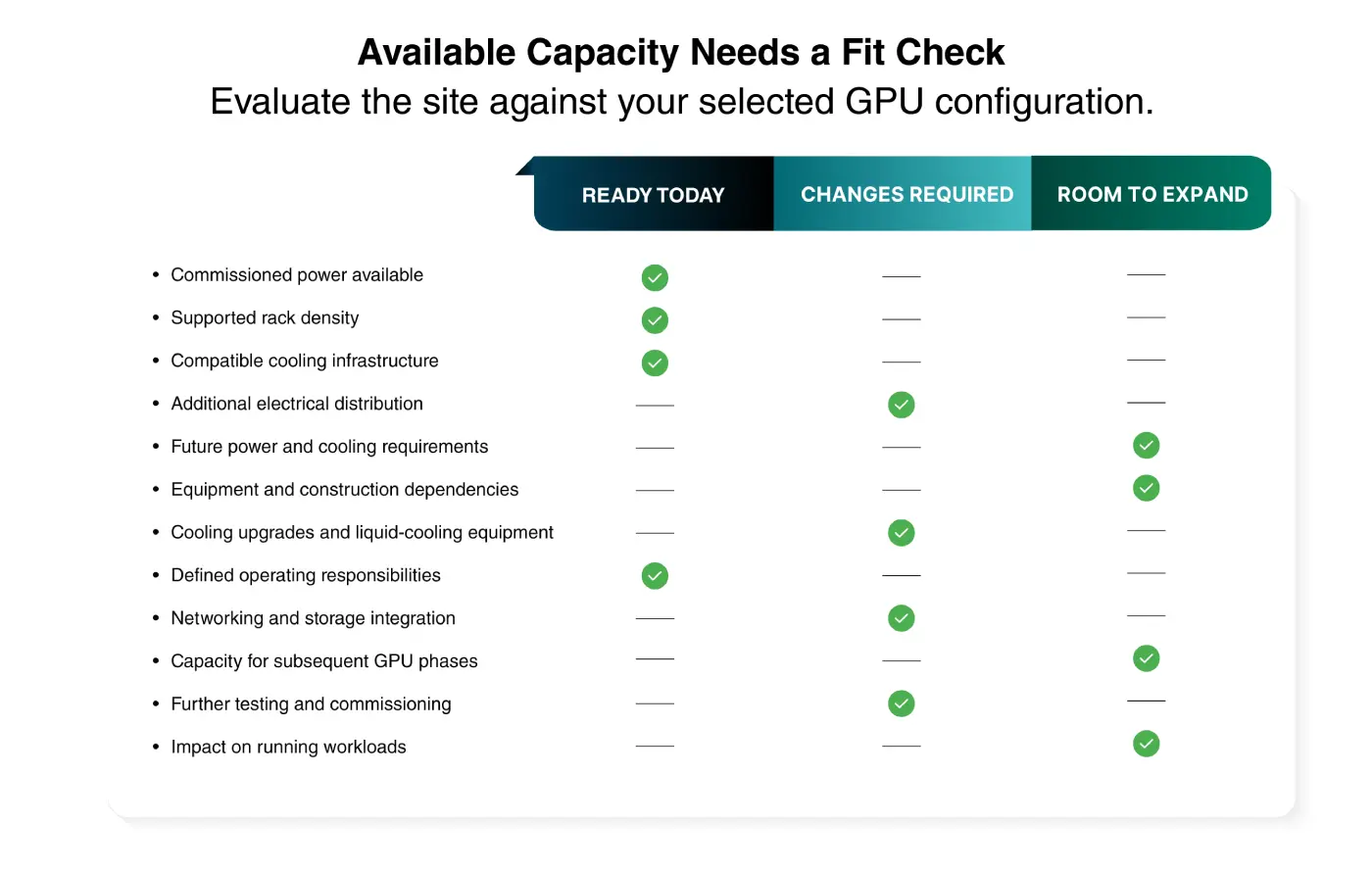
An existing datacenter hall may provide a faster route to deployment than building entirely new infrastructure. However, the availability of floor space or electrical capacity does not automatically establish compatibility with a specific GPU configuration.
At CtrlS, we evaluate deployment options based on the installed infrastructure, supported rack densities, cooling architecture, operational readiness and potential expansion requirements. For suitable workloads, an existing facility may reduce the scope of new construction and equipment installation. For higher-density or larger-scale deployments, additional electrical distribution, cooling infrastructure or dedicated halls may be required.
Our approach is to determine the appropriate deployment model based on the customer’s immediate requirements and longer-term capacity roadmap, rather than assuming that a single infrastructure configuration can serve every AI workload.
For Neocloud providers, this evaluation should address three important considerations:
- Current readiness: What power, cooling and supporting infrastructure is already installed, commissioned and available for the intended GPU configuration?
- Deployment flexibility: What modifications or additional equipment would be required for the selected hardware and its expected operating conditions?
- Expansion readiness: How can additional GPU capacity be introduced in subsequent phases while managing dependencies and minimizing disruption to existing operations?
The outcome should be a deployment plan based on site-specific infrastructure readiness, not simply an advertised power or rack-capacity figure.
Commissioning Establishes Confidence in Operational Readiness
The installation of infrastructure is an important project milestone. Commissioning provides the evidence that the integrated systems perform as intended. For high-density AI facilities, this includes validation of electrical distribution, UPS operation, generator transitions, protection coordination, cooling performance and the intended resilience architecture. Liquid-cooled environments introduce additional requirements around coolant circulation, temperature management, leak detection and cooling continuity.
The Uptime Institute’s October 2026 research on liquid-cooled commissioning highlights the need for adapted load-simulation equipment and commissioning procedures for direct liquid cooling environments.
At CtrlS, we consider commissioning evidence, documented operating procedures and defined handover responsibilities essential elements of infrastructure readiness. The testing approach must reflect the actual facility design, installed equipment, operating conditions and agreed customer requirements.
Commissioning should establish what the infrastructure has been demonstrated to support, rather than create assumptions about future capacity or performance.
This distinction enables customers to make better-informed decisions about hardware deployment and production planning.
CtrlS’s Strategy: Align Infrastructure Readiness With Customer Deployment Milestones
For Neocloud providers, the challenge is not only securing infrastructure capacity but coordinating multiple interdependent investments. GPU hardware procurement, datacenter power readiness, cooling systems, networking, storage and operational acceptance must progress through a realistic and integrated delivery plan.
CtrlS’s strategy is to bring infrastructure engineering, deployment planning and operational considerations into the customer engagement process from an early stage. This means establishing clear visibility into the infrastructure that is available today, the additional work required for the selected GPU configuration and the dependencies associated with future expansion phases.
It also means aligning commercial commitments with documented infrastructure milestones and clearly defined responsibilities. Depending on the engagement model, CtrlS may support customers through high-density colocation, dedicated infrastructure environments and associated engineering and managed services.
The exact scope must be established for each deployment, particularly where GPU hardware, interconnect equipment or other technology components are supplied or operated by different parties. This approach is important because a successful AI infrastructure investment is measured not only by the capacity deployed, but also by the infrastructure’s reliability, operating efficiency, scalability and ability to support the intended business requirements over time.
From Megawatts to Sustainable AI Infrastructure
As AI investment grows, Neocloud providers will increasingly evaluate datacenter partners on more than the quantity of power available. The ability to translate secured electricity into usable, commissioned and operationally dependable GPU infrastructure will have a direct bearing on deployment execution and investment outcomes.
For CtrlS, this reinforces our focus on high-density infrastructure engineering, scalable facility design, operational resilience and disciplined capacity delivery. Our objective is to help customers make infrastructure investment decisions based on verifiable capabilities, realistic deployment milestones and a clear understanding of technical and operational responsibilities.
In the AI infrastructure business, securing a megawatt is an important starting point. Turning that megawatt into reliably operating GPU capacity is where engineering, execution and long-term customer trust come together.

Chetan Sonar, SVP – GPU Cloud & AI Orchestration, CtrlS Global
With over 21 years of experience across datacenters, cloud, managed services and AI infrastructure, he brings together deep technology expertise with business and operational leadership.
His current focus includes AI datacenter strategy, GPU cloud architecture, high-density infrastructure, AI/HPC orchestration, multi-tenant GPU platforms, performance engineering, TCO and pricing models, and the evolution of datacenters into AI factories. He is particularly interested in where engineering decisions become business decisions, connecting architecture, performance, automation, economics and customer experience.

 marketing@ctrls.in