
Global Capability Centres in India were once designed mainly for cost-efficient delivery and operational support. That mandate has changed. Many now own global platforms, product engineering, data, artificial intelligence, cybersecurity and business-critical processes. Yet infrastructure strategy often remains concentrated at the enterprise headquarters.
India’s GCC leadership model already reflects this shift. According to NASSCOM-Zinnov (original article/Report link), 64% of GCC site leaders now hold dual mandates connecting site leadership with global business-unit ownership. As accountability moves closer to India, infrastructure influence must follow. Where architecture and hosting decisions remain centrally controlled, GCC teams can become responsible for application performance, security and availability without having sufficient control over the environments producing those outcomes.
As GCCs Own Critical Capabilities, They Inherit Infrastructure Consequences
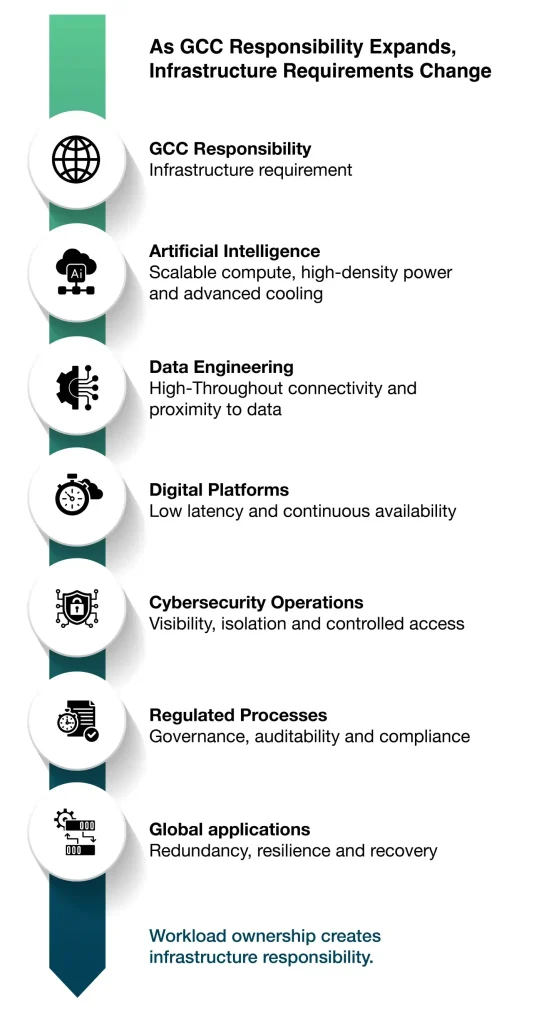
Traditional GCC workloads could depend largely on office connectivity and applications hosted elsewhere. Today’s responsibilities create different infrastructure demands. Artificial intelligence needs scalable compute, high-density power and advanced cooling. Data engineering depends on high-throughput connectivity and proximity to large datasets. Digital platforms require low latency and continuous availability.
The same connection applies elsewhere. Cybersecurity teams need visibility, controlled access and workload isolation. Regulated processes require governance, auditability and compliance. Global platforms need redundancy, recovery and dependable operations. These are not secondary technical considerations. They shape performance, security, resilience and the speed at which GCC teams can deliver business outcomes.
The shift is visible in both scale and responsibility. India added more than 400 GCCs and 1,100 GCC units over the five years ending in 2025, while engineering research centres grew 1.3 times faster than the overall GCC market. Global leadership roles within Indian GCCs are expected to rise from approximately 6,500 to more than 30,000 by 2030. These numbers point to a structural change: India is not only executing enterprise work but increasingly leading the products, platforms and capabilities behind it. (Govt. of India)
Cloud Remains Essential, But the Workload Must Determine the Environment
Public cloud is central to modern enterprise architecture, but cloud-first should not automatically mean cloud-only. Some workloads are better suited to dedicated or collocated infrastructure, particularly when demand is predictable, operations are continuous or the enterprise needs tighter control over performance, security and cost.
Sensitive data, private artificial intelligence models, legacy applications, network and security appliances, and applications with specialised infrastructure requirements need dedicated environments. At sufficient scale, steady workloads can also expose unfavourable cloud economics. The right question is therefore not whether an enterprise should choose cloud or colocation. It is which operating environment best fits each workload.
That decision produces a hybrid architecture. Public cloud can provide elasticity, managed services and rapid experimentation. Colocation or private infrastructure can support predictable capacity, specialised hardware, sensitive data and controlled operating environments. The design should follow application behaviour, economics and risk—not an enterprise-wide preference applied indiscriminately.
Infrastructure Should Move Closer to Operational Responsibility
If India-based teams build, operate and secure global capabilities, locating relevant infrastructure in India can strengthen their operational control. It places applications and data closer to engineering, platform, security and support teams. That can reduce latency for locally accessed systems, accelerate incident response and simplify infrastructure changes that otherwise cross regions, time zones and organisational boundaries.
India also offers domestic cloud regions, carrier ecosystems and multiple datacenter markets. Enterprises can combine public cloud, private environments and colocation while designing resilience across cities. This is particularly relevant for regulated data, private artificial intelligence and sensitive enterprise workloads that require greater control over placement, access and governance.
The principle is straightforward: infrastructure should move closer to the teams, data and operational responsibility it supports. It should not remain in a distant region merely because enterprise headquarters or a historical architecture placed it there. Legal ownership may be global, but operational dependency increasingly sits in India.
Hyderabad Brings Talent, Workloads and Infrastructure into One Operating Ecosystem
Hyderabad becomes relevant after the India decision—not before it. Its strength comes from the convergence of three ecosystems: a large GCC base, an expanding cloud and datacenter market, and deep capability across technology, life sciences, healthcare and enterprise engineering.
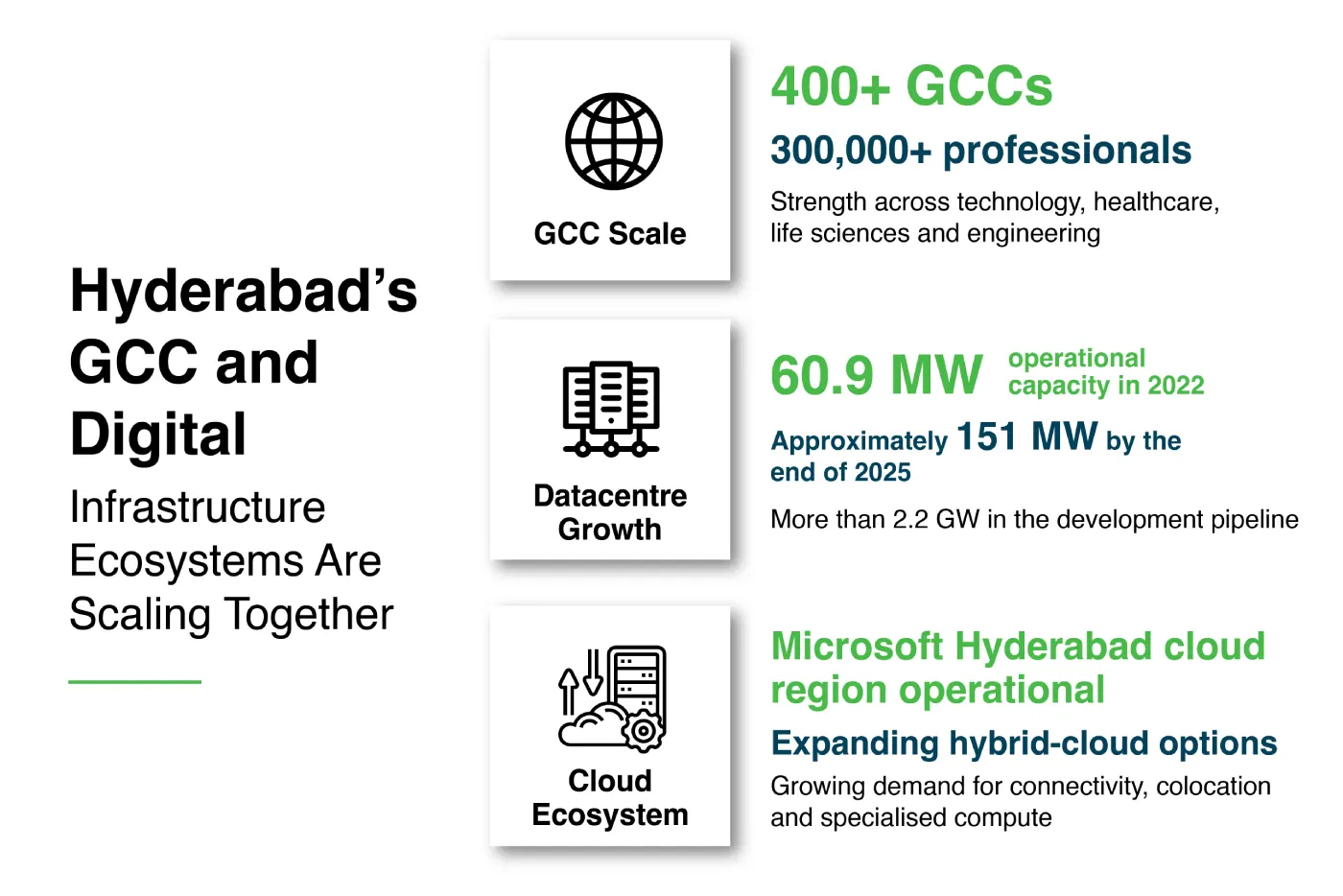
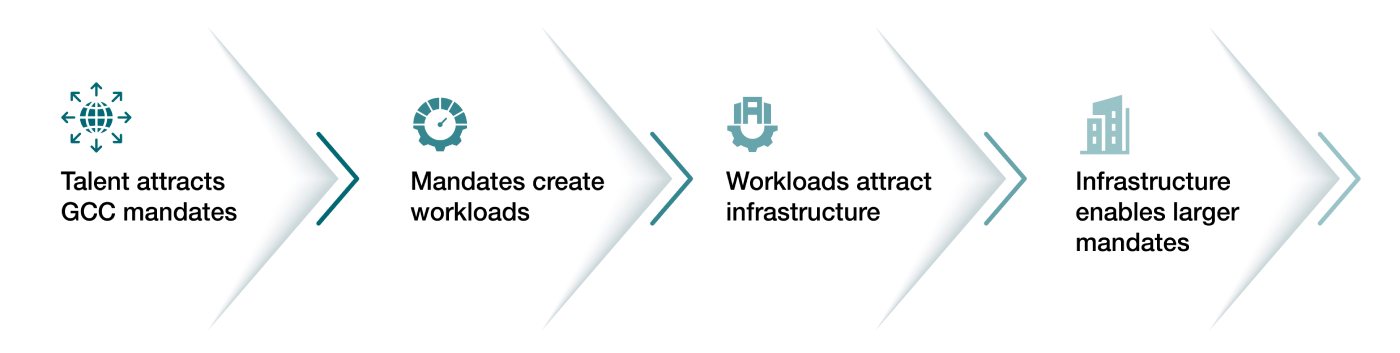
The scale on both sides is becoming measurable. Hyderabad hosts more than 400 GCCs employing over 300,000 professionals, according to the Telangana government. Its operational datacenter capacity increased from 60.9 MW in 2022 to approximately 151 MW by the end of 2025, while the development pipeline has crossed 2.2 GW. Microsoft has also launched its Hyderabad cloud region, giving the city another foundation for hybrid architectures. Talent is attracting workloads; those workloads are now attracting the cloud, colocation and compute capacity needed to support them. (Times of India, Knight Frank, Microsoft)
Proximity Creates Value for The Workloads That Need It
Proximity becomes valuable when the GCC operates latency-sensitive applications, large data platforms, artificial intelligence inference, private cloud, engineering environments, security operations, regulated databases or business-critical systems requiring local support.
As data volumes and application dependencies grow, distance introduces measurable costs. Teams may face higher latency, slower data movement, greater dependence on long-distance routes and more complex incident coordination. Placing selected infrastructure closer to its operators can reduce that friction without requiring the entire enterprise estate to move.
Hyderabad can support two distinct roles. For local GCCs, it can become a primary colocation market, the private component of a hybrid-cloud design or a dedicated environment for sensitive workloads. For GCCs elsewhere in India, it can provide secondary capacity, geographic separation, recovery infrastructure or support for a hub-and-spoke operating model.
The limitations must remain part of the decision. Hyderabad is an inland market, so carrier diversity and route design require careful evaluation. Concentrating teams and infrastructure in one city can also increase geographic risk. The answer is not to avoid Hyderabad, but to place it within a multi-city resilience strategy.
Local Experience and Scalable Colocation for Hyderabad GCCs
For GCCs evaluating Hyderabad, CtrlS brings the advantage of established local operating experience backed by a wider multi-city datacenter footprint. Its three Hyderabad datacenters support requirements ranging from individual racks and secure cages to dedicated halls, while its broader capabilities span high-density infrastructure, hybrid-cloud connectivity, security, managed operations and multi-city resilience. This allows GCCs to align infrastructure with each workload while retaining room to scale. Explore CtrlS Colocation Services.

Praneeth Busireddy, VP - Enterprise Colocation Sales, CtrlS Datacenters
Praneeth is a seasoned IT professional with over 20 years of industry experience. Currently, he leads Mid-Market business across India and manages colocation services for Telangana and Andhra Pradesh. With deep industry expertise, strong business acumen, and extensive experience in datacenter services, Praneeth brings valuable insights and leadership to every engagement.

 marketing@ctrls.in