
Every infrastructure decision starts with a good reason. The setup meets the requirements. The capacity looks right. The contract is signed, and everything goes live on time. For a while, it feels like the perfect call.
Then the business moves. AI workloads arrive. A new market opens. A new regulation lands on the CIO’s desk. Suddenly, the infrastructure that fit so well feels like it was built for a different company.
This is the quiet risk in many infrastructure decisions. Nothing breaks, and nothing fails. The setup simply stops keeping up. What fits today can quietly limit tomorrow.
The “good for now” trap
Most infrastructure decisions are made around current needs: cost, speed, and capacity. That is a sensible way to decide. Teams have deadlines, budgets, and workloads to support today, and they choose what solves those problems best.
The trouble is that business needs rarely stay still. Plans change, markets shift, and technology moves faster than most contract cycles.
The cost of that gap is easy to miss because it doesn’t show up on the invoice. It shows up later, when you try to change direction and find the road is narrower than you expected. That is where optionality comes in. In one line, it is the freedom to change course without paying a penalty.
Three ways flexibility slips away
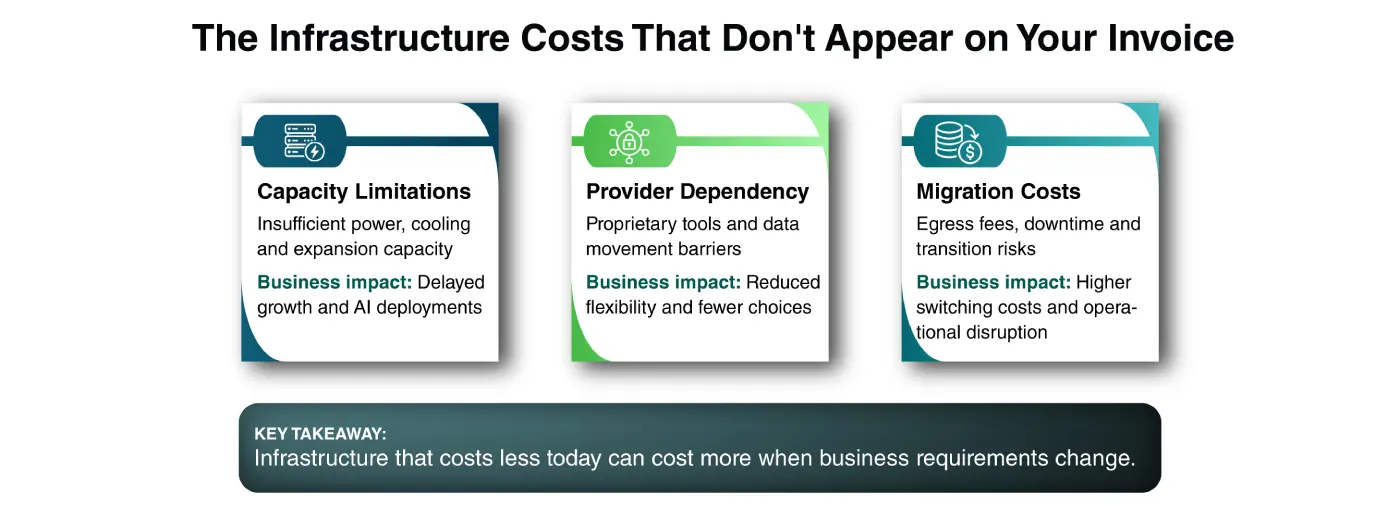
Flexibility rarely disappears all at once. It fades through a few common patterns.
1. Limited room to grow: Datacenters can’t easily add capacity or new locations. Others can’t support AI-ready, high-density environments, which need far more power and cooling than traditional racks. A growing number of operators now report peak rack densities of 30 kW or higher to support advanced computing workloads. Our CIO guide to high-density rack strategy covers how to plan for it.
2. Provider dependency: Over time, proprietary tools and growing data volumes make moving harder every year. This leads to vendor lock-in. The more data and applications sit in one place, the more that place pulls on everything else, and the fewer choices you have when needs change. The UK’s Competition and Markets Authority found in its 2025 cloud market investigation that egress fees are a key commercial barrier to switching providers or using more than one cloud. And from 12 January 2027, the EU Data Act stops providers from imposing switching charges on customers who move to another service.
3. Migration costs: Moving takes time, carries risk, and can mean downtime. Data transfer (egress) fees add to the bill, and these costs grow the longer you wait. Many enterprises stay where they are not because it is the best fit, but because leaving looks too expensive. For a closer look at this trade-off, read Outages Changed Everything: Cloud Repatriation Is No Longer Optional.
What it looks like in real life
These constraints sound abstract until the business runs into one.
- A new AI workload needs more power and speed than the current setup can give. The project waits while the infrastructure catches up, and the competitive window may not wait with it.
- A new regulation requires data to stay in-country, but the setup is built around a single region. What began as a compliance question turns into an infrastructure rebuild. India already has rules of this kind. the Reserve Bank of India directed payment system providers to store their payment data in systems located only in India. Our guide to DPDP 2025 for CXOs and datacenters explains what the newer data protection rules mean for infrastructure.
- A sudden demand spike exposes the cost of capacity that can’t scale on demand. Teams either overpay for capacity they rarely use, or fall short when it matters most. Flexera’s 2026 State of the Cloud report puts estimated wasted spend on cloud infrastructure and platform services at 29%, the first rise in five years.
In each case, the infrastructure worked exactly as designed. It just wasn’t designed for what came next.
Flexibility is strategy, not a luxury
It is tempting to treat flexibility as a technical detail for the engineering team. It is better seen as a business decision, because its effects reach well beyond the datacenter.
CTOs, CIOs, and CFOs should weigh optionality alongside uptime, security, and cost. It shapes how fast the business can launch new services, how well it handles disruption, and how much control it keeps over spending as plans change.
Put simply, flexible infrastructure gives the business speed when opportunities appear, resilience when conditions change, and cost control when plans shift. Rigid infrastructure does the opposite, and the bill arrives at the worst possible time.
How to build in optionality: questions to ask before you sign
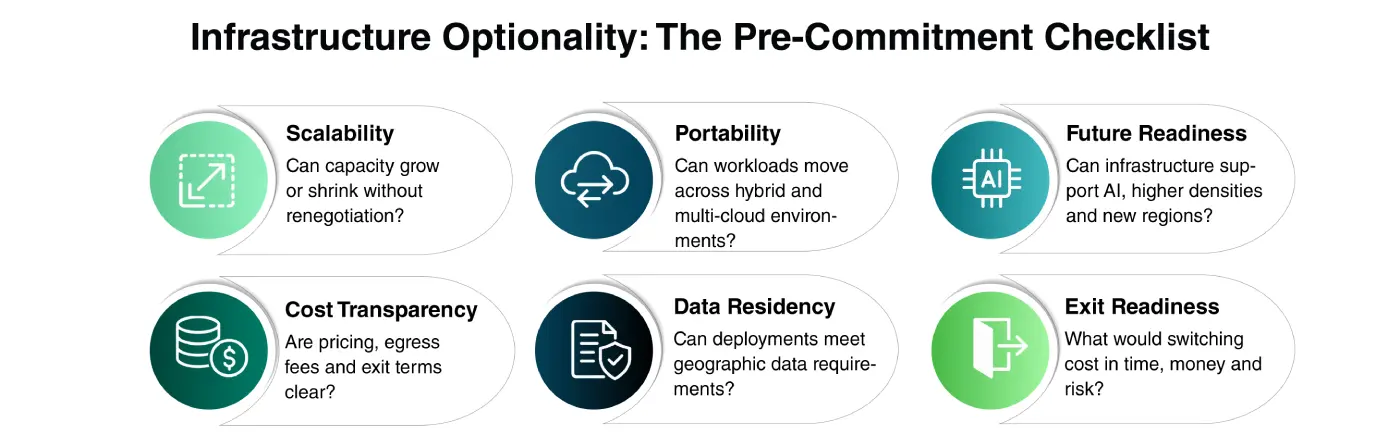
Optionality is easiest to build in at the start. Before committing to any infrastructure decision, it helps to ask:
- Can we scale up or down without renegotiating?
- Can we move workloads between environments (hybrid or multi-cloud) without a rebuild?
- Can we grow into new needs, such as AI, new regions, or higher density?
- Are pricing and exit terms clear, including data transfer costs?
- Can we meet data residency rules wherever we operate?
- What would leaving cost, in time, money, and risk?
These questions take a few minutes to ask now. If the answers are unclear today, they will only get harder to find tomorrow.
The CtrlS perspective
Enterprises need the flexibility to scale capacity as demand grows, connect seamlessly across environments, and adapt to emerging requirements, from AI workloads and geographic expansion to evolving regulations.
At CtrlS, we understand that infrastructure delivery timelines directly affect how Neocloud providers meet customer commitments. Our experience operating 19 datacenters across 9 Indian markets, with over 370 MW of capacity, demonstrates our ability to deliver and manage infrastructure at scale. Our customer base includes 5 of the world’s top 7 hyperscalers, reflecting our experience supporting large-scale infrastructure requirements.
CtrlS offers deployment flexibility, from individual racks to dedicated, built-to-suit buildings, allowing Neocloud providers to align infrastructure commitments with customer demand. Our phased campus expansion strategy supports capacity growth as requirements evolve.
None of this is about size for its own sake. It is about making sure that when your needs change, your infrastructure partner has room to say yes. The goal isn’t to predict the future. It is to be ready for whichever one arrives.

Praneeth Busireddy, VP - Enterprise Colocation Sales, CtrlS Datacenters
Praneeth is a seasoned IT professional with over 20 years of industry experience. Currently, he leads Mid-Market business across India and manages colocation services for Telangana and Andhra Pradesh. With deep industry expertise, strong business acumen, and extensive experience in datacenter services, Praneeth brings valuable insights and leadership to every engagement.

 marketing@ctrls.in