
For many years, India’s digital infrastructure landscape had two big dots on it, Mumbai and Chennai. Global data landed there, and the rest of the country plugged in from those points, but now the map is being reimagined – from Kolkata, along the Bay of Bengal, to Visakhapatnam in South India. Datacenters and the supporting subsea cable infrastructure are emerging rapidly in these regions. The two cities are located roughly 1,000 km apart, but together they’re starting to serve as one corridor.
Here’s how both cities are coming together, and why it matters for enterprises.
Why the east, and why now
Let’s start with demand, because that’s what sets everything else in motion. According to Wood Mackenzie, India’s datacenter capacity is expected to surpass 12 GW by 2030, with AI-dedicated capacity growing from 275 MW in 2025 to 6,546 MW in 2030. Cushman & Wakefield counts 1,789 MW of operational capacity across India’s top seven markets as of H1 2026, with another 3,860 MW expected by 2030. Knight Frank adds that 371.5 MW came online in 2025 alone, with more than 8 GW committed or planned. The same C&W report notes that India has about 825,000 people for every MW of live capacity, which tells you how much room there is to build.
This growth in capacity means that investments are pouring into India. CBRE expects datacenter investment commitments to cross $100 billion by 2027. Demand at that scale can’t reside in two or three cities. It needs new gateways, and India’s east coast is prepared to be one.
Visakhapatnam: the AI and subsea anchor
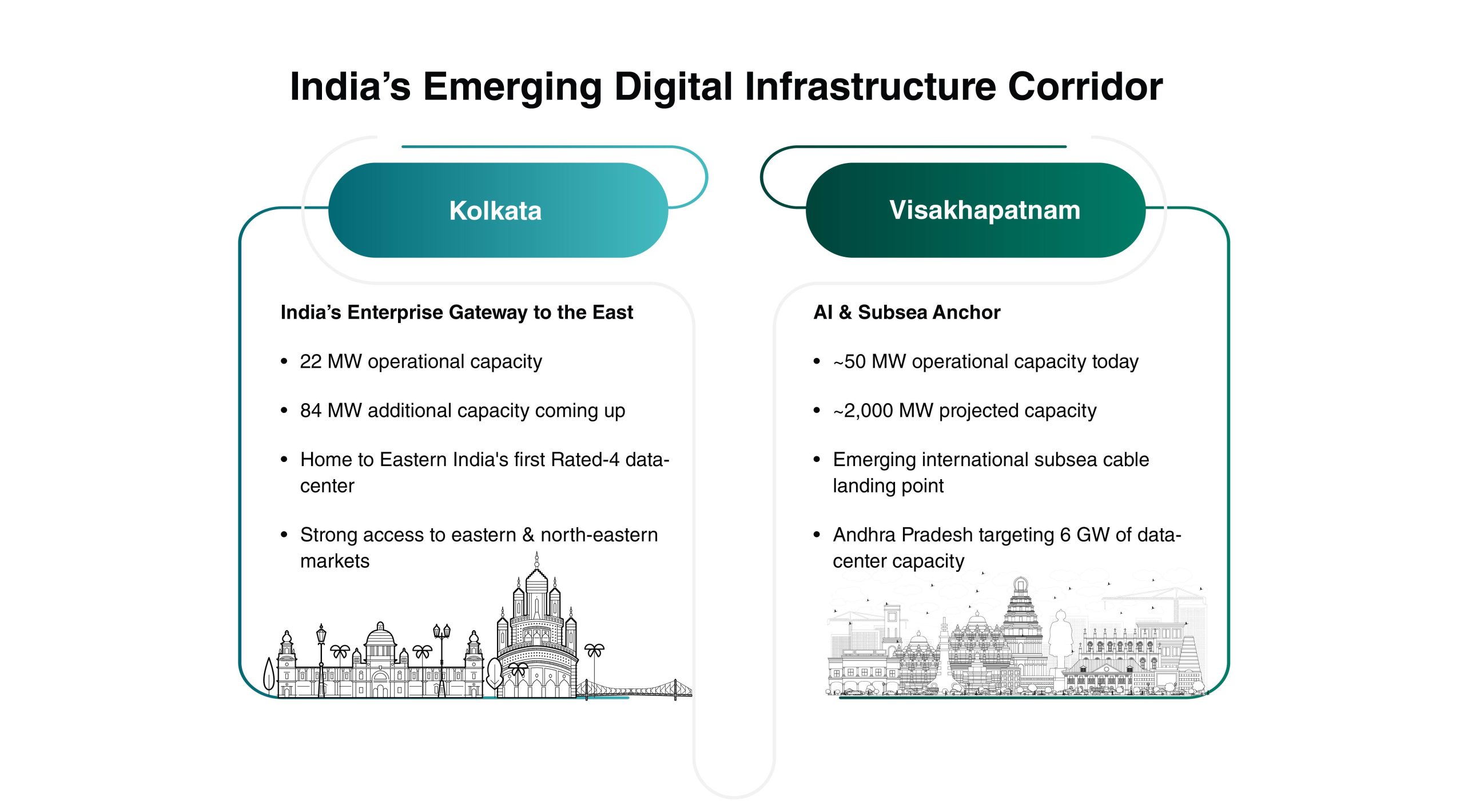
This is the city where the region’s digital growth story gets bigger. The city’s operational datacenter capacity is expected to grow from around 50 MW today to roughly 2,000 MW in the years ahead. Andhra Pradesh government has set a 6 GW capacity target for the state, and agreements covering about 5.6 GW have already been signed. State officials have said Andhra Pradesh drew close to 25 percent of all foreign direct investment into India in 2025, with the vision framed as a “data city” spanning roughly a 100 km radius.
The subsea layer is just as important in the growth story. Visakhapatnam is emerging as a landing point for international subsea cables linking India to Singapore and other global hubs, opening new international gateways that sit alongside the country’s existing cable landing infrastructure in Mumbai and Chennai. Greater cable routes into the country will bring shorter paths and steadier connectivity for the region and beyond.
The scale of digital infrastructure development is reshaping the city itself. A recent industry report projects Visakhapatnam’s datacenter ecosystem to generate over 50,000 jobs. Recognising this potential and to encourage the growth of datacenters, the state’s Data Centre Policy 4.0 offers GST reimbursement on capital goods and a capital subsidy on machinery for qualifying projects.
Kolkata: the enterprise gateway to the east
Kolkata, located at the other end of the corridor, is emerging too. As per Cushman & Wakefield, Kolkata’s operational datacenter capacity currently stands at 22 MW, with additional 84 MW more on the way. This is a clear sign of the industry’s growing interest in eastern India.
The Bengal Silicon Valley in New Town is the center of that growth momentum, major companies committing significant investments. CtrlS, for instance, has launched eastern India’s first Rated-4 datacenter at the campus with 16 MW of live capacity, scaling to over 60 MW. The facility is AI-ready, with provision for high-density racks and energy-efficient cooling.
So, what makes Kolkata a favourable destination?
Kolkata is the closest major metro to eastern and north-eastern India, and to Nepal, Bhutan and Bangladesh. Leveraging the city’s geographical advantage, banks, insurance companies, PSUs, government bodies and manufacturing companies in the region can keep their data close to operations. Whereas, for companies with primary locations in Mumbai, Delhi, Bengaluru and other metros, Kolkata is a natural home for a disaster recovery site in a different part of the country.
What ties the two ends together
A corridor means a lot more than the cities themselves. It needs fiber connectivity, power infrastructure, cable landing stations and a strong policy pulling everything in the same direction. West Bengal’s 2021 datacenter policy has already drawn 11 companies to set up infrastructure in the state, and Andhra Pradesh is offering its own strong incentives. Both ends of the corridor now have policies that welcome datacenters.
What this means for businesses
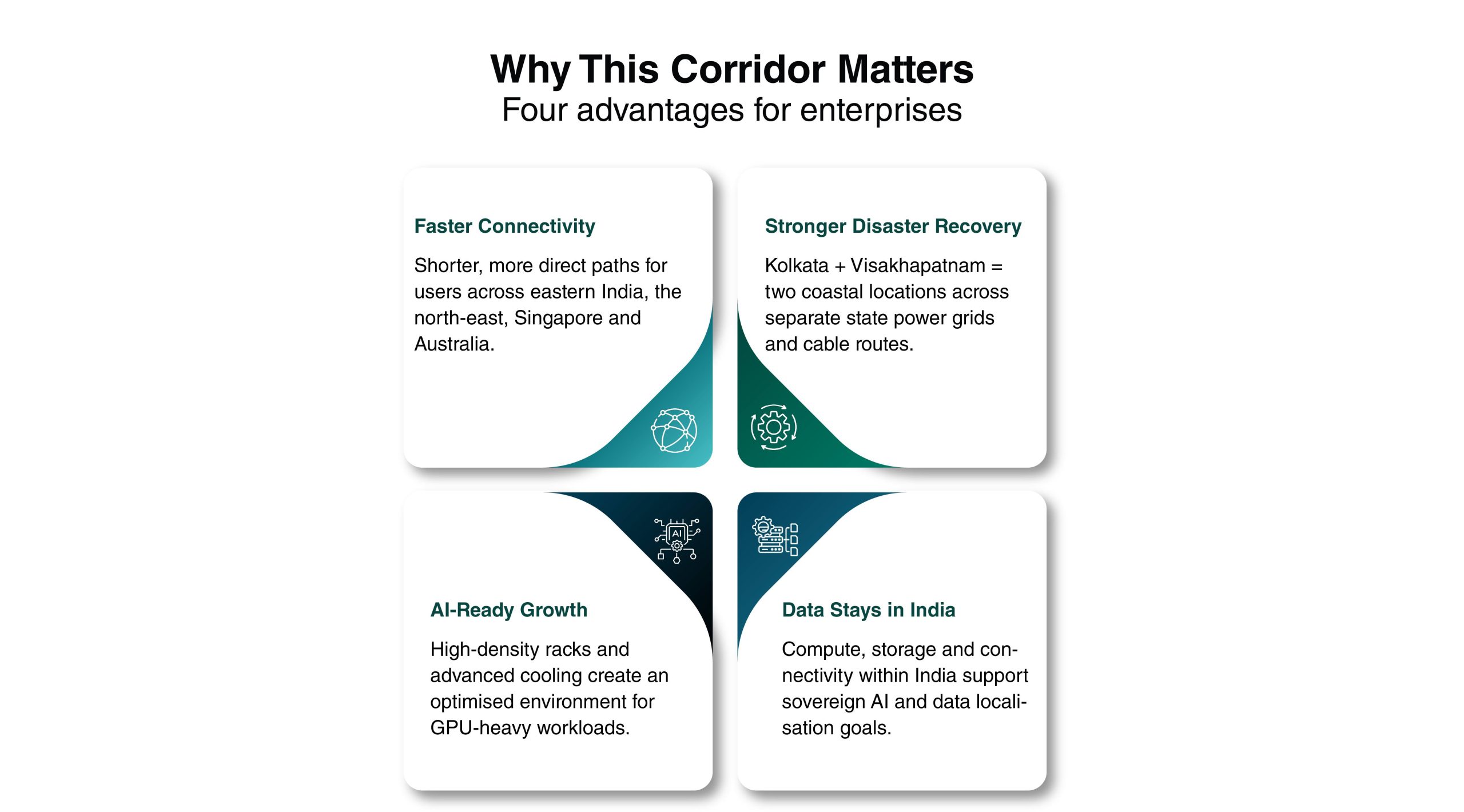
For enterprises planning their next infrastructure move, this corridor delivers several clear advantages.
- Faster experiences in the eastern region and beyond: Users across eastern India and the north-east, and traffic heading to Singapore and Australia, get shorter, and more direct connectivity paths.
- Stronger disaster recovery: Pair a site in Kolkata with another site in Visakhapatnam and you get two coastal locations with separate state power grids and separate cable routes.
- Room to grow with AI: New datacenter campuses are being designed for high-density racks and advanced cooling, so GPU-heavy workloads have an optimised environment to operate in.
- Data stays in India: Sovereign AI and data localisation goals are easier to meet when compute, storage and connectivity all sit within the country.
The road ahead
About a decade ago, nobody would have called Kolkata to Visakhapatnam a digital corridor. However today, it has a hyperscale AI hub, new subsea gateways, a growing set of datacenters and enterprise-grade facilities, and governments ready to back them. Kolkata brings the enterprise base, the neighbouring markets and the eastern landing point. Whereas, Visakhapatnam brings digital infrastructure, and subsea connectivity. Between them, India’s digital backbone gets a strong new spine along the Bay of Bengal. If you’ve been thinking of the east as tomorrow’s story, it’s worth another look. The building is happening now.

Kallol Sen, EVP & Regional CEO, CtrlS Datacenters
With over 28 years of experience in IT solution sales and business growth across government, manufacturing, energy and utilities, banking, and financial services sector, Kallol has successfully led growth strategies across accounts, territories, verticals, and channel ecosystems, driving sustained business expansion and customer engagement. Kallol brings extensive expertise in system integration services, business development, account management, alliances, and channel performance. With end-to-end experience spanning consulting to implementation, he is known for building strong client relationships, delivering enterprise solutions through proven delivery models, and driving high-performance sales organizations.

 marketing@ctrls.in