
Summarize with:
read in < 1 min
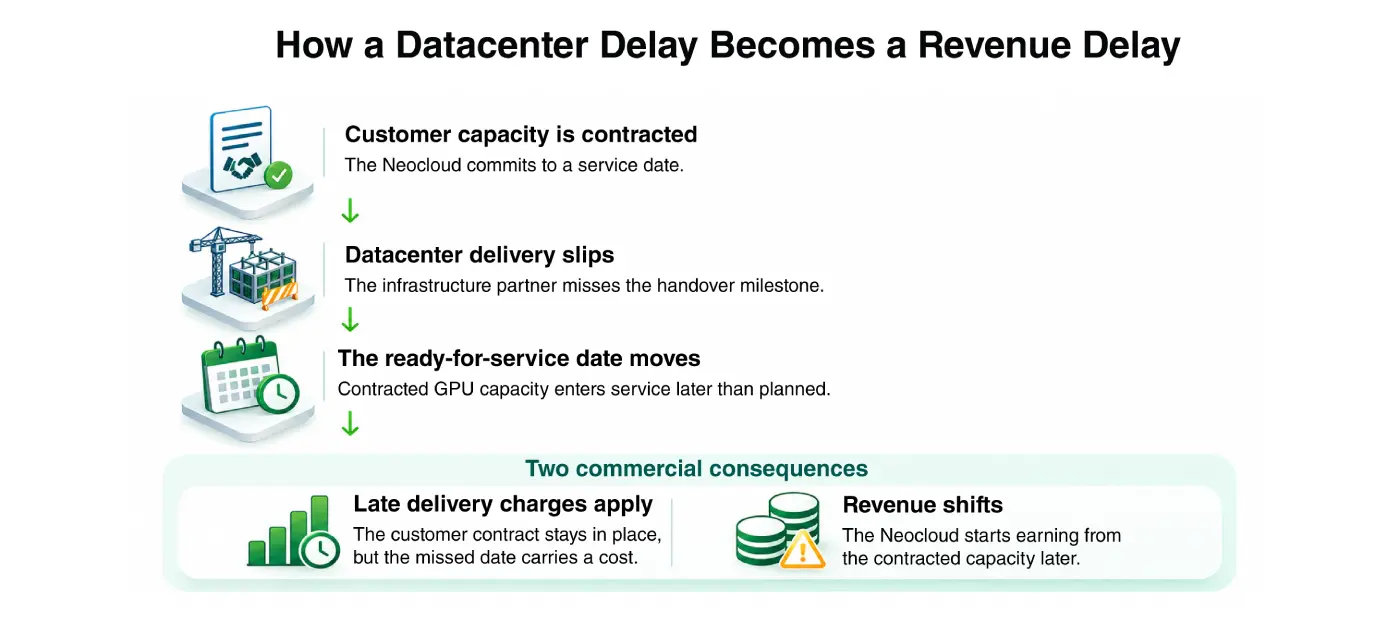
A Neocloud operator recently reduced its revenue outlook after a third-party datacenter provider delayed infrastructure delivery. Demand remained intact and the underlying customer offtaker contract was preserved, but it came with heavy late delivery charges, shifting of RFS pushed the expected revenue realisation and made the investors jittery. This is hypersensitive given the current valuations of NCP in anticipation of revenues. The delay also cost the operator a window to capture growing demand. Lower token costs made more AI use cases economically viable, increasing demand for GPU compute.
The episode illustrates a critical expansion risk for Neoclouds. The October 30 selloff in Neocloud stocks brought that risk into sharper focus. Investors are increasingly questioning whether Neoclouds can deliver the infrastructure needed to meet revenue projections and growth expectations. Winning customer contracts and securing GPUs do not guarantee timely service delivery for the NCP. Physical infrastructure ultimately determines when contracted capacity can generate revenue. A dependable colocation partner must therefore do more than provide space. It must help plan, engineer, deliver and operate infrastructure against a Neocloud’s commercial commitments to the offtaker.
Infrastructure Design & Planning must begin before GPUs arrive
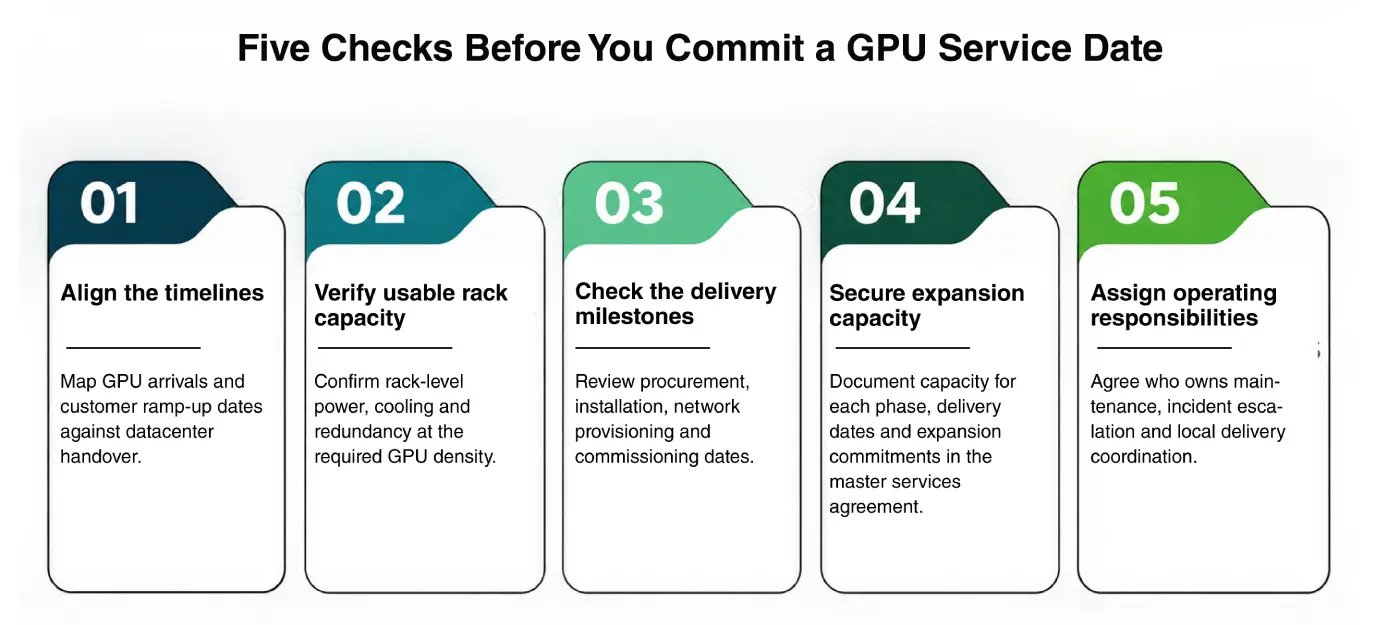
GPU procurement and datacenter development run on different timelines. NCPs must align hardware deliveries not only with power and land but also with delivered power at rack-level, cooling systems, network connectivity and operational readiness. A mismatch can either leave expensive accelerators idle or push customer deployments beyond committed dates. The problem gets aggravated when an NCP contracts several customers each of whom have different capacity requirements, deployment schedules and expansion expectations within the same hall/building or the campus. How the Colo partner work together for flexible design without impacting schedules and with minimal risk of over or under sizing is the million-dollar question.
These imperatives need to be resolved before commercial commitments become difficult to change. Infrastructure capacity is valuable only when it can support the variable contracted workload at the required time.
Power And Cooling Capabilities Determine Usable GPU Capacity
Available megawatts in a powered campus or core and shell do not automatically translate into operational GPU capacity. High-density clusters place concentrated demands on electrical distribution, cooling and facility resilience. A site may have sufficient aggregate power yet lack the rack-level delivery architecture or cooling capability required by the expensive hardware. Retrofitting systems after GPU procurement and deployment adds cost, complexity and potentially significant delays.
A dependable colocation partner brings engineering capabilities that extend beyond conventional rack hosting. These include designs that cater to high-density power distribution, direct-to-chip liquid cooling, thermal management and that have a scope to accommodate future GPU generations as well. CtrlS, for example, has outlined high-density configurations supporting upwards of 250 kW per rack and immersion cooling up to 300 kW per rack at its planned Chandanvelly, Future City, Vizag and Chonburi, Thailand campuses.
For Neocloud expansion teams, the relevant question is not simply how much power a facility advertises. It is how much capacity can be delivered at the required density, with the necessary cooling and redundancy, on the contracted schedule.
Execution Capability Separates Planned Capacity from Revenue-Generating Infrastructure
Infrastructure delays often emerge between design approval and operational handover. Electrical works, cooling installation, equipment procurement, network provisioning and commissioning must converge before GPUs can enter service. Neoclouds need partners capable of coordinating these activities, resolving delivery constraints and providing credible milestones rather than optimistic completion dates. CtrlS works on project milestones as part of its planning exercise with NCPs to arrive at an agreeable schedule. Material Delivery List and LLE procurement schedules are often part of Master Project Plan that we share with our customers.
As an established colocation provider, CtrlS has reduced execution complexity through existing facilities, factory level testing, experienced delivery and commissioning teams, standardized engineering and defined commissioning processes
Flexible Colocation Models Allow Capacity to Follow Customer Demand
Committing to infrastructure “too early” creates capital exposure for Colocation partner as well as NCP who often invest in GPU capex vide models. Committing “too little” can constrain revenue growth when new contracts arrive. This is especially relevant for Tier 2 NCPs, where slowing of funding and financial constraints are getting real. Neoclouds therefore need deployment models that match customer ramp-up without sacrificing on an already constrained capacities in India.
The right colocation partner provides options across flexible models, supported by a credible expansion roadmap. CtrlS’ colocation portfolio that includes dedicated halls and dedicated buildings. The commercial advantage comes from matching each deployment phase to demand, delivery requirements and future infrastructure needs.
CtrlS works closely with NCPs to ensure that their expansion opportunities are explicitly stated in the MSA.
Dependable Operations Plus Local Execution Knowledge to Protect Long-Term Growth
Colocation providers must establish clear operating responsibilities, maintenance procedures and incident escalation processes.
For Neoclouds entering India, the partner’s local delivery capabilities, handholding NCPs when it comes to local rules become equally important.
To summarise, CtrlS’ Indian datacenter footprint covers more than 80% of the country’s population and this is especially relevant when inferencing in a cloud setup need to stay closer to users. Our planned AI-ready hyperscale campuses offer a relevant infrastructure foundation, subject to facility-specific capacity and delivery verification.
A dependable infrastructure partner does not merely accommodate growth. It makes growth easier to plan, finance and deliver.
Neocloud leaders should evaluate colocation partners against best and decisive standard:
- Power readiness, engineering capability, execution track record, operational accountability and expansion commitments must carry greater weight than available floor space alone.
- Partners ability to deliver contracted GPU capacity on time, operate it reliably and support the next phase of growth.
- Handholding and flexibility in funding options when it comes to capex.
For Neoclouds planning their India expansion, the priority is clear: secure the infrastructure delivery plan before committing the customer service date.

Dharmendra Singh, VP - Hyperscale Business & Alliances, CtrlS Datacenters
Dharmendra is a seasoned expert in hyperscale and enterprise Datacenter Build-to-Suit (BTS) and hosting solutions. He leads initiatives that bridge collaborations with hyperscale service providers, large enterprises, government entities, and OEMs, driving innovative solutions that address the evolving IT infrastructure landscape. With a deep focus on customer engagement and architecture optimization, he ensures seamless transitions across on-premises, colocation, cloud, and hybrid environments. Committed to delivering customer success, he emphasizes network redundancies, cost-effective strategies, and operational efficiency, enabling organizations to realize their strategic objectives and maximize value from their IT investments.

 marketing@ctrls.in