
AI is turning computing into a capability that can influence productivity, industrial competitiveness, public services, scientific research and national security. That shift changes where computing needs to be located and who needs to control it.
As countries build their own AI capabilities, location of where the data, models, networks and the infrastructure are critical for regulation, resilience and economic sovereignty. With a rapidly expanding digital economy, growing cloud ecosystem and datacenter capacity, which is backed by strong semiconductor and electronics ecosystem, India is particularly well placed to capture this opportunity. For Neocloud providers looking for their next major infrastructure location, India deserves serious consideration given its technological advantage, access to high-skill human capital and increasingly favourable policies.
AI changes the strategic importance of computing
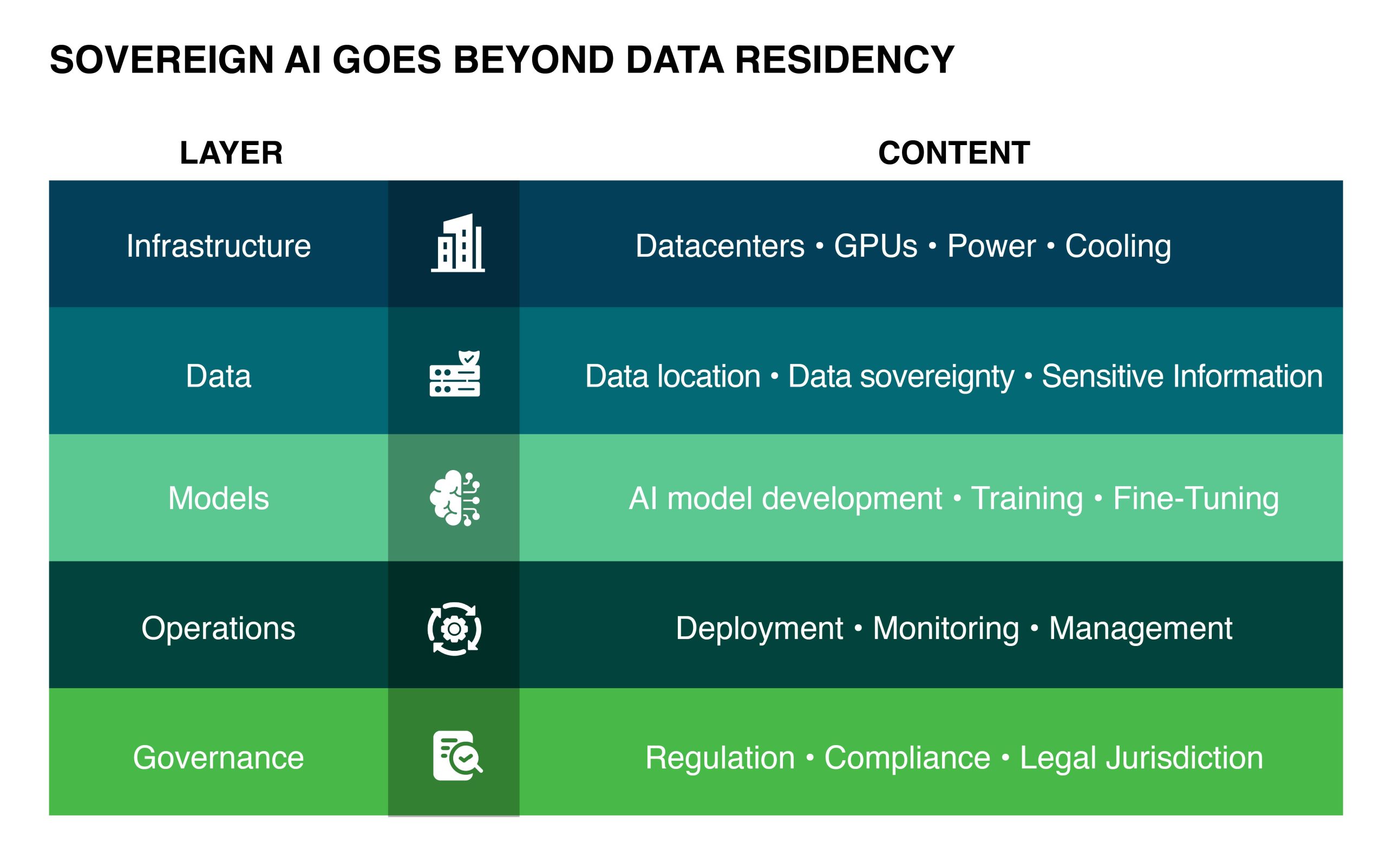
AI can improve and transform sectors such as healthcare, financial services and defence. Countries that develop strong AI capabilities can build advantages across several parts of their economy. This is the reason behind governments treating AI infrastructure like a strategic asset. Countries are investing building sovereign ecosystem to develop and operate AI systems.
McKinsey describes sovereign AI in terms of a country’s ability to develop, deploy and govern AI with control over infrastructure, data, models, operations and legal structures. The question of where the computing power that runs the AI, therefore becomes much more important.
Local infrastructure creates strategic and commercial advantages
For cloud and Neocloud providers, local AI infrastructure can serve a much wider purpose than satisfying a data residency requirement.
Compliance becomes easier to manage. Keeping compute and data within the relevant jurisdiction can simplify the design of services around local regulatory requirements.
Latency becomes a business consideration. AI applications increasingly involve real-time inference. Locating infrastructure closer to these users and systems reduces the distance that data must travel.
Connectivity becomes part of AI performance. High-speed networks, multiple carriers, internet exchanges and connections between datacenters determine how efficiently AI compute resources can interact with data and applications.
Resilience improves when infrastructure is distributed. Having edge datacenters can place workloads across different geographic zones, reducing dependence on a single site. For enterprises operating across a large domestic market, this can support continuity while keeping workloads within the country.
The next question is whether countries have the underlying digital infrastructure to support that demand.
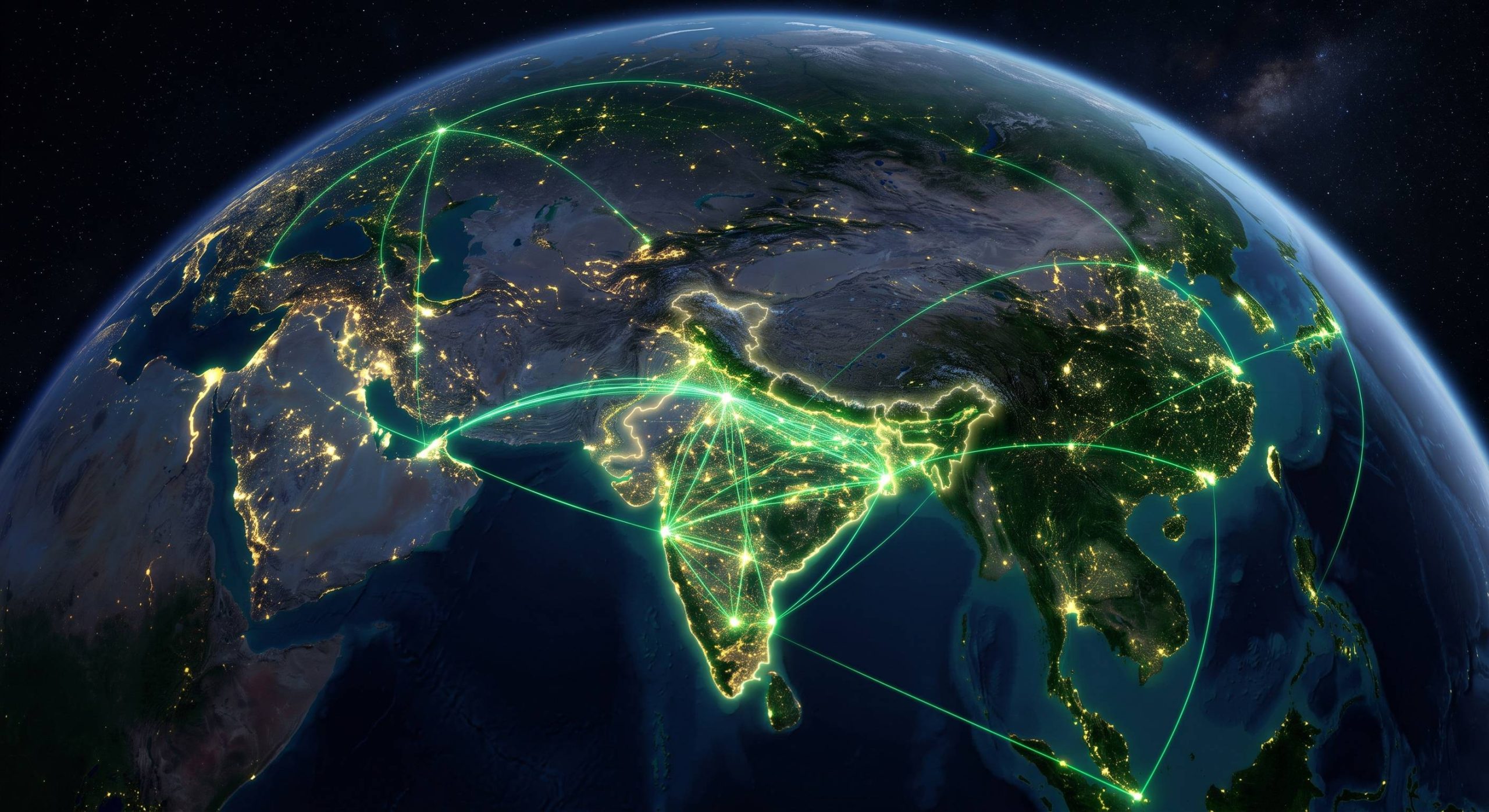
Geographic and political position creates a larger opportunity
India’s digital transformation has created strong foundations for AI growth, supported by expanding access to high-performance GPUs and a rapidly growing connectivity network. India’s optical fibre network has expanded significantly, according to the Department of Telecommunications. A growing digital economy and demand from regulated sectors further strengthen the case for local AI infrastructure. And India’s Union Budget 2026-27 proposed a tax holiday until 2047 for eligible foreign companies providing cloud services globally by procuring datacenters services from India.
India’s opportunity extends beyond its domestic market.
Its geographic position places it between two regions with significant digital and economic activity: the Middle East and Southeast Asia. An AI infrastructure investment in partnership with CtrlS can be designed around Indian demand while also serving selected workloads and customers across neighbouring markets, subject to the relevant regulatory and connectivity requirements.
Datacenters connected to multiple networks and subsea cable systems can provide access to regional markets while maintaining infrastructure within India. CtrlS, for example, has direct access to major subsea cable landing stations, multiple network carriers and connectivity across global regions as part of its infrastructure proposition. For a Neocloud provider, geography therefore becomes part of the business case and India can function as a large domestic market and as a potential regional infrastructure base.
But policy and demand alone don’t create infrastructure capability
India adds another consideration: scale across geography. A national AI infrastructure strategy cannot depend entirely on a single population centre. Demand is distributed across the country in financial, technology, manufacturing, government and consumer industries. Infrastructure therefore needs a combination of hyperscale capacity and geographically distributed facilities.
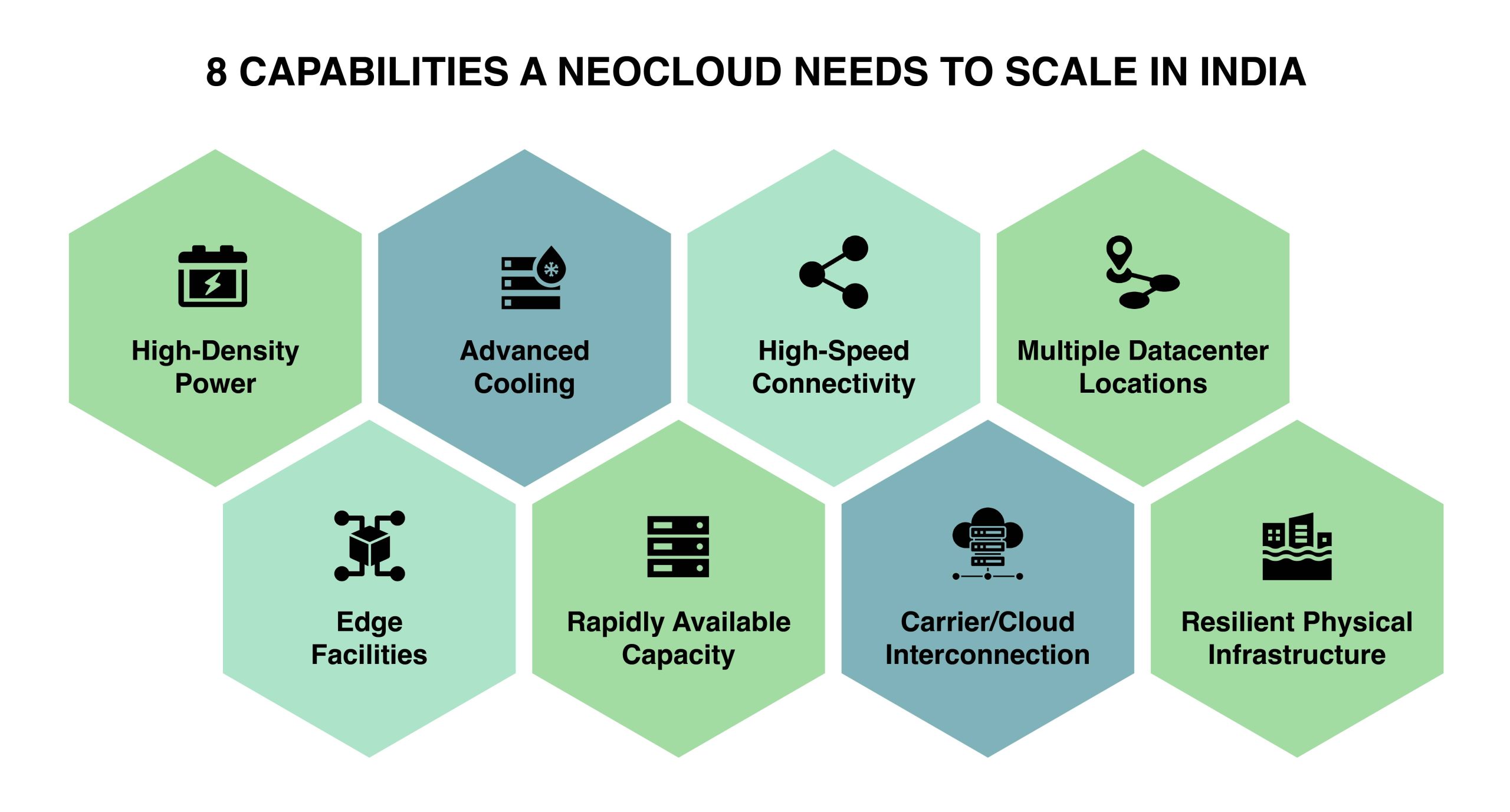
That means providers need:
- Strong domestic and international network connectivity
- Multiple datacenters locations
- Edge facilities for latency-sensitive inference
- Readily available capacity for rapid deployment
- High-density power infrastructure
- Advanced air and liquid cooling
- Resilient power and physical infrastructure
- Interconnection with carriers, clouds and internet exchanges
The ability to provide these services determines how quickly a Neocloud provider can move from announcing an Indian strategy to actually delivering AI capacity.
CtrlS fits that capability profile
This is where the choice of infrastructure partner becomes important.
CtrlS has built a distributed datacenters presence across India with an existing capacity of 370 MW and a planned capacity of 4+ GW by 2030, spanning major markets in India. Its network provides a combination of large campuses and geographically distributed capacity with 19 datacenters spread over 9 cities. CtrlS’ datacenters are designed to support high-density GPU deployments of up to 240 kW per rack and uses advanced cooling technologies including direct-to-chip cooling, liquid cooling and immersion cooling.
India’s infrastructure opportunity is becoming strategically significant
For Neocloud providers, the choice is about leveraging an infrastructure footprint that can support sovereign workloads, low-latency applications, regulated industries and regional expansion over time.
For providers looking to build their next generation of Neocloud infrastructure in India, partnering with an infrastructure operator that understands power, connectivity, high-density computing, cooling, geographic distribution and mission-critical operations can determine how quickly that opportunity becomes a working platform.
That is the role CtrlS is positioned to play for the global Neocloud players who are looking to build sovereign AI solutions for this region.

Rahul Dhar President - Global Datacenter Operations, CtrlS Datacenters
With nearly two decades of leadership experience leading critical infrastructure and technology teams, Rahul Dhar brings a deep understanding of managing and scaling mission-critical datacenter operations. At CtrlS, Rahul leads the company’s global operations charter. He is also responsible for ensuring operational resilience and reliability, improving uptime and recovery, and coordinating across infrastructure, facilities, and support functions to maintain the highest standards of service quality across CtrlS’ expanding global footprint. He recently served as the Country Director - Datacenters at Microsoft India. Previously, he has held senior leadership roles at Tata Communications, COLT, and Vodafone, where he led cross-geographic teams, delivered large-scale programs, and drove major process transformations across global operations.

 marketing@ctrls.in