
Neoclouds cannot expand efficiently if every market requires a new GPU architecture, vendor stack and commissioning process. They also cannot impose an identical facility design across countries with different power systems, climates and regulations. The scalable model is a standardised GPU pod with defined performance, facility and operating requirements, delivered through locally appropriate infrastructure. It makes deployment schedules, costs and customer commitments more predictable. Reducing repeated engineering, site qualification and commissioning also improves confidence in when new capacity can begin generating revenue.
Repeatability Makes Expansion a Platform Capability
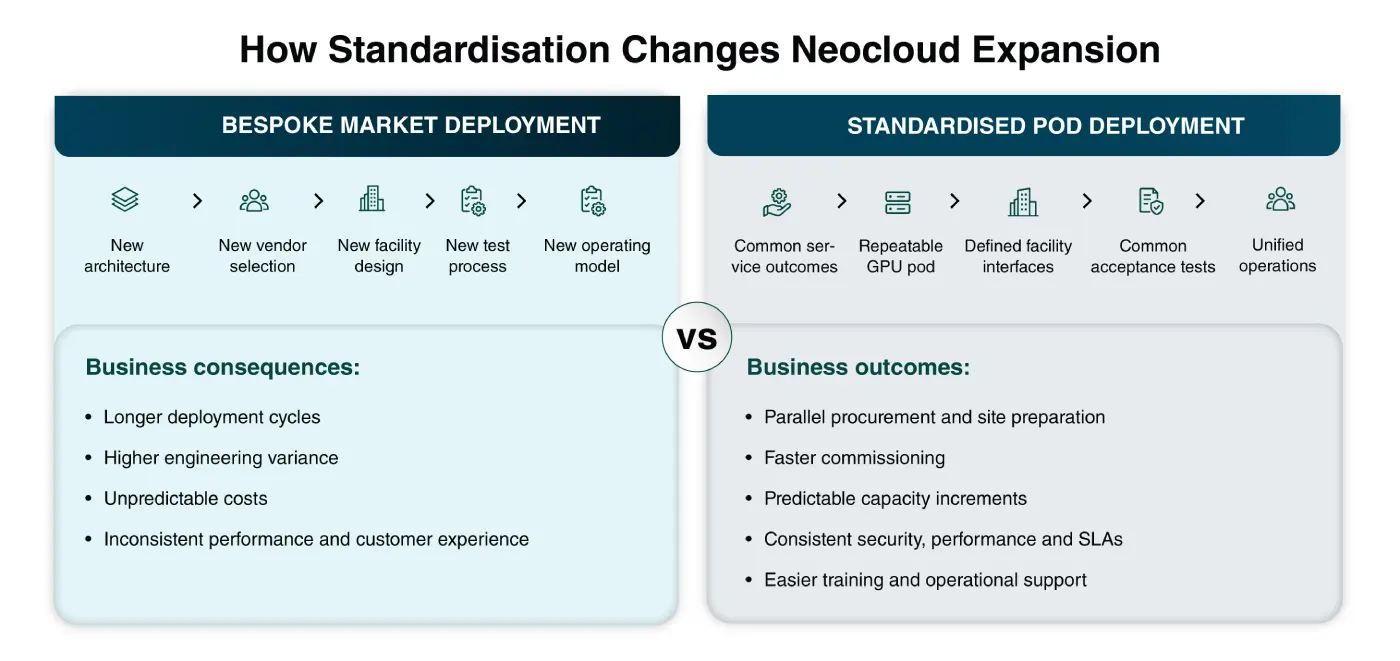
Bespoke deployments force engineering teams to repeat design validation and prevent procurement from aggregating demand. Operating knowledge stays tied to individual sites. The result is longer customer ready-for-service timelines, higher contingency and less confidence in when capacity can be sold.
As Neoclouds build multi-region portfolios, they need to qualify sites and commission clusters quickly without creating different service standards in each market. Repeatability becomes a commercial capability: customers need confidence that promised capacity will be available and perform as expected.
Define the Service Before the Hardware
Customers experience a cloud through productive GPU performance, provisioning time, availability, observability, support and evidence that service commitments are met. Where relevant, P95 and P99 network behaviour also matters. These outcomes should define the global standard before a Neocloud selects servers, switches or cooling equipment.
A fixed bill of materials will age as GPU generations, fabrics and rack densities change. The standard should instead specify the performance envelope and interfaces needed to accommodate higher-density racks, new fabrics, changing coolant distribution requirements and modular capacity growth. This lets the infrastructure accommodate new technology without fragmenting the service or forcing a full facility redesign with every GPU generation.
Make the GPU Pod the Unit of Expansion
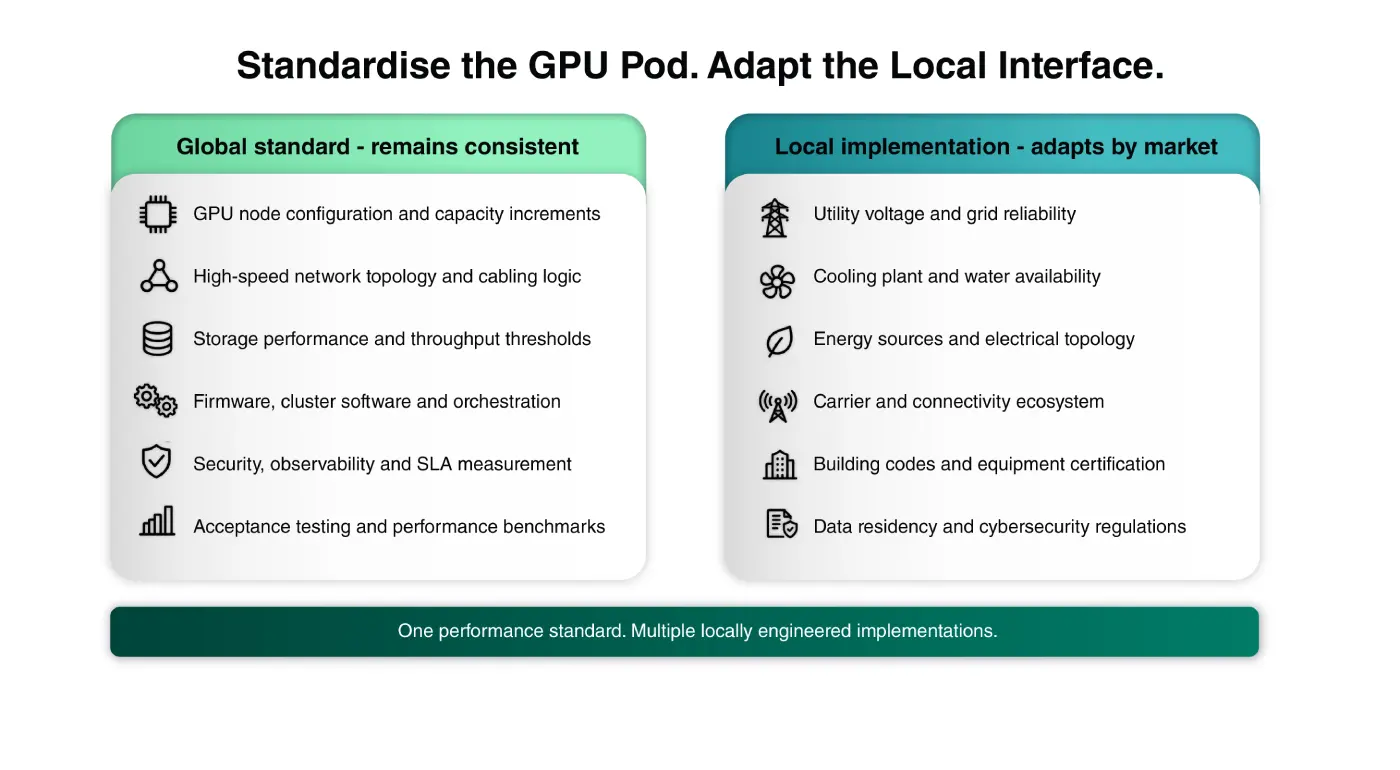
A GPU pod is more than a group of racks. It combines compute nodes, high-speed fabric, storage, management, orchestration and telemetry with defined facility interfaces and acceptance criteria. Node configuration, rack topology, cabling, firmware, cluster software and capacity increments should follow a repeatable reference architecture.
NVIDIA’s DGX SuperPOD reference architecture featuring DGX GB200 illustrates the principle. Each scalable unit contains eight DGX GB200 rack systems; the design also specifies fabrics, storage, rack layouts and wiring. Repeatable expansion requires a complete infrastructure unit, not a standardised server alone.
Standardise Facility Interfaces, Then Adapt Local Designs
The global specification should define what each facility must deliver: rack and pod power, redundancy, liquid-cooling supply and return conditions, coolant distribution boundaries, heat rejection, network demarcation, telemetry, fault thresholds and incident ownership. These requirements must be measurable so a proposed site can be assessed against the pod standard.
How a facility meets them will vary. Climate, water restrictions and permitted equipment affect cooling design. Utility voltage, grid stability, power-market structure, equipment certification and building constraints influence electrical design; carrier availability shapes connectivity. Data residency, cybersecurity rules, export restrictions, equipment eligibility and local support obligations also require market-specific implementation.
Prove Performance Before Each Pod Enters Production
A reference architecture only creates consistency when every deployment passes the same tests. Facility commissioning and cluster acceptance must be separate release gates. A hall can pass electrical and mechanical checks while its cluster still misses fabric, storage or workload-performance targets.
Facility tests should verify power, cooling, redundancy, thermal performance and failover at the required load. Cluster tests should establish fabric behaviour, storage throughput, workload performance, telemetry and operational readiness. Each deployment needs a common evidence pack with load and thermal results, failover tests, benchmarks, soak and burn-in results, and predefined pass/fail thresholds. Both gates must pass before production.
Consistency must continue in operation. Identity and privileged access, segmentation, firmware management, vulnerability remediation, logging and incident handling need a common baseline, extended where local rules require it. Incident ownership, notification times, service measures, SLA remedies, spares, remote hands and escalation paths should also remain predictable. Customers should receive comparable security, support and accountability wherever their workloads run.
Turn the Standard into Faster Market Entry
A defined pod, facility interface, acceptance suite and operating model can shorten site qualification. A pre-agreed RFI/RFP template and capacity-state definitions allow Neoclouds to compare proposed sites against the same requirements early. Once interfaces and evidence requirements are agreed, procurement, facility preparation, network readiness and commissioning can proceed in parallel, improving confidence in customer ready-for-service dates.
For a Neocloud entering India, the infrastructure-partner test is specific: can the proposed site or hall deliver the required power, rack density, cooling conditions, network architecture, commissioning date, operating SLA and contractual expansion rights? CtrlS can support that deployment through its in-house design-to-operate capabilities, customised colocation, connectivity and managed services while adapting local infrastructure to the customer’s pod standard. The decision should rest on evidence for the proposed deployment, with available and committed capabilities clearly distinguished from pipeline capacity or roadmap plans.

Vishesh Gaindher, AVP - Hyperscaler, CtrlS Datacenters
Vishesh Gaindher is a datacenter business leader with over 16 years of experience across L&T, Techno Digital and CtrlS. He combines expertise in business development, strategic sales, procurement and infrastructure delivery. At CtrlS, he manages the hyperscaler business and key accounts, focusing on developing hyperscale datacenter opportunities for anchor customers. His cross-functional experience connects customer requirements with commercial strategy and project execution.

 marketing@ctrls.in