
A user in a Tier-2 city uploads a medical scan and receives an AI-powered diagnosis within seconds. The system does not route that request to a distant cloud region. It processes the data at a nearby edge node.
A UPI transaction in a semi-urban market gets flagged for fraud in real time before completion. An OTT platform streams high-definition content without buffering in a Tier-3 town during peak hours.
These are not future possibilities. They reflect a structural transformation already underway in India’s digital infrastructure.
For years, enterprises built infrastructure around centralized cloud models. That approach optimized scale and cost, but assumed workloads could tolerate latency. That assumption no longer holds.
AI inference, real-time decisioning, and data localisation mandates are forcing compute closer to users. The next phase of India’s digital evolution will not be about expanding centralized infrastructure, it will be about redistributing it intelligently.”
By 2036, India is poised to become one of the most edge-dense digital ecosystems globally. The organizations building this infrastructure foundation will determine how far and how reliably India’s digital economy can scale.
Why Edge Computing is Becoming Structurally Essential
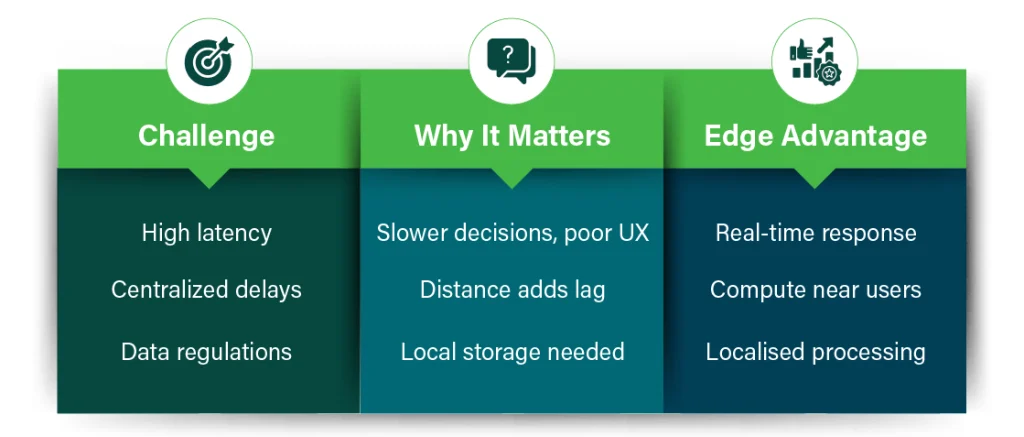
Real-time digital services are no longer optional, they are mission-critical. Financial platforms must validate transactions instantly. Manufacturing systems must detect anomalies before downtime occurs. Healthcare systems must deliver diagnostics without delay. These workloads cannot tolerate latency.
This transformation is being driven by a combination of performance and regulatory factors:
Latency Has Become a Business Variable
Latency now directly impacts fraud prevention, customer experience, and operational efficiency. In critical systems, delay is no longer a technical inconvenience,it is a business risk.
Centralized Cloud Has Its Limits
Routing data to distant cloud regions introduces unavoidable delays, especially at scale. Traditional centralized models cannot consistently support ultra-low-latency applications.
Data Localisation Is Reshaping Architecture
Regulatory frameworks such as RBI payment data requirements and evolving data protection laws are pushing compute closer to the point of origin.
This combination of technical and regulatory pressure makes edge computing far more than a performance enhancement, it makes it a structural necessity.
Why India is Exceptionally Well Positioned
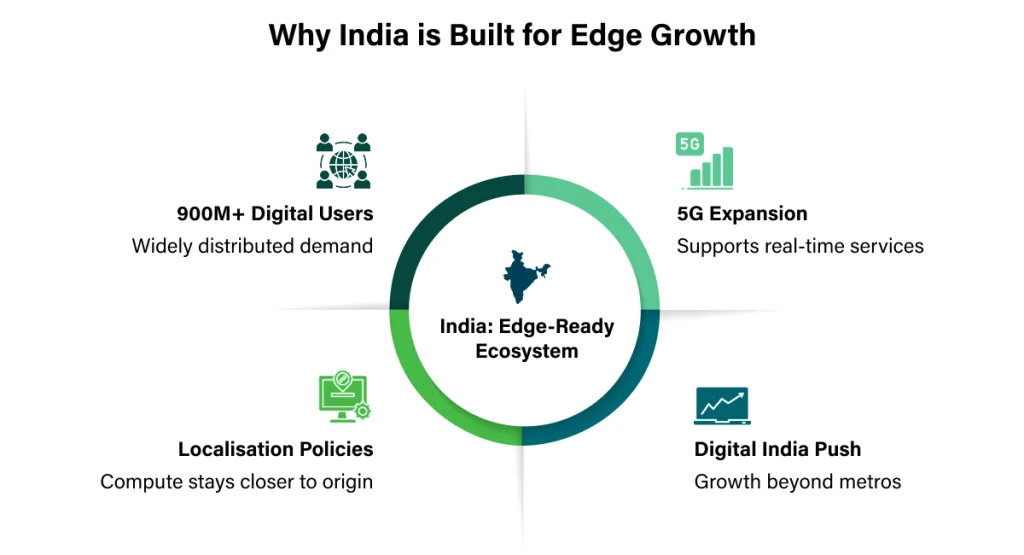
India’s digital ecosystem naturally supports
With a digital population over 900 million, demand is widely distributed across metros, Tier-2, and Tier-3 cities. This creates conditions where centralized infrastructure becomes inefficient. distributed infrastructure.
Several structural factors make India particularly suited to an edge-first architecture:
● Mobile-first consumption at scale
A large user base accessing digital services across geographies increases the need for localized processing.
● 5G expansion enabling real-time use cases
Faster networks require nearby compute to deliver meaningful performance gains.
● Government-led digital acceleration
Initiatives such as Digital India, smart city programs, and production-linked incentives are driving adoption beyond Tier-1 cities.
● Regulatory direction toward localisation
Data policies are reinforcing in-country and near-user processing requirements.
Together, these factors make distributed infrastructure not just advantageous, but necessary for India’s next phase of digital growth.
The Architecture Shift: From Centralized to Proximity-Driven
The structure of infrastructure is undergoing a clear transition.
The traditional model relied on a small number of hyperscale facilities serving national demand. This optimized capacity but ignored proximity.
The emerging model distributes workloads across layers:
- Core hyperscale facilities handling large-scale compute and AI training
- Metro edge nodes serving low-latency urban demand
- Micro data centers operating in Tier-2 and Tier-3 cities
This creates a proximity-driven architecture where compute happens where data is generated.
This distinction is critical. Edge infrastructure is not an application layer. It is the foundation layer that enables applications to operate efficiently and reliably at scale.
Building the Edge Foundation in Tier-2 and Tier-3 India
Deploying edge infrastructure beyond Tier-1 cities is not just about expansion. It requires solving fundamental infrastructure challenges that determine reliability, compliance, and long-term scalability.
To deliver consistent performance in these markets, infrastructure providers must address several critical requirements:
● Power reliability
Infrastructure must include stable utility feeds, on-site generation, and advanced UPS systems to ensure uninterrupted operations.
● Connectivity density
Carrier-neutral access and strong fiber networks are required to support low-latency performance and 5G integration.
● Modular infrastructure design
Facilities must be scalable and deployable in phases, enabling faster rollout in emerging markets.
● Compliance readiness
Certified environments aligned with global standards are essential for regulated industries.
● Operational maturity
Distributed environments require remote monitoring, predictive maintenance, and consistent uptime across locations.
Organizations such as CtrlS Datacenters Ltd are already contributing to this foundation by extending high-resilience digital infrastructure into Tier-2 and Tier-3 markets. With a nationwide presence and Rated-4 certified facilities, the focus remains on building resilient, compliant, and future-ready infrastructure that can support India’s growing distributed digital ecosystem.
The ability to replicate high-quality infrastructure consistently across geographies will ultimately define the success and scalability of India’s distributed digital economy.
AI Is Accelerating the Edge Imperative
Artificial intelligence is accelerating infrastructure decentralisation.
AI workloads follow a dual model. Training remains centralized due to high compute intensity. Inference must occur closer to users to deliver real-time outcomes.
Applications such as fraud detection, video analytics, and industrial automation depend on immediate processing.
According to Goldman Sachs, global data center power demand is expected to grow by around 160% by 2030, driven largely by AI workloads.
IDC further projects that edge computing spending will approach 380 billion dollars by 2028, driven by AI and real-time applications.
AI is not just using edge infrastructure. It is making it economically necessary.
What Edge Infrastructure Enables Across Industries
The value of edge infrastructure becomes clear when applied to real-world use cases. These are not theoretical advantages, but operational requirements across sectors:
● Financial services
UPI fraud detection and real-time payment processing require low-latency infrastructure aligned with localisation mandates.
● Healthcare
AI-assisted diagnostics and telemedicine depend on compute close to patients to ensure speed and compliance.
● Manufacturing
Smart factories rely on real-time monitoring and predictive maintenance to prevent downtime.
● Media and agriculture
OTT platforms require localized delivery for seamless streaming, while IoT-based agriculture depends on real-time processing in remote regions.
Across all these sectors, the requirement is consistent. Infrastructure must be local, resilient, and compliant to support real-time digital operations.
India’s Digital Infrastructure in 2036
By 2036, India’s infrastructure landscape will operate on a distributed-first model.
Thousands of edge nodes will be deployed across metros, Tier-2, and Tier-3 cities. AI workloads will move dynamically between centralized and edge environments based on latency, compliance, and cost.
Hybrid infrastructure will become the enterprise standard, combining cloud, colocation, and edge.
India will emerge as a low-latency digital economy and a global model for distributed infrastructure.
Conclusion: The Foundation of the Edge Decade
Edge will not replace cloud. It will extend it, closer to users, closer to compliance boundaries, and closer to where digital activity is actually happening. The applications running at the edge will drive innovation. But they depend on something more fundamental.
They depend on infrastructure that enables them.
Certified, resilient, and scalable data center infrastructure will form the foundation of India’s distributed digital future. Organizations building this infrastructure backbone will play a defining role in shaping how India scales its digital economy, ensuring resilience, compliance, and long-term sustainability across an increasingly distributed landscape.
The edge decade is not approaching. It has already begun.
To know more, reach out to us at marketing@ctrls.in

Vipul Kumar, Senior Vice President – Edge & Network Business, CtrlS Datacenters
Vipul is a seasoned telecom and datacenter leader with over two decades of rich experience spanning submarine cable systems, edge datacenters, and network infrastructure ecosystems. He is passionate about building sustainable, compliant, and scalable digital infrastructure that empowers regional enterprises, SMEs, and hyperscale players alike. As Senior Vice President – Edge & Network Business at CtrlS, he leads initiatives that bridge connectivity and compute — from fiber and network deployments to strategic partnerships and business development, building the network foundation and ecosystem partnerships that power CtrlS’s pan-India edge datacenter expansion.

 marketing@ctrls.in