
A CIO selecting infrastructure is not trying to achieve a metric. The objective is to secure reliable compute capacity at a predictable cost, protect business continuity and create enough headroom for growth.
Power Usage Effectiveness (PUE) supports this decision. It shows how efficiently a datacenter uses energy to support its IT equipment. It is standardized, comparable and useful for understanding the facility overhead associated with delivering compute.
But the infrastructure decision has become larger than energy efficiency. AI and high-performance computing are increasing rack densities, power demand and cooling complexity. Power availability can determine whether capacity is deployed on schedule. Connectivity affects workload performance. Resilience requirements vary by application. Sustainability now extends beyond facility efficiency.
This creates a critical distinction:
A datacenter can have an excellent PUE and still be the wrong environment for a company’s workload.
PUE measures infrastructure efficiency. It does not establish infrastructure effectiveness: the ability to deliver the compute and business outcomes the workload requires.
Why PUE Became Important to the CIO
PUE gave infrastructure leaders a simple, consistent way to measure facility energy use beyond the power consumed by IT equipment.
A lower PUE generally means less energy is used for cooling, power distribution and other supporting systems. At scale, this can reduce costs and improve environmental performance. Because PUE is standardized, it also enables comparison across facilities when measurement conditions are consistent.
PUE therefore remains useful. But it measures facility efficiency, not whether the infrastructure has the power, cooling, resilience and connectivity required by the workload.
The Infrastructure Decision Has Become Larger Than Efficiency
Traditional enterprise workloads operated within predictable power and cooling limits. Standard rack configurations and gradual expansion were often sufficient.
AI and HPC have changed this model. High-density GPU systems require more power per rack and cooling designed for the intended load. Depending on the deployment, this may involve air cooling, rear-door heat exchangers, direct-to-chip liquid cooling or hybrid systems.
Workload needs also vary. Training requires sustained compute and high-bandwidth interconnects. Inference is often more sensitive to latency, traffic patterns and proximity to users or data. Critical applications demand greater availability and recovery capability than batch workloads.
The CIO is therefore evaluating more than capacity. The infrastructure must fit the workload and continue supporting it as demand changes.
A Low PUE Does Not Guarantee the Infrastructure You Need
PUE measures the total facility energy required to support IT equipment. It does not show whether the facility has sufficient power, rack density, cooling, connectivity, resilience or expansion headroom.
A facility can report a strong PUE but still be unsuitable for a high-density GPU deployment or critical application. It may also constrain compute utilization or delay expansion. A low PUE can reduce facility overhead. It cannot offset underused compute, delayed capacity or poor workload fit.
Infrastructure Effectiveness Starts with Deliverable Capacity
Infrastructure efficiency measures how efficiently a facility uses energy. Infrastructure effectiveness measures how well it delivers the required compute and business outcome.
This distinction changes how technical specifications are interpreted.
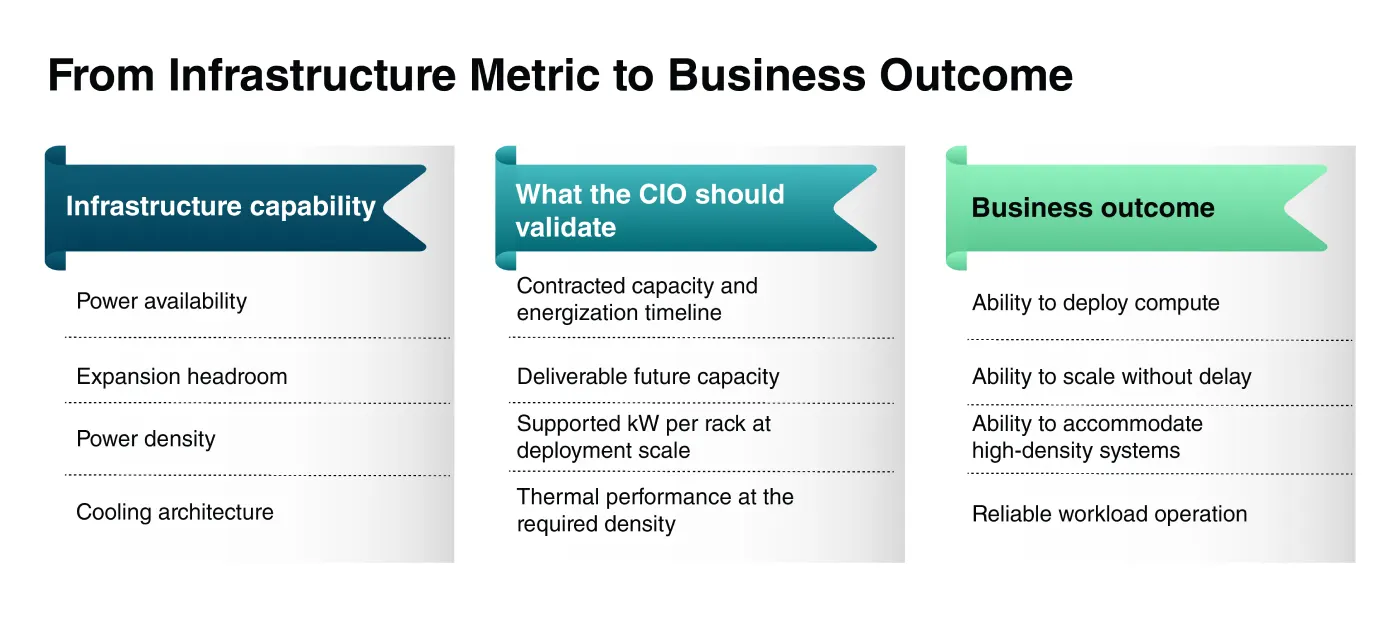
Power availability determines how quickly the business can deploy and expand compute. Contracted capacity, energization timelines and expansion headroom matter more than announced future capacity.
Power density determines whether high-density systems can be deployed without spreading them across additional racks. This affects space, cabling, network design, cooling and overall deployment economics.
Cooling architecture determines whether the intended density can be maintained reliably. The relevant issue is not whether liquid cooling appears on a feature list. The thermal design must support the specified equipment and operating load at scale.
Effective Infrastructure Protects Performance and Continuity
Resilience connects infrastructure design to business continuity. Redundancy, maintenance design, backup systems and operating procedures must reflect the cost of interrupting the workload. A customer-facing transaction platform will require a different resilience model from a non-production development environment.
Connectivity determines how effectively data, applications and compute resources interact. Carrier availability, route diversity, cloud connectivity and latency can affect application performance, data-transfer time and architectural flexibility.
Expansion capacity protects time-to-market. Available land or announced capacity is not the same as deliverable capacity. CIOs need visibility into available power, cooling readiness, delivery schedules and the provider’s ability to bring additional infrastructure online.
Operational capability connects all these elements. Staffing, monitoring, preventive maintenance, change management, incident response and capacity planning determine whether design performance is sustained under operating conditions.
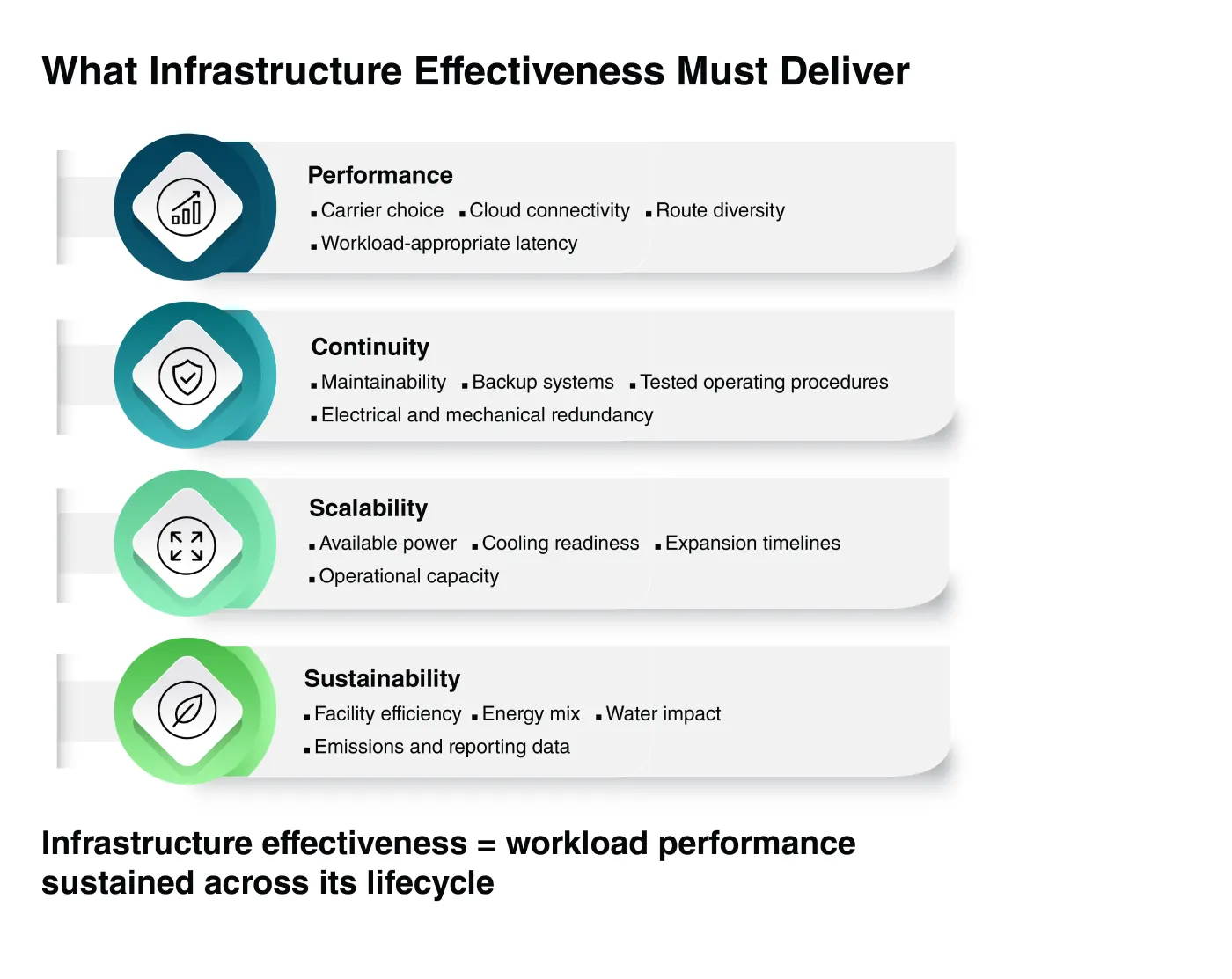
Sustainability also needs a wider lens. PUE provides insight into facility energy efficiency, but it does not describe the energy mix, water impact, embodied carbon or emissions associated with consumed electricity. The infrastructure decision must align facility data and reporting capabilities with the organisation’s environmental objectives.
Infrastructure effectiveness cannot be represented by one replacement metric. It is the alignment between the workload, the facility and the business outcome.
Build the Decision from the Workload Outward
The evaluation should begin with the workload rather than the datacenter.
First, define the business outcome. This could be faster AI development, reliable customer transactions, regulatory compliance, geographic expansion or lower operating risk.
Next, translate that outcome into workload requirements. Define the compute profile, rack density, cooling requirement, network dependencies, latency threshold, availability target, recovery expectation and growth forecast.
Then validate the infrastructure against those requirements. Confirm that power is available, not merely planned. Test supported density at the required scale. Assess whether cooling, connectivity and resilience operate as an integrated system. Establish how additional capacity will be delivered and how long expansion will take.
Finally, assess economics and sustainability across the workload lifecycle. Include facility efficiency, compute utilization, network costs, deployment time, operational support and the cost of delayed or unavailable capacity.
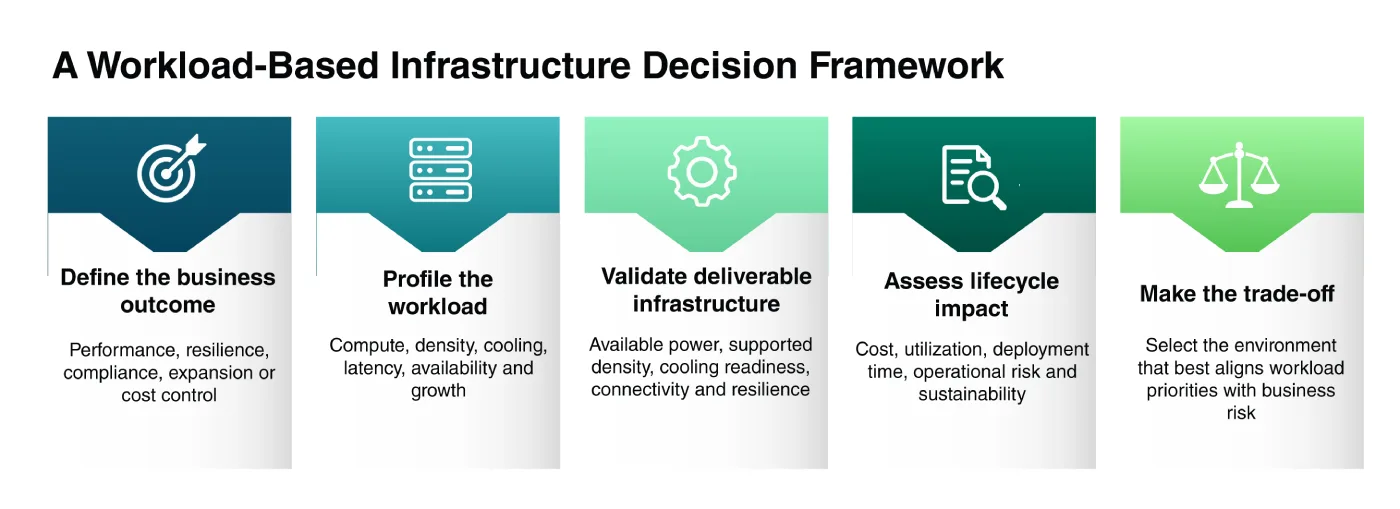
This framework makes trade-offs explicit. A workload with moderate density but strict latency requirements may prioritize network proximity. An AI training environment may place greater weight on power scale, cooling and high-bandwidth connectivity. A critical enterprise platform may justify additional resilience even if it increases facility overhead.
The best infrastructure decision does not maximize every specification. It meets
the workload’s priorities with acceptable cost, risk and expansion flexibility.
PUE Belongs Inside a Broader Infrastructure Decision
PUE remains an important measure of data-centre efficiency. The required change is one of position. It should sit within a broader framework connecting infrastructure capabilities to workload requirements and business outcomes.
At CtrlS, this principle is reflected in colocation options ranging from individual racks and caged environments to dedicated halls, floors and buildings. These are supported by Rated 4 facilities, connectivity services, modern cooling infrastructure and an expanding data-centre footprint. This allows the infrastructure environment to be aligned with workload scale, security, resilience and growth requirements rather than treated as standardized capacity. Explore CtrlS colocation capabilities.
The objective is not to find the datacenter with the best individual metric. It is to find infrastructure that can efficiently, reliably and sustainably deliver the compute the business needs today—and as those requirements change.

Nikhil Rijhwani, Vice President – Sales and City CEO, CtrlS Datacenters
with over 20 years of experience growing digital infrastructure businesses in India. He leads sales and cross-functional teams serving hyperscalers, neoclouds, enterprises and government institutions. His expertise spans datacenter economics, capacity monetization and strategic partnerships. Through business transformation, he helps build scalable infrastructure that supports India’s digital economy.

 marketing@ctrls.in